


The forex market participants behind every price move are far more varied than most beginners realize. A chart shows candles, but each candle is the combined result of central banks, commercial banks, hedge funds, corporations, brokers, and retail traders, all trading for different reasons and on different timeframes. Understanding who these participants are, and what each one is trying to do, makes price behavior less mysterious. This guide maps the structure of the market from top to bottom and explains how it affects the way you read charts and manage risk.
Why the Structure of the Forex Market Matters
Forex is a decentralized market. There is no single exchange where every trade is matched. Instead, forex market participants trade through networks of banks, dealers, and platforms. Because of this, different participants see different prices, have different costs, and care about different outcomes.
A corporation converting revenue does not care about a 5-pip move. A hedge fund might. A retail trader on a one-minute chart sits at the far end of this structure, so understanding the larger players helps put short-term moves into context.
The Main Forex Market Participants
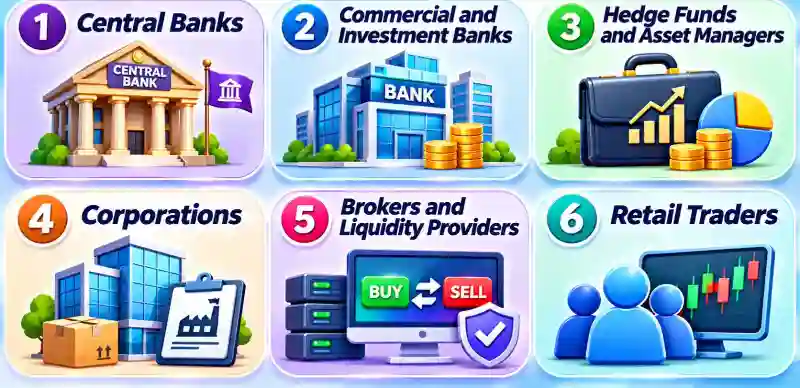
1. Central Banks
Central banks set interest rates, manage national reserves, and sometimes intervene in currency markets to influence exchange rates. Their policy decisions and statements are major drivers of currency values over time. They generally act to achieve economic policy goals rather than trading profits.
2. Commercial and Investment Banks
Large banks form the core of the interbank market. They trade for clients, manage hedging activities, and trade for their own accounts. They also quote prices to other institutions and brokers, providing much of the liquidity in the forex market.
3. Hedge Funds and Asset Managers
Hedge funds and asset managers trade to generate returns using short-term and long-term strategies. Their large positions can influence market trends, making them important forex market participants. They closely monitor interest rate expectations, market sentiment, and economic data.
4. Corporations
Importers, exporters, and multinational companies exchange currency to pay suppliers, receive revenue, and hedge future exposure. Their trades are driven by business needs, not by chart patterns, and they are often large and executed at specific times.
5. Brokers and Liquidity Providers
Brokers connect retail traders to the market. Depending on the model, they may pass orders to liquidity providers or take the other side of trades themselves. The model affects spreads, execution, and potential conflicts of interest, as explained in our guide on how forex brokers execute your trades.
6. Retail Traders
Individual traders trade through brokers using smaller accounts. Although their share of total market activity is relatively small compared with institutional flows, retail traders are still important forex market participants. Their orders often cluster around obvious price levels, making their behaviour relevant to certain market patterns.
6 Truths About Forex Market Participants Most Traders Miss

1. Most Participants Are Not Trying to Predict Price
Corporations hedge, central banks pursue policy, and banks serve clients. Only some participants trade purely for speculative profit. This is why a price move does not always have a “technical” reason behind it.
2. Different Participants Operate on Different Timeframes
A central bank thinks in months and years. A day trader thinks in minutes and hours. A move that looks huge on a five-minute chart may be a rounding error to a large institution, and a long-term trend may look like noise to a scalper. Matching your timeframe to your plan is part of reading the market.
3. Liquidity Is Shaped by Who Is Active at the Time
Participation changes through the day. When major financial centers are open and overlapping, more participants are active, spreads tend to be tighter, and fills are smoother. In quieter periods, fewer orders are resting and moves can be sharper. Our guide on the role of liquidity in forex price movement explains how this works.
4. Large Orders Need Counterparties
A big participant cannot always fill an order at a single price without moving the market. They may split orders, trade in pieces, or seek areas where many resting orders sit. This is one reason price is often drawn toward obvious highs and lows, a behavior we explain in our guide on stop hunts in forex trading. It describes an observable market effect, and it does not prove that a specific firm targeted a specific trader.
5. News Affects Participants in Different Ways
A rate decision can change a central bank’s currency outlook, force funds to adjust positions, and alter corporate hedging. Because participants react differently and at different times, price can move before, during, and after a release. We explore this in our guide on why price moves before news is released.
6. Charts Show the Result, Not the Cause
Concepts such as market structure, order blocks, and imbalances are attempts to read the footprints of larger activity. They are interpretations, not proof of what a specific participant did. Treat them as tools with limits.
A Real Example: One News Day, Many Participants
Imagine a central bank announcing a rate decision that comes in slightly more cautious than expected. A bank’s trading desk adjusts its quotes and widens spreads. A hedge fund reduces a long position on that currency. An importer with a payment due next month decides to hedge now. A retail trader sees a sharp spike on a one-minute chart and enters, thinking it is the start of a trend.
Within an hour, the initial spike partly reverses as the fund’s selling finishes and other participants take the other side. The retail trader, who entered with a tight stop, is stopped out. Nothing mysterious happened. Different participants simply acted for different reasons, and the retail trader saw only one candle of a much bigger picture.
How Participants Connect to Chart Concepts
- Market structure: Swings in structure reflect shifts in the balance between buyers and sellers. Our beginner’s guide to market structure in forex trading shows how to read them.
- Order blocks: Traders use these to mark areas where aggressive buying or selling began a strong move. Read our guide on order blocks in forex trading for the idea and its limits.
- Imbalances: Fast moves can leave gaps between candles that price sometimes revisits, as explained in our guide on the fair value gap in forex.
What This Means for Retail Traders
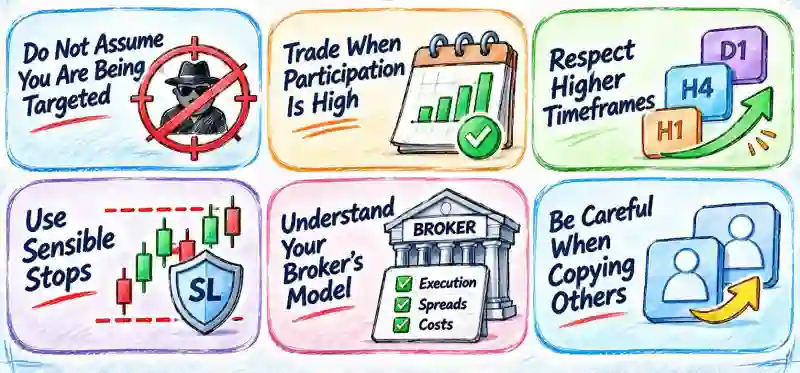
- Do not assume you are being targeted: Many losses come from weak ideas or poorly placed stops, not from a deliberate plan against you.
- Trade when participation is high: Liquid sessions usually offer tighter spreads and cleaner fills.
- Respect higher timeframes: They reflect larger flows and give context to lower timeframe moves.
- Use sensible stops: Give trades room beyond obvious levels and reduce size to match.
- Understand your broker’s model: Execution, spreads, and costs depend on it.
- Be careful when copying others: A signal provider’s risk may differ from yours, as covered in our guide on how copy trading works in forex.
Common Misconceptions About Market Participants
- “Banks control every candle”: Price reflects the combined activity of many participants, and no single one controls it.
- “Retail traders move the market”: Retail flow is small compared with institutional activity, though it can be visible at specific levels.
- “Everyone is trying to beat me”: Most participants have their own objectives and are not focused on individual retail trades.
- “Knowing the players guarantees profit”: Understanding the structure improves your reading of the market, but it does not remove risk.
Protect Your Account Whatever the Participants Do
You cannot control central banks, funds, or liquidity conditions. You can control your own risk. Small position sizes, structure-based stops, and a daily loss limit protect an account regardless of who is driving a particular move. Our guide on risk management tips for prop firm traders covers these habits, and our article on mastering patience for the perfect trade setup explains why waiting for clear setups matters in a market this large.
Final Thoughts
The hidden structure of forex market participants explains why price behaves the way it does. Central banks set the policy backdrop, banks provide liquidity, funds and corporations move large amounts for different reasons, brokers connect retail traders to the market, and retail traders sit at the edge with small positions. Seeing the market as a web of motives, rather than a single opponent, helps you read news, liquidity, and structure more realistically. Trading always carries the risk of loss, so use this knowledge to build better habits and size your trades so that normal market movement cannot damage your account.
FAQs
Who are the biggest forex market participants?
Central banks, large commercial and investment banks, hedge funds, asset managers, and multinational corporations are the largest by volume. Retail traders make up a much smaller portion of total activity.
Do retail traders affect forex prices?
Individually, very little. Collectively, retail orders can cluster at obvious levels, which can matter for short-term moves, but institutional flow has far more impact on overall direction.
Why does forex have no central exchange?
Forex is an over-the-counter market, where participants trade directly through banks, dealers, and electronic platforms. This is why prices and spreads can differ slightly between brokers.
Does knowing the market structure help me win trades?
It helps you read price more realistically and avoid common misunderstandings, but it does not guarantee profit. Risk management and a tested plan still matter most.

