


Waiting for the perfect trade setup is one of the hardest skills a trader ever has to learn. It sounds simple on paper — wait for your conditions to line up, then act — but in practice, most traders click the buy or sell button long before their setup is actually ready. This guide breaks down the psychology behind that impulse and gives you a practical, step-by-step framework for building the patience every consistently profitable trader eventually develops.
If you have ever entered a trade too early, watched it fail, and then seen the “real” setup form five minutes later, this post is written for you.
What Does Waiting for the Perfect Trade Setup Really Mean?
A perfect trade setup is not about finding a flawless, risk-free trade — no such thing exists in the markets. Instead, it refers to a moment where every condition in your trading plan lines up: your technical criteria are met, your risk-to-reward ratio makes sense, market context supports your bias, and you feel calm rather than rushed. When even one of those pieces is missing, the setup is incomplete, no matter how tempting the chart looks.
Traders who chase incomplete setups are usually not making a technical mistake — they are making an emotional one. Understanding this distinction is the first step toward developing the patience needed to wait for a genuine perfect trade setup.
Why Traders Struggle to Wait for the Perfect Trade Setup
Patience is rarely taught as a skill, yet it is arguably more important than any indicator or strategy. Below are the three psychological forces that most commonly break a trader’s discipline.
Fear of Missing Out (FOMO)
FOMO convinces traders that the market is about to move without them. This fear pushes many to enter trades based on price movement alone, without confirming that a true perfect trade setup has actually formed. The irony is that FOMO-driven entries are statistically among the weakest, because they skip the confirmation step that makes a setup worth taking in the first place.

Overconfidence After a Winning Streak
A string of wins can quietly erode discipline. Traders begin to feel that their instincts alone are enough, so they stop waiting for a genuine perfect trade setup and start trading on feel. This is one of the most common causes of giving back profits shortly after a strong run.
Boredom and the Need for Action
Markets do not always offer clean opportunities. During quiet periods, boredom can push traders to manufacture trades that do not meet their real criteria, simply to feel active. Recognizing boredom as a trigger — rather than a signal to trade — is essential for anyone serious about long-term consistency.
The Psychological Cost of Chasing Trades Instead of Waiting
Every time a trader enters without a real perfect trade setup, two things happen at once: the account takes on unnecessary risk, and the trader’s confidence in their own plan weakens. Over time, this creates a cycle where the trading plan is trusted less and impulse is trusted more — the exact opposite of what builds long-term consistency.
This cycle is well documented in behavioral finance research. According to Investopedia’s overview of trading plans, traders who deviate from a written plan are significantly more likely to experience inconsistent results than those who follow predefined entry criteria.
How to Train Yourself to Wait for the Perfect Trade Setup
Patience can be trained the same way any other trading skill is trained — through structure, repetition, and self-awareness. Here are four practical methods that work.
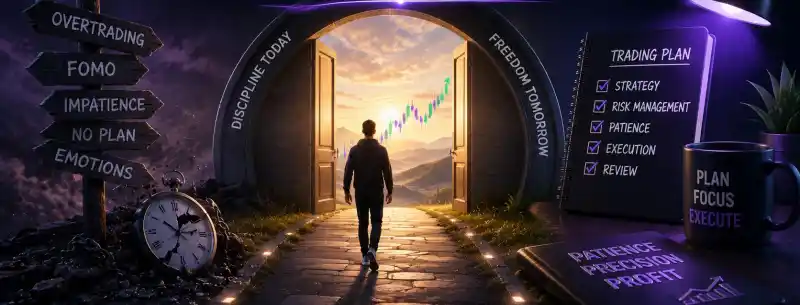
Build a Written Trading Plan
A written plan turns your idea of a perfect trade setup into something concrete instead of a feeling. Define your entry conditions, stop-loss placement, target, and the specific market context you require before ever opening a position. If you’re just getting started, our trading strategies section is a good place to build this foundation.
Use a Trade Checklist
Before every entry, run through a short checklist: Does this match my defined setup? Is my risk-to-reward acceptable? Am I calm, or am I rushing? If any answer is “no,” the setup is not ready yet, regardless of how the chart looks in the moment.
Practice Mindfulness and Emotional Awareness
Simply noticing the urge to enter early — without acting on it — weakens its power over time. Traders who pause for even ten seconds before clicking “buy” often catch themselves chasing a setup that isn’t actually complete.
Track Your Patience, Not Just Your Profits
Keep a trading journal that records not only your wins and losses but also how many valid setups you waited for versus how many trades you took out of impatience. Over a few months, this single habit reveals patterns that pure profit-and-loss tracking never shows.
Real-World Example: A Perfect Trade Setup in Action
Imagine a trader following a simple trend-continuation strategy on a major currency pair. The plan requires price to pull back to a key support zone, form a confirmation candle, and align with the broader trend on a higher timeframe. Midway through the pullback, price looks tempting — but the confirmation candle has not yet formed.
A patient trader waits. An impatient one enters early “just in case.” In this example, price continues lower for another 15 pips before finally confirming and reversing — meaning the early entry would have been stopped out just before the actual perfect trade setup appeared. This is a pattern that repeats constantly across all markets and timeframes.
Perfect Trade Setup vs. Perfect Timing: Why They Are Different
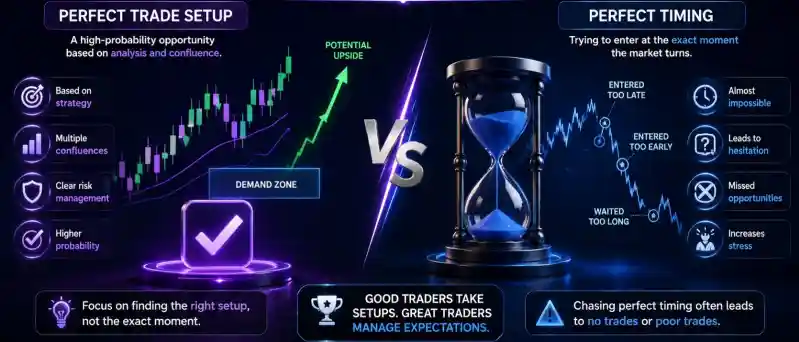
One confusion that trips up many traders is treating a perfect trade setup and “perfect timing” as the same thing. They are not. A setup can be technically complete — trend aligned, structure confirmed, risk-to-reward acceptable — while the exact candle you enter on still carries some uncertainty. No trader, no matter how experienced, can consistently pick the single best tick to enter a market.
Chasing perfect timing on top of a valid setup usually backfires. Traders wait for “just a little more confirmation,” miss the move entirely, and then chase price once it has already run. The goal is not flawless timing; it is a complete perfect trade setup combined with an entry that respects your predefined rules, even if it isn’t the absolute best possible price.
Separating these two ideas — setup quality versus entry precision — removes a huge amount of unnecessary pressure. Once your criteria are met, the trade is valid, and second-guessing the exact entry candle only reintroduces the same impatience this guide is trying to eliminate.
How Waiting for the Right Setup Improves Long-Term Risk Management
Risk management is usually discussed in terms of stop-loss placement and position sizing, but patience is just as much a risk-management tool. Every trade taken without a true perfect trade setup is, by definition, a trade taken with incomplete information. That missing information is itself a form of hidden risk, even if the position size and stop-loss look identical to a properly qualified trade.
When traders commit to only acting on a fully formed setup, three measurable benefits tend to follow over time: fewer low-probability trades enter the account, average losses shrink because stops are placed at more logical technical levels, and win rate improves simply because entries are better qualified. None of this requires a new strategy — it is the direct result of discipline applied to an existing one.
Tools That Help You Wait for the Perfect Trade Setup
- Price alerts: Set alerts at your predefined entry zones instead of watching the screen, which reduces the temptation to act early.
- Checklists and templates: A simple pre-trade checklist keeps emotional decisions in check.
- Trading journals: Reviewing past trades highlights exactly how often impatience has cost you money.
- Volatility tools: Indicators like ATR help confirm whether current conditions actually support your setup — see our guide on how to use ATR in forex trading.
- Demo accounts: Practicing patience in a risk-free environment builds the habit before real capital is involved. XM’s weekly demo contest is one free way to practice this.
Common Mistakes When Waiting for a Perfect Trade Setup
- Moving the goalposts: Changing your criteria mid-analysis to justify a trade you already want to take.
- Overanalyzing: Waiting so long for absolute certainty that valid setups are missed entirely.
- Revenge trading: Entering impulsively after a loss to “win it back,” without a real setup in place.
- Ignoring higher timeframes: Taking a setup on a lower timeframe that contradicts the broader trend.
Final Thoughts on Mastering Patience for the Perfect Trade Setup
Learning to wait for a genuine perfect trade setup is less about the markets and more about mastering your own mind. The traders who succeed long-term are rarely the ones with the most complex strategies — they are the ones with the discipline to sit on their hands until their own rules are satisfied. Build your plan, track your patience, and let the market come to you instead of chasing it.
For more guidance on building a disciplined trading routine, explore our risk and psychology section for additional strategy breakdowns and tools.
| You may also like this…….. 1. STMarket Weekly Cash Giveaway – Win RM50 Every Week 2. TheFXBuddy $80 No Deposit Bonus – How It Works and Who Can Claim It |
FAQs
How long should I wait for a perfect trade setup?
There is no fixed time frame — you wait until every condition in your trading plan is met, whether that takes minutes or several days.
Is it possible to be too patient as a trader?
Yes. Overanalyzing can cause valid setups to be missed. The goal is disciplined patience guided by clear criteria, not indecision.
What’s the fastest way to build patience in trading?
Using a written checklist before every trade is one of the fastest and most measurable ways to build patience, since it forces a pause before entry.

