


Leverage in forex lets you control a trading position that is much larger than the money you put up. A broker offering 1:100 leverage, for example, allows you to open a position worth 100 times your margin. That sounds powerful, and it is, but the same multiplier applies to losses as well as gains. Many beginners lose an account not because their analysis was poor, but because they used more leverage than their account could survive. This guide explains how leverage works, how margin and margin calls fit in, and why high leverage is one of the most common causes of large losses.
What Is Leverage in Forex?
Leverage in forex is a ratio that shows how large a position you can open compared with the margin you set aside. At 1:50 leverage, 1,000 USD of margin can support a position worth up to 50,000 USD. At 1:500, the same margin could support a position worth up to 500,000 USD.
The broker is not giving you free money. It is allowing you to take a larger market exposure while holding your margin as security. Profits and losses are calculated on the full position size, not just on your margin. This is the key point that many beginners miss.
How Margin Connects to Leverage
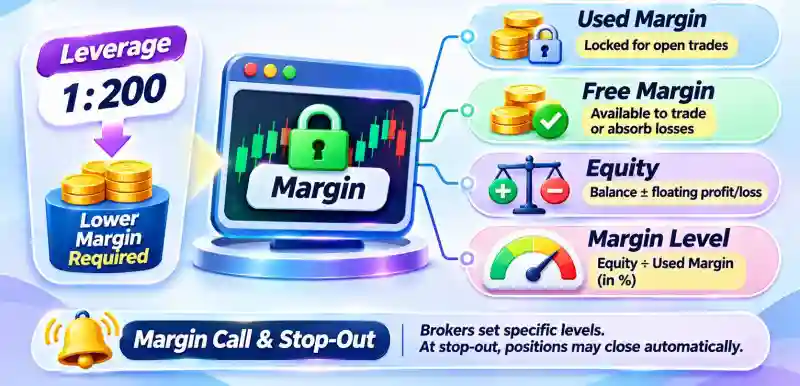
Margin is the portion of your account that is locked while a trade is open. With higher leverage in forex, the margin required for a given position is lower.
- Used Margin: The money reserved to keep your open positions running.
- Free Margin: Your equity minus used margin, which remains available to open new trades or absorb losses.
- Equity: Your balance plus or minus the floating profit or loss on open trades.
- Margin Level: Equity divided by used margin, shown as a percentage. A falling margin level warns that your account is under stress.
Brokers set margin call and stop-out levels. When your margin level drops to the stop-out level, the broker may automatically begin closing your positions. Exact percentages vary between brokers, so always check your account terms.
A Worked Example: Same Leverage, Two Very Different Outcomes
Imagine two traders, each with a 1,000 USD account and access to 1:100 leverage on EUR/USD. For a standard lot, one pip is worth about 10 USD, while for 0.1 lot, one pip is worth about 1 USD.
- Trader A opens 0.1 lot: The position is worth about 10,000 USD. Required margin at 1:100 is about 100 USD. A 50-pip move against the trade costs about 50 USD, equal to 5% of the account.
- Trader B opens 1.0 lot: The position is worth about 100,000 USD. Required margin at 1:100 is about 1,000 USD, using the entire account. A 50-pip move against the trade costs about 500 USD, equal to 50% of the account. A move of around 100 pips would wipe out the account.
Both traders had access to the same leverage in forex, but they used it differently. This is why experienced traders often focus on position size and effective leverage, calculated by dividing total position value by account equity, rather than simply choosing the maximum leverage offered by the broker.
6 Costly Truths About Leverage Every Trader Should Know
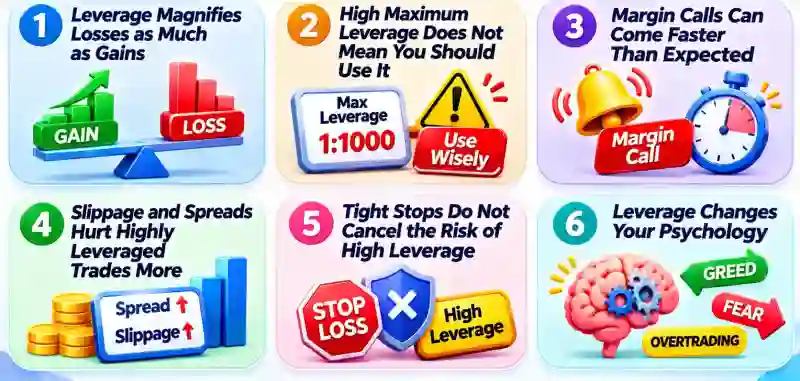
1. Leverage Magnifies Losses as Much as Gains
With leverage in forex, even a small adverse price move can cause a significant percentage loss when the position is large relative to account equity. For example, a 1% move against a position worth ten times your equity results in a 10% loss of your account value.
2. High Maximum Leverage Does Not Mean You Should Use It
Some brokers offer 1:500 or higher leverage in forex, especially outside tightly regulated regions. This figure represents the maximum available limit, not a recommended setting. Many experienced traders keep their effective leverage far lower than the maximum offered by their broker.
3. Margin Calls Can Come Faster Than Expected
When most of your equity is tied up as margin, even a modest move can push your margin level toward the stop-out level. Volatile periods, such as major news, can make this happen quickly. Our guide on why price moves before news is released explains why price can behave unpredictably around events.
4. Slippage and Spreads Hurt Highly Leveraged Trades More
When the position is large relative to the account, a few extra pips from slippage or a wide spread can take a meaningful share of your equity. Understanding how forex brokers execute your trades helps you see why fills can differ from the price on screen.
5. Tight Stops Do Not Cancel the Risk of High Leverage
Some traders use very high leverage and a very tight stop to limit the loss. The problem is that a tight stop is easier to trigger through normal noise, and a gap or fast move can still fill beyond your stop. Many stop-outs also happen at obvious levels, which we discuss in our guide on stop hunts in forex trading.
6. Leverage Changes Your Psychology
Large floating profits and losses from leverage in forex can create emotional pressure. A trader who worries about every pip may close trades early, move stop-losses or add to losing positions. Lower effective leverage often makes it easier to stay calm and follow a trading plan.
Why Leverage Is Especially Risky in Prop Firms
Funded and evaluation accounts add strict daily loss and maximum drawdown rules. A leveraged position that moves sharply against you can breach those limits before you have time to react. Many firms also set maximum leverage for their accounts, and your effective leverage still depends on your lot size. Our guide on risk management tips for prop firm traders explains how to size positions so that normal losing streaks do not threaten the limits, and our article on prop firm challenge capital shows how account size affects comfort and risk.
Leverage in Copy Trading
When you copy another trader, the leverage they use can pass through to your account, depending on the platform’s settings. A provider using large positions relative to their equity can create sharp drawdowns for followers. Before copying anyone, check their maximum drawdown and typical position sizing, and read our guide on how copy trading works in forex to understand how trades are scaled to your account.
How to Use Leverage More Responsibly
- Size from your stop, not from the maximum: Decide how much you are willing to lose, set the stop at a logical level, and calculate the lot size from there.
- Watch effective leverage: Compare total position value with your equity, and keep it moderate for your strategy.
- Keep free margin available: Avoid using most of your account as margin, so a normal adverse move does not threaten a stop-out.
- Avoid stacking correlated trades: Several positions on related pairs can multiply exposure without looking like it.
- Test your approach first: Use a demo account and realistic assumptions before using real money, as explained in our guide on how to backtest a forex strategy properly.
- Read structure for logical stops: A stop placed at a point where the idea is invalid allows a sensible position size, and our beginner’s guide to market structure in forex trading shows how to find those points.
Common Leverage Mistakes
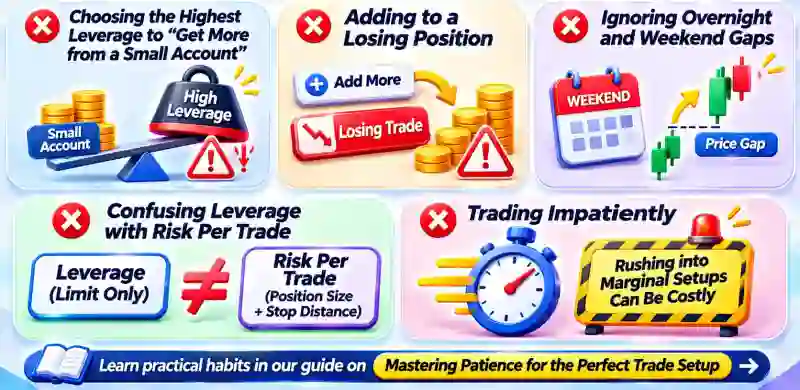
- Choosing the highest leverage available to “get more from a small account”: A larger position on a small account increases the chance of a fast wipeout.
- Adding to a losing position: This raises exposure at the worst moment and can trigger a margin call.
- Ignoring overnight and weekend gaps: Price can jump past a stop while markets are closed or thin.
- Confusing leverage with risk per trade: The ratio is only a limit. Your real risk depends on position size and stop distance.
- Trading impatiently: Rushing into marginal setups with large size is a recipe for damage. Our guide on mastering patience for the perfect trade setup covers practical habits.
Final Thoughts
Leverage in forex is a tool that increases both opportunity and danger. It lets a small account control a large position, but it also means small price moves can cause large losses, margin calls, and forced closures. The safer approach is to treat the broker’s maximum leverage as a ceiling, size each trade from a defined risk, and keep effective leverage at a level your account and your nerves can handle. Trading carries a real possibility of loss, including the loss of your full deposit, so only risk money you can afford to lose and check the margin rules of your own broker before you trade.
FAQs
What does 1:100 leverage mean?
It means you can control a position worth up to 100 times your margin. With 1,000 USD of margin, you could open a position worth up to 100,000 USD, though your actual risk depends on how large a position you choose to open.
Is higher leverage better for small accounts?
Not necessarily. Higher leverage allows larger positions, but it also makes it easier to lose a large share of the account on a small move. Many traders prefer to keep effective leverage low, even when more is available.
What is a margin call?
A margin call is a warning from the broker that your margin level has fallen to a set threshold. If it continues to fall to the stop-out level, the broker may close positions automatically. The exact levels vary by broker.
Can I lose more than my deposit?
It depends on the broker and the region. Some brokers offer negative balance protection, while others may not. Check the terms of your account before trading with leverage.

