


A stop hunt in forex trading is a sharp price move that pushes through an obvious level, triggers a cluster of stop-loss orders, and then reverses back in the original direction. Almost every trader has experienced it: your stop gets hit by a single wick, and price then moves exactly where you expected it to go. It feels personal, but understanding what a stop hunt really is, why it happens, and what it does not prove can change how you place your stops and manage risk. This guide explains the concept honestly, including the parts that are often exaggerated online.
What Is a Stop Hunt in Forex Trading?
A stop hunt, also called a stop run or liquidity sweep, happens when price briefly moves beyond a visible swing high, swing low, or round number where many traders have placed their stop-loss orders. Those stops become market orders once triggered, creating a burst of buying or selling. After that burst, price often snaps back toward its previous range.
The key point is that the move itself is mechanical. In stop hunt in forex trading, stop-losses are orders, and orders create liquidity. When many stop-losses sit around the same obvious price level, the market may move toward that area because large participants need opposite-side orders to execute their trades. However, not every breakout or sharp price movement is a stop hunt; price can also continue in the same direction when supported by strong momentum or new market information.
Why a Stop Hunt in Forex Trading Happens

Obvious Levels Attract Clustered Orders
Previous highs, previous lows, equal highs, equal lows, and round numbers like 1.1000 are watched by many traders. Because so many traders place stop-losses just beyond these points, orders tend to accumulate around the same price levels. In stop hunt in forex trading, these areas are important because a brief move beyond a visible level can trigger multiple stop-loss orders, creating a sudden burst of buying or selling before price reverses or continues in its original direction.
Large Orders Need Liquidity
A big buy order cannot be filled at one price without moving the market. Resting sell orders, including triggered stop-losses from short positions, give larger participants something to buy against. This is the same mechanism covered in our guide on the role of liquidity in forex price movement.
Thin Conditions Exaggerate the Move
During low-volume trading hours, rollover periods, or just before major economic events, fewer orders may be available in the market. In stop hunt in forex trading, these thin-liquidity conditions can allow a relatively small amount of buying or selling pressure to push price quickly beyond an obvious level. This can create a dramatic-looking wick that triggers stop-loss orders before price reverses or continues in the same direction.
5 Costly Truths About Stop Hunts Every Trader Should Know

- Not every stop-out is a stop hunt: Sometimes price simply moves through a level because the trade idea was wrong. Calling every loss a hunt prevents honest review and keeps the same mistakes alive.
- Obvious stops are the most exposed: Placing a stop exactly at a recent low or a round number puts it where the most orders already sit, which is also where price is most likely to probe.
- A sweep is not a reversal by itself: Price may sweep a level and keep going. The wick only becomes meaningful when followed by a clear shift in structure.
- Retail traders cannot prove intent: Online claims that brokers or “smart money” are deliberately targeting individual accounts are rarely provable. What traders can observe is where orders tend to cluster and how price behaves around those areas.
- Tight stops pay the highest price: The tighter the stop sits near an obvious level, the more likely ordinary volatility or a sweep will take it out before the trade has a chance to work.
Stop Hunt vs Genuine Breakout: How to Tell the Difference
This is the question that matters most in practice, and no signal is perfect. Traders usually look at a few things together:
- Speed of return: A quick rejection back inside the range, often within a few candles, leans toward a sweep. A strong close beyond the level with follow-through leans toward a genuine breakout.
- Candle structure: Long wicks with small bodies beyond the level suggest rejection. Large bodies closing beyond it suggest acceptance.
- Higher-timeframe context: A sweep that happens against a clear higher-timeframe trend is less meaningful than one that aligns with it. Our guide to market structure in forex trading explains how to judge that context.
- Follow-through after the move: Genuine reversals usually show a structure shift afterward, often leaving behind areas like an order block or an imbalance that traders can study.
A Real Example: How a Stop Hunt Plays Out
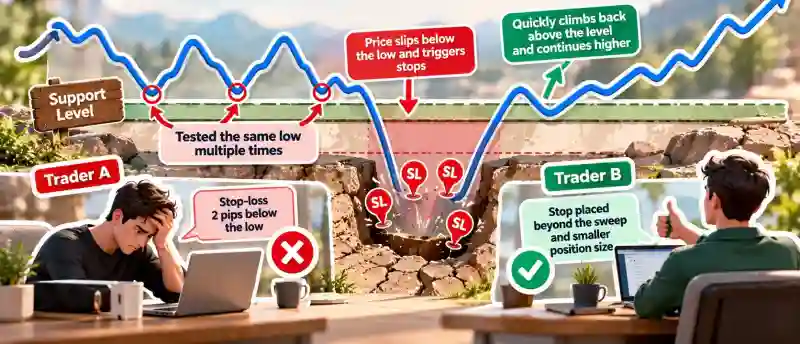
Picture a currency pair that has tested the same low three times over two days. Many traders have opened long positions around that support level, with their stop-loss orders placed just below it. During a quiet trading session, price slips a few pips beneath the low, triggering those stops, then quickly climbs back above the level and continues higher. This is a common example of stop hunt in forex trading, where a brief move beyond a visible support level triggers clustered orders before the market reverses.
Trader A placed a stop-loss two pips below the low and was taken out during the sweep, potentially at an unfavorable price. Trader B placed the stop beyond the sweep area and reduced position size to account for the wider stop, allowing the trade to remain open during the temporary dip. Neither trader predicted the move with certainty. The difference was the placement of the stop-loss and how position size was adjusted to match the level of risk.
How to Protect Yourself From Stop Hunt in Forex
- Avoid placing stops at obvious levels: Give the trade room beyond clear highs, lows, and round numbers rather than exactly at them.
- Size down when you widen the stop: A wider stop only works if position size shrinks to keep risk per trade the same. This principle is covered in our risk management tips for prop firm traders.
- Base stops on structure, not guesswork: Place them where the trade idea is clearly invalidated, not simply where the loss feels comfortable.
- Wait for confirmation: Waiting for price to reject a level and show a structure shift before entering often avoids the worst of the sweep.
- Be cautious around low-liquidity windows: Spreads widen and spikes become more likely during rollover and around major events.
- Understand your execution environment: Slippage and fill quality affect how stops behave in fast markets, which is explained in our guide on how forex brokers execute your trades.
Common Mistakes Traders Make With Stop Hunts
- Moving the stop further away mid-trade: Widening a stop after entry because “it might get hunted” often turns a controlled loss into a much larger one.
- Removing stops entirely: Trading without a stop to avoid being hunted exposes the account to unlimited downside, which is far more dangerous than an occasional sweep.
- Re-entering immediately out of anger: Revenge trading after a stop-out compounds losses and usually breaks risk rules.
- Treating every wick as a trap: Over-reading sweeps leads to missed genuine breakouts and overconfident counter-trend trades.
Final Thoughts
A stop hunt in forex trading is best understood as price moving toward areas of clustered liquidity rather than as a personal attack on your trading account. Stop-losses placed at obvious price levels are naturally more exposed to temporary sweeps. Learning to identify where orders tend to gather can help you make more informed decisions about stop placement. However, no strategy can eliminate the risk of loss. Sound position sizing, structure-based stop-losses, and an honest review of every stopped-out trade will help you manage risk more effectively than trying to anticipate every liquidity sweep.
FAQs
Are stop hunts real or just an excuse traders make?
Price does often sweep obvious levels where orders cluster, so the pattern itself is real. What cannot be proven by a retail trader is that any specific sweep was aimed at their account, and many stop-outs are simply trades that were wrong.
Do brokers hunt stop-losses?
Regulators have taken action against some firms for poor or unfair execution practices, so choosing a properly regulated broker matters. However, most stop-outs come from normal market behavior and liquidity dynamics rather than deliberate targeting, and it is difficult for individual traders to tell the difference.
Should I trade without a stop-loss to avoid being hunted?
No. Trading without a stop-loss exposes your account to potentially severe losses from a single move. A better approach is placing stops beyond obvious levels and reducing position size to keep risk controlled.

