


The role of liquidity in forex price movement is one of the most overlooked concepts among retail traders, yet it quietly explains almost everything that happens on a chart — from sudden spikes and stop-hunts to why certain levels get respected while others get blown straight through. Liquidity isn’t just a background statistic; it’s the actual fuel that price needs to move. Understanding the role of liquidity in forex price movement changes the way you read charts, because you start seeing price action as a hunt for orders rather than a random series of candles.
What Liquidity Actually Means in Forex
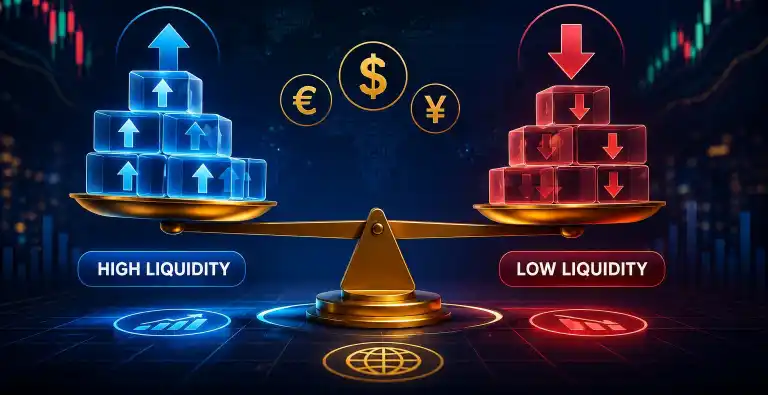
Liquidity refers to the volume of buy and sell orders resting at a given price level, along with how easily a position can be entered or exited without significantly moving the price. In highly liquid conditions, large orders get filled smoothly. In thin, low-liquidity conditions, even moderately sized orders can cause sharp, disproportionate price moves.
This is where The Role of Liquidity in Forex Price Movement becomes important. Liquidity influences how easily orders are absorbed and how price responds when large buying or selling activity enters the market. In forex specifically, liquidity is never evenly distributed. It clusters heavily around certain price levels, trading sessions, and economic events — which is exactly why price doesn’t move randomly, even though it often looks that way on a raw candlestick chart.
Why the Role of Liquidity in Forex Price Movement Matters So Much
Every significant price move needs liquidity to occur. A large institutional order cannot be executed efficiently in an empty market; it requires enough opposite-side orders at a particular level to absorb the transaction. This helps explain why price often moves toward obvious highs, lows, and round numbers before reversing, as these areas can contain clusters of retail stop-losses and pending orders that create concentrated pools of liquidity.
This relationship is an important part of The Role of Liquidity in Forex Price Movement, as areas with concentrated orders can influence where price moves next and how larger orders are executed.
6 Powerful Truths About Liquidity Every Trader Should Understand
- Liquidity pools form at obvious levels: Swing highs, swing lows, and round numbers naturally attract stop-losses and pending orders, turning them into liquidity pools that price is often drawn toward.
- Stop-hunts aren’t random: A sudden wick beyond a key level followed by a sharp reversal is frequently a liquidity grab, where price briefly pushes into a pool of orders before reversing in the intended direction.
- Session overlaps carry the deepest liquidity: The overlap between the London and New York trading sessions typically brings the highest liquidity and trading volume of the day. This increased market participation often leads to greater volatility and can create stronger price movements, making session timing an important part of The Role of Liquidity in Forex Price Movement.
- Low-liquidity periods create false moves: Thin liquidity during off-hours or right before major news can produce sharp, unreliable spikes that reverse quickly once deeper liquidity returns to the market.
- Liquidity precedes real directional moves: Price often needs to sweep a liquidity pool before it has enough “fuel” to make a genuine sustained move in a new direction, which is why order blocks and structure shifts frequently follow a liquidity grab.
- News events temporarily distort liquidity:Major economic releases can temporarily reduce liquidity and widen spreads, increasing the risk of slippage around the announcement. These sudden changes in market conditions are an important part of The Role of Liquidity in Forex Price Movement, particularly when traders are entering or exiting positions during high-impact news events.
A Real Example: Liquidity in Action
Picture a currency pair holding a clear range for several hours, with an obvious low that multiple traders have placed stop-losses just beneath. Price suddenly wicks below that low, triggering those stops, then snaps back above it within minutes and rallies hard. To an untrained eye, that wick looks like random noise or a “fakeout.” In reality, that move likely reflects the role of liquidity in forex price movement directly — larger participants needed the liquidity resting below that low to fill their buy orders, and once it was swept, price had the fuel to move higher. This is also why understanding how forex brokers execute your trades helps make sense of why these sharp wicks happen the way they do.
How Liquidity Connects to Market Structure

Liquidity and market structure work together rather than separately. A break of structure often occurs right after a liquidity sweep, because that sweep is frequently what supplies the volume needed for the subsequent move. Traders who study structure without factoring in liquidity often misread genuine reversals as random noise, and vice versa. For a deeper foundation on this relationship, it’s worth reading our guide on market structure in forex trading, since structure gives liquidity sweeps their context and directional meaning.
Where Liquidity Tends to Cluster
- Previous day’s high and low: Widely watched levels that frequently attract resting orders from multiple trader types.
- Round numbers: Levels like 1.1000 or 150.00 tend to draw disproportionate order clustering simply due to psychological rounding.
- Session highs and lows: The Asian session range, for example, often becomes a liquidity target once the London session opens.
- Equal highs or equal lows: When price tests the same level multiple times without breaking it, resting liquidity tends to build up just beyond that level.
Common Mistakes Traders Make With Liquidity
- Placing stop-losses at obvious round numbers: This makes a position an easy target for a liquidity sweep, since so many other traders do the same thing at identical levels.
- Assuming every wick is a liquidity grab: Not all sharp moves are institutional liquidity hunts — some are simply genuine breakouts, and treating every wick as a trap leads to missed opportunities.
- Ignoring session timing: Trading a liquidity-based strategy during low-volume hours often produces unreliable results compared to higher-liquidity session overlaps.
- Trading immediately into a news release: Liquidity often thins dramatically in the seconds around major news, making entries riskier and slippage more likely.
Final Thoughts
The role of liquidity in forex price movement is far more central than most beginners realize — it explains why price sweeps obvious levels before reversing, why certain sessions feel more volatile than others, and why some breakouts hold while others fail instantly. Learning to read where liquidity is likely resting, rather than focusing purely on indicators or patterns, gives traders a much clearer sense of why price actually moves the way it does, rather than just where it might go next.
FAQs
Why does price often move against most retail traders first?
Because retail stop-losses and pending orders frequently sit at obvious levels, creating liquidity pools that larger participants can trade against before the market moves in its intended direction.
Which forex sessions have the highest liquidity?
The London and New York session overlap typically carries the deepest liquidity and volume of the trading day, which is why volatility often picks up noticeably during those overlapping hours.
Is low liquidity always risky?
Not always, but it does increase the chance of sharp, unreliable price spikes and wider spreads, which is why many traders avoid taking new positions during known low-liquidity windows.

