


The right risk management tips for prop firm traders matter more than almost any strategy detail, because prop firm evaluations are won or lost on drawdown control, not raw profit. A trader with an average strategy and disciplined risk rules will consistently outlast a trader with a brilliant strategy and no risk plan. This guide covers the 10 rules experienced funded traders actually follow to protect their accounts through both the evaluation phase and live funded trading.
Why Risk Management Tips for Prop Firm Traders Matter More Than Strategy

Prop firm challenges are structured around drawdown limits — daily and overall — not just profit targets. This means a strategy that wins 60% of the time can still fail an evaluation if a handful of oversized losing trades breach a drawdown rule. The most effective risk management tips for prop firm traders exist specifically to prevent that scenario, keeping any single trade or bad day from ending an otherwise solid trading approach.
The 10 Rules That Protect Your Account
1. Risk a Fixed Percentage Per Trade
A common conservative approach is to risk around 0.5–1% per trade, although the appropriate level depends on the firm’s rules, account size, and the trader’s strategy. This keeps any single loss small relative to the account, which is the foundation almost every other rule on this list builds on.
2. Respect Daily Drawdown Limits Strictly
Breaching a daily drawdown limit can immediately end an evaluation, which makes understanding and monitoring this rule essential. Track your running daily loss in real time and stop trading well before you approach the firm’s threshold, not exactly at it.
3. Know Your Maximum Drawdown Buffer
Understanding exactly how much room you have before hitting the maximum drawdown limit lets you plan position sizing with real numbers instead of guesswork. Our complete guide to prop firm rules breaks down how daily and maximum drawdown limits typically work across different firms.
4. Avoid Overtrading After a Loss
Revenge trading after a loss is one of the fastest ways to breach a drawdown limit. Building in a rule — such as stopping for the day after two consecutive losses — removes the emotional decision in the moment.
5. Use a Stop-Loss on Every Single Trade
No exceptions. A trade without a predefined stop-loss is a trade with undefined risk, which directly contradicts the fixed-percentage rule above no matter how good the setup looks.
6. Size Positions Based on Volatility, Not Emotion
Using a volatility-based tool to size positions — rather than a flat lot size for every trade — keeps risk consistent even as market conditions change. Our guide on how to use ATR in forex trading explains how to apply this in practice.
7. Don’t Risk More Than You Can Comfortably Reset
If a reset fee would create financial pressure, your position sizing is likely too aggressive relative to your actual risk tolerance, not just the firm’s rules. Trading scared money tends to produce worse decisions.
8. Track Every Trade in a Journal
A trading journal reveals patterns that memory alone misses — which setups actually respect your risk rules and which ones tend to tempt you into oversized positions. Our guide to trading journal metrics covers exactly what to track.
9. Avoid Trading High-Impact News Without a Specific Plan
Volatility spikes around major news releases can blow through normal stop-loss assumptions. Either sit out these windows entirely or trade them with a specific, tested plan rather than your standard position size.
10. Set a Personal Daily Loss Limit Below the Firm’s Limit
Building in your own buffer — stopping at, say, 70% of the firm’s daily drawdown limit — gives you a margin for error that a slippage event or a fast-moving market won’t immediately turn into a rule breach.
Tools That Help Enforce These Rules Automatically
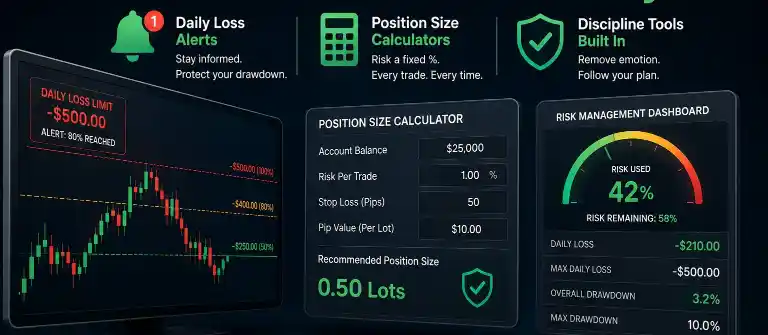
One of the most practical risk management tips for prop firm traders is to use trading platform tools to reinforce discipline. Many modern platforms allow traders to set maximum daily loss alerts, helping them monitor losses and avoid emotional decisions. These alerts make it easier to follow a trading plan and reduce the risk of exceeding prop firm drawdown limits.
Position size calculators are equally useful for enforcing fixed-percentage risk automatically. Rather than manually calculating lot size for every trade, a calculator that factors in your stop-loss distance and account balance removes the room for error that often creeps in during high-pressure moments. Combining this with a volatility-based sizing approach, as covered in our ATR guide, keeps position sizing consistent even as market conditions shift throughout an evaluation.
A Simple Pre-Trading Checklist
Before opening any trade during a prop firm evaluation, running through a short checklist can catch rule violations before they happen rather than after.
| Check | Question to Ask |
|---|---|
| Position size | Does this risk 0.5–1% of account balance or less? |
| Daily loss so far | Am I within my personal buffer below the firm’s daily limit? |
| Stop-loss | Is a stop-loss set before the order is placed? |
| Recent losses | Have I hit my stop-trading trigger after consecutive losses today? |
| News events | Is a high-impact release due before this trade would close? |
Running through even a short version of this checklist consistently is often what separates traders who pass evaluations calmly from those who breach a rule on an otherwise avoidable mistake.
Common Risk Management Mistakes That Fail Prop Firm Challenges
- Treating the evaluation like a sprint: Rushing to hit a profit target quickly often means taking oversized risk that isn’t sustainable.
- Increasing position size after a win streak: Confidence after wins is exactly when discipline tends to slip.
- Not accounting for correlated positions: Holding several trades on correlated pairs can multiply your real risk beyond what it looks like on paper.
- Ignoring the daily limit until it’s too late: By the time a trader notices they’re close to the daily limit, they’ve often already breached it.
How Risk Management Changes Across Challenge Types
Not all prop firm evaluations follow the same structure, which is why risk management tips for prop firm traders can vary depending on the challenge format. One-step challenges combine the evaluation into a single phase with a stricter overall drawdown limit, so traders generally need to use lower per-trade risk from the beginning, as there is no second phase to recover from an early mistake.
Two-step challenges, by contrast, often provide more flexibility in Phase 1, with a lower profit target and sometimes slightly more relaxed drawdown rules before moving to Phase 2. Traders who understand their evaluation format—and apply the right risk management tips for prop firm traders by adjusting position size and per-trade risk accordingly—are more likely to stay within the firm’s rules and avoid unnecessary drawdown violations.
How These Rules Change Once You’re Funded
Risk management tips for prop firm traders don’t disappear once an account is funded — if anything, they matter more, since a breached rule on a funded account usually means losing the account entirely rather than just a reset fee. Many funded traders actually tighten their per-trade risk slightly after passing, since protecting a working funded account is now more valuable than pushing for maximum growth speed. Consistency, not aggression, is what keeps a funded account active long-term.
Final Thoughts
None of these risk management tips for prop firm traders are complicated on their own. Fixed risk per trade, respecting drawdown limits, and avoiding emotional decisions after losses are all simple concepts. The real challenge is applying them consistently, especially under the pressure of a prop firm evaluation.
Traders who follow these risk management tips for prop firm traders as part of a written trading plan are more likely to reduce avoidable mistakes and manage evaluation risk effectively. Building these habits into a simple pre-trade checklist and reviewing it before every trading session can make a significant difference in long-term consistency and evaluation success.
FAQs
What’s the most important risk management rule for a prop firm challenge?
Respecting the daily drawdown limit is typically the most critical rule, since it’s the most common reason evaluations fail — more so than the overall maximum drawdown limit. Traders who build in a personal buffer below the firm’s official limit tend to avoid this failure point almost entirely.
How much should I risk per trade during a prop firm evaluation?
Most experienced funded traders risk between 0.5% and 1% of account balance per trade, which keeps any single loss from meaningfully threatening the daily or overall drawdown limit. This range can be adjusted slightly based on the specific challenge type and how much drawdown buffer is available.
Do risk management rules change after getting funded?
They typically stay just as strict, and many traders tighten their risk further, since a rule breach on a funded account usually means losing it rather than just paying a reset fee. Protecting a working funded account is often treated as more valuable than pushing for faster growth.

