


Most traders judge a strategy by its win rate and risk-to-reward ratio, yet spread, commission, and swap often decide whether that strategy makes money at all. These three costs are charged quietly on almost every trade, and because each one looks small on its own, they rarely get the attention they deserve. This guide explains what each cost is, how they combine, and why a strategy that looks profitable on a chart can end up flat or negative once real trading costs are counted.
What Spread, Commission, and Swap Mean
Spread
The spread is the gap between the buy price (ask) and the sell price (bid). Every trade opens slightly in the negative by the size of that gap, so price must move in your favor before you even reach break-even.
Commission
Commission is a fixed fee some brokers charge per lot, usually on raw-spread or ECN-style accounts. When comparing spread, commission and swap, remember that commission is an additional trading cost on top of the spread. It is typically charged when you open a trade and may be charged again when you close it, depending on the broker’s fee structure.
Swap
Swap, also called rollover, is the interest paid or earned for holding a position past the daily rollover time. It depends on the interest rate difference between the two currencies and on whether you are buying or selling. It can be a charge or a credit, and rates differ between brokers.
6 Hidden Ways These Costs Affect Profitability

1. Costs Are Paid Before Your Trade Has a Chance to Work
If a pair has a 1.5 pip spread, your trade starts 1.5 pips behind. On a target of 10 pips, that is already 15% of your expected move gone. On a target of 5 pips, it is 30%. The shorter your target, the larger the share that costs take.
2. Frequent Trading Multiplies the Damage
Every new trade pays the spread and any commission again. A scalper placing 20 trades a day pays these costs 20 times, while a swing trader placing 3 trades a week pays them far less often. This is why high-frequency strategies need a much stronger edge to survive.
3. A Low Spread Does Not Always Mean a Low Cost
Raw-spread accounts often offer very tight spreads, but the added commission can make their overall cost similar to or higher than that of a standard account. When comparing spread, commission and swap, focus on the total trading cost per lot by adding the spread cost and commission in the same unit.
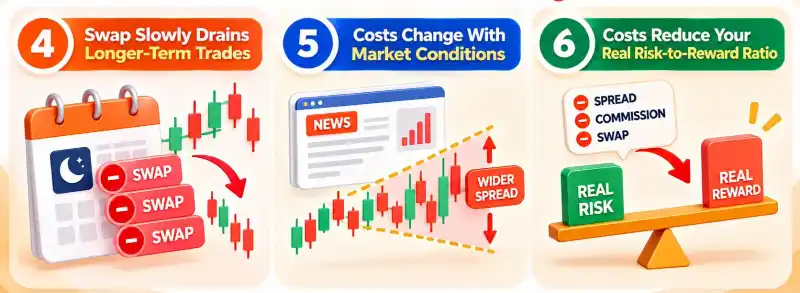
4. Swap Slowly Drains Longer-Term Trades
For trades held for days or weeks, swap charges accumulate every night. A trade that gains 40 pips but pays several pips in swap loses a noticeable part of its profit. Triple swap on the midweek rollover can make this more visible.
5. Costs Change With Market Conditions
Spreads widen during news, rollover, and thin sessions. A strategy tested on average spreads can behave very differently if it enters during those moments. Understanding how forex brokers execute your trades helps explain why the price you get is not always the price you saw.
6. Costs Reduce Your Real Risk-to-Reward Ratio
A planned 1:2 risk-to-reward trade may not deliver the same ratio once trading costs are included. The stop-loss effectively becomes more expensive, while the potential reward decreases. Understanding spread, commission and swap is essential because these costs can gradually reduce your actual trading edge over many trades.
A Worked Example: Same Strategy, Different Cost Settings
Imagine a strategy that risks 10 pips to make 15 pips, with a 50% win rate over 100 trades. Before costs, 50 winning trades generate 750 pips, while 50 losing trades cost 500 pips, leaving a net profit of 250 pips.
Now include spread, commission and swap costs, assuming a total round-trip cost of 2 pips per trade. Across 100 trades, costs reduce the result by 200 pips, leaving just 50 pips of profit. If costs rise to 3 pips per trade, the final result becomes a 50-pip loss. The strategy remains unchanged, but higher trading costs turn a profitable system into a losing one.
Cost Impact by Trading Style
- Scalping: Spread and commission matter most because targets are small and trade count is high.
- Day trading: Spread and commission still matter, but swap is usually avoided because positions close the same day.
- Swing trading: Swap becomes important, while spread has less impact because targets are larger.
- Position trading: Swap is often the largest recurring cost, so checking rates before entering is essential.
How to Keep These Costs Under Control
- Compare total cost, not headline spread: Add commission to the spread before choosing an account type.
- Avoid entries during thin liquidity: Rollover and the minutes around major news often carry wider spreads.
- Check swap before holding overnight: Look at the long and short rates for your pair, since they can differ a lot.
- Match your targets to your costs: If costs take a large share of your target, widen the target or trade less often.
- Review your trade journal for cost drag: Compare your results before and after costs to see the real picture.
Put Costs Into Your Backtest

The most common cost mistake is testing a strategy with zero costs and expecting live results to match. Always include realistic spread, commission, and swap in your testing, and use a worse-than-average spread to stay on the safe side. Our guide on how to backtest a forex strategy properly shows how to build these costs into your test so the results are closer to what you will actually experience.
Costs, Risk Rules, and Account Survival
Costs also eat into your risk budget. If your daily loss limit is small, a few trades with wide spreads can use up part of it before price even moves against you. This matters especially for funded accounts, where limits are strict, and it is one more reason to follow the sizing habits in our risk management tips for prop firm traders.
Costs are also one reason copied trades can differ from the original trader’s results, since your spread, commission, and fills may not match theirs. We explain the mechanics in our guide on how copy trading works in forex.
Common Mistakes With Trading Costs
- Ignoring commission on raw-spread accounts: The low spread looks attractive until the commission is added.
- Assuming swap is always a charge: Depending on the pair and direction, it can sometimes be a credit, but you should never count on that.
- Using tight stops without considering spread: A very tight stop can be hit by the spread widening alone, a situation related to the sweeps explained in our guide on stop hunts in forex trading.
- Overtrading small moves: Taking many marginal setups increases cost without increasing edge. Patience is a cost-saving skill, as covered in our guide on mastering patience for the perfect trade setup.
Final Thoughts
Spread, commission and swap are ongoing costs that can reduce the profitability of any trading strategy. Their impact is greater when profit targets are small or trades are frequent. Calculate the full trading cost, include realistic fees in backtesting, and choose a trading style that suits your broker’s cost structure. Although no strategy eliminates the risk of loss, understanding your actual costs helps you make more informed trading decisions.
FAQs
Which cost matters most for a beginner?
Spread usually matters most at the start because every trade pays it. If you hold trades overnight, swap becomes just as important, so check both before choosing a style.
Is a commission-free account always cheaper?
Not necessarily. A commission-free account normally builds its fee into a wider spread, so the total cost can be similar to or higher than a raw-spread account. Compare the all-in cost per lot.
Can swap be positive?
Yes, in some cases a position earns a positive swap, depending on the interest rate difference and trade direction. Rates change and differ between brokers, so check them before relying on it.

