

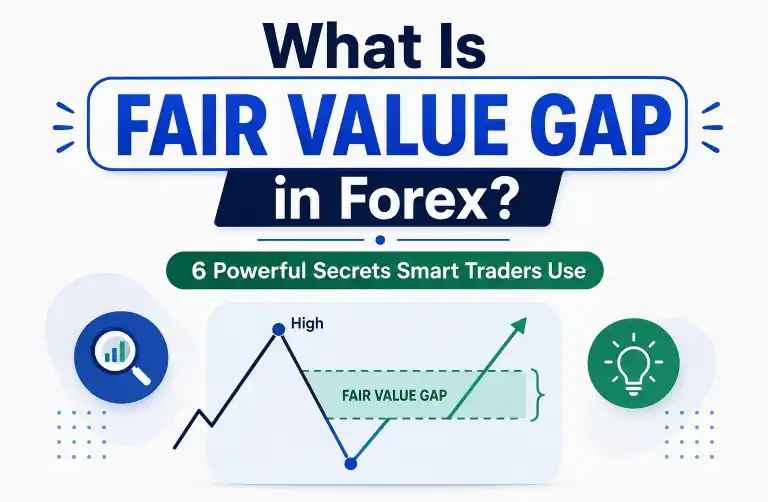
A (FAG) fair value gap in forex is a three-candle price imbalance that forms when the market moves so fast in one direction that not every order gets filled along the way. It leaves behind a visible “gap” between candles — an area traders believe still holds unfinished business, which is exactly why price so often returns to revisit it later. For anyone studying Smart Money Concepts, understanding a fair value gap in forex is usually the natural next step after learning about order blocks, since the two concepts are closely connected but not identical.
What Is Fair Value Gap in Forex, Exactly?
A fair value gap forms across three consecutive candles. The first candle sets the initial range, the second (often a large, fast-moving candle) drives price sharply in one direction, and the third candle’s range doesn’t overlap with the first. That empty space between the first candle’s high (or low) and the third candle’s low (or high) is the fair value gap itself — a zone where buying or selling pressure was so aggressive that price simply skipped over it without proper two-sided trading.
In plain terms: a fair value gap in forex shows where the market moved too quickly for balance to form, leaving an imbalance that price frequently comes back to “fill” later.
Bullish vs Bearish Fair Value Gaps
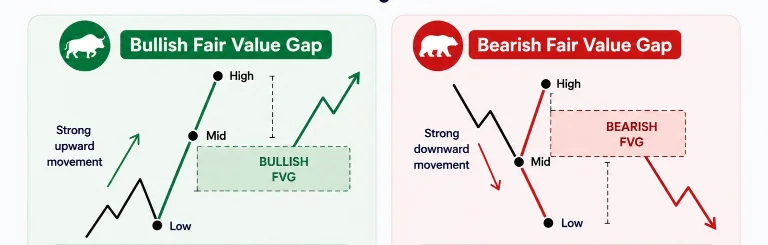
Bullish Fair Value Gap
A bullish FVG forms during a strong upward move, when the low of the third candle stays above the high of the first candle. This gap is viewed as a potential demand zone, where price may retrace down into before continuing higher.
Bearish Fair Value Gap
A bearish FVG forms during a sharp downward move, when the high of the third candle stays below the low of the first candle. This gap acts as a potential supply zone, where price may retrace up into before continuing lower.
6 Powerful Secrets Smart Traders Use With Fair Value Gaps
- Treating FVGs as a magnet, not a guarantee: Price often returns to fill an FVG, but not always fully or immediately — smart traders treat the zone as an area of interest, not a certainty.
- Combining FVGs with order blocks: An order block is the last opposing candle before a displacement move, while the FVG is the gap left behind by that same displacement. Used together, they add far more confidence than either alone.
- Checking for bias alignment: An FVG that aligns with the broader trend and higher-timeframe direction carries far more weight than one traded against the dominant bias.
- Avoiding choppy, low-momentum ranges: FVGs formed during sideways, low-conviction price action tend to be far less reliable than those formed during a clean directional leg.
- Watching for inverse fair value gaps: Sometimes an FVG’s role flips — a bullish gap can turn into a bearish zone once broken, known as an inverse FVG, giving traders a secondary signal to watch for.
- Using partial fills as confirmation: Price doesn’t always need to fill an entire gap before reacting; watching how price behaves at the edge of the zone often tells traders more than waiting for a full fill.
A Real Example: Spotting a Fair Value Gap on a Chart
Picture three consecutive candles during a strong rally: the first candle closes near its high, the second candle gaps up and closes strongly higher, and the third candle’s low sits clearly above the first candle’s high. That empty space between them is the fair value gap in forex traders would mark on this chart. A few hours later, price pulls back into that exact zone, reacts, and resumes the uptrend — the classic pattern smart money traders wait patiently for instead of chasing the original breakout candle.
How Fair Value Gaps Differ From Order Blocks
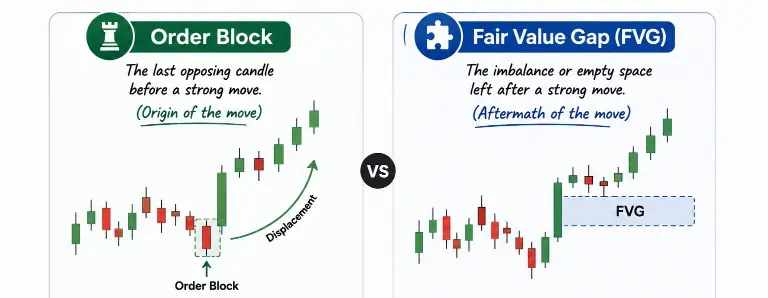
These two concepts are often confused because they appear close together on a chart, but they are not the same thing. An order block marks the last opposing candle before a displacement move — the origin point — while a Fair Value Gap in Forex represents the imbalance or empty space left behind by that same displacement — the aftermath.
For a deeper explanation of order blocks, see What Is Order Block in Forex Trading? – A Beginner’s Guide to Smart Money Zones. Studying both concepts together can provide a fuller picture of price behavior, which is why many Smart Money traders analyze order blocks and fair value gaps as a pair rather than separately.
Common Mistakes Beginners Make With Fair Value Gaps
- Treating every gap as tradeable: Not every imbalance qualifies as a meaningful setup — the gap needs to align with bias and sit within a clean directional leg to carry real weight.
- Ignoring higher-timeframe context: A fair value gap in forex on a lower timeframe means far less if it contradicts structure on a higher timeframe, a concept explained further in our beginner’s guide to market structure in forex trading.
- Marking gaps in choppy ranges: FVGs formed during sideways consolidation tend to be far less reliable than those formed during strong directional moves.
- Expecting a full fill every time: Price sometimes only partially fills a gap before reversing, and waiting for a complete fill can mean missing the actual reaction.
Final Thoughts
A fair value gap in forex is a genuinely useful way to spot where institutional-driven imbalances have formed on a chart, but it works best as part of a broader framework rather than a standalone signal. Combining FVGs with order blocks, market structure, and higher-timeframe bias gives traders a far more complete picture than marking gaps in isolation — and, as with any concept in trading, disciplined risk management still matters more than the pattern itself.
FAQs
Do fair value gaps always get filled?
Not always. Price often returns to an FVG, but it can also fill only part of the gap before reversing, or in some cases skip it entirely, especially during very strong trending moves.
Is a fair value gap the same as a regular price gap?
Not quite. A fair value gap in forex is a three-candle imbalance identified within continuous intraday price action, rather than an overnight or weekend price gap seen on markets that close.
Can fair value gaps be used alone as a trading strategy?
They can, but most experienced traders combine FVGs with order blocks, liquidity analysis, and market structure rather than relying on the gap alone, since confluence generally produces more reliable setups.


