


Learning how to build a simple trading system is often the single biggest turning point for a beginner trader, because it replaces random, emotion-driven decisions with a repeatable process. A trading system doesn’t need to be complicated to work — in fact, the simplest systems are usually the ones traders actually stick to under real market pressure. This guide walks through exactly how to build a simple trading system step by step, from defining your market to testing it properly before risking real capital.
What a Trading System Actually Is
A trading system is a fixed set of rules that defines when to enter, where to place stop-loss and take-profit levels, how much to risk, and when to stop trading. How to Build a Simple Trading System starts with creating a clear, repeatable process that removes guesswork and emotional decisions. The goal is not to predict every market move, but to develop a consistent and testable approach that can provide an edge over time.
7 Proven Steps for How to Build a Simple Trading System
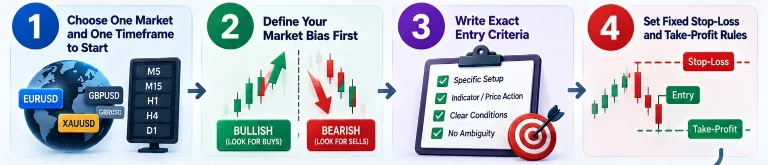
1. Choose One Market and One Timeframe to Start
Beginners often try to trade every pair on every timeframe at once, which makes it impossible to spot patterns clearly. Picking one currency pair and one primary timeframe — for example, the 1-hour chart on EUR/USD — gives you enough repeated exposure to actually learn how that specific market behaves.
2. Define Your Market Bias First
Before looking for entries, decide how you will determine the overall market direction. This could mean trading only with the higher-timeframe trend or using basic market structure to identify whether buyers or sellers are currently in control. This clear directional bias is an important part of how to build a simple trading system..
3. Write Exact Entry Criteria
This is the step most beginners skip, and it’s the most important one. Instead of “buy when it looks strong,” define something specific and repeatable — for example, entering only after price breaks a recent swing high with a clear increase in momentum. If you can’t describe your entry rule in one clear sentence, it’s not specific enough yet.
4. Set Fixed Stop-Loss and Take-Profit Rules
Decide in advance where your stop-loss goes relative to market structure (such as just beyond the most recent swing low or high) and what risk-to-reward ratio you’re aiming for. A simple system might target a minimum 1:2 risk-to-reward on every trade, which means you can be right less than half the time and still be profitable.

5. Define Your Position Sizing Rule
A simple trading system needs a clear and consistent position-sizing rule, such as risking a fixed 1% of the account balance per trade, regardless of how confident you feel about a setup. This is a key part of how to build a simple trading system and can help protect your account from excessive losses over time.
6. Backtest the System Before Trading It Live
Once your rules are written down, the next step is testing them against historical data to see how the system would have performed. This is where how to backtest a forex strategy properly becomes essential — a system that hasn’t been tested across a large enough sample is still just a theory, not a proven process.
7. Forward Test on Demo Before Going Live
After a solid backtest, run the system in real time on a demo account for several weeks. This step reveals execution issues, emotional reactions, and real-time data quirks that historical testing alone can’t fully capture, before any real money is involved.
A Real Example: Building a System From Scratch
Consider a beginner who decides to trade only GBP/USD on the 4-hour chart, using a rule that only takes long trades when price breaks above the previous day’s high while the daily chart is in a clear uptrend. The stop-loss goes just below the breakout candle’s low, the target is set at twice the risk, and position size is fixed at 1% risk per trade. After backtesting 150 historical trades and confirming a positive expectancy, the trader forward tests the same rules on a demo account for a month before finally trading it live. This entire process, done in order, is what separates a genuine trading system from a collection of random trade ideas.
Why Simple Systems Often Outperform Complex Ones

A system with 15 indicators and complicated conditional rules can be difficult to follow consistently, especially during the emotional pressure of a live losing streak. A simpler system with two or three clear conditions is easier to execute the same way on every trade. This consistency often matters more for long-term results than any small theoretical advantage a highly complex system may provide. In how to build a simple trading system, the focus should therefore be on creating rules that are clear, repeatable, and easy to follow. Consistent execution is often what separates profitable traders from unprofitable ones, rather than the sophistication of the strategy itself.
Common Mistakes When Building a Trading System
- Changing rules mid-test: Adjusting entry criteria partway through a backtest because a few trades didn’t work out undermines the entire point of testing objectively.
- Skipping position sizing rules: A great entry strategy paired with inconsistent, emotion-based sizing still leads to unpredictable results and can quickly breach an account’s risk limits, a mistake covered in detail in our risk management tips for prop firm traders.
- Ignoring higher-timeframe context: A system that only looks at one timeframe in isolation often misses the bigger picture, a gap explained further in our beginner’s guide to market structure in forex trading.
- Rushing straight to live trading: Skipping demo forward testing removes an important layer of validation and often leads to avoidable, costly mistakes early on.
Why Patience Matters More Than the Rules Themselves
Even a well-built system fails if a trader can’t wait patiently for their exact setup to appear. Jumping into trades that only partially match the rules, out of boredom or impatience, quietly turns a tested system into something completely different from what was actually backtested. This connects directly to the discipline covered in our guide on mastering patience for the perfect trade setup, since the system is only as reliable as a trader’s willingness to follow it exactly, trade after trade.
Final Thoughts
Understanding how to build a simple trading system step by step comes down to writing clear, specific rules for entries, exits, and position sizing, then testing those rules honestly before ever risking real capital. The simplest systems, followed consistently, tend to outperform complicated ones that are too difficult to execute the same way every single time. Building this kind of structure is what turns trading from a series of guesses into an actual repeatable process.
FAQs
How many rules should a simple trading system have?
Most effective simple systems have just two to four core rules covering market bias, entry trigger, stop-loss and target placement, and position sizing. Adding more conditions than that often makes the system harder to follow consistently without adding meaningful edge.
Do I need coding skills to build a trading system?
No. A trading system can be entirely rule-based and tested manually on historical charts. Coding is only necessary if you want to automate backtesting or execution, which is optional rather than required for beginners.

