


The debate around copy trading vs manual trading comes up constantly among beginners, usually framed as a simple question of which one makes more money. That framing misses the point entirely. Copy trading vs manual trading isn’t really about profitability — both can win and both can lose. It’s about control, learning speed, cost structure, and what kind of trader you’re actually trying to become. This guide breaks down seven honest differences so you can decide which approach genuinely fits your situation.
What Each Approach Actually Involves
Copy Trading
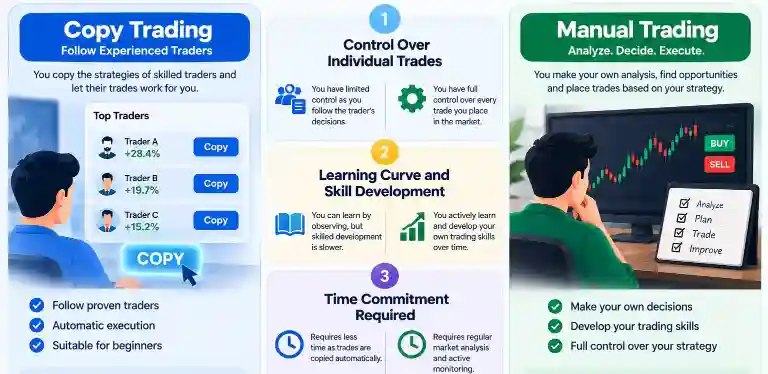
Copy Trading vs Manual Trading means that copy trading automatically mirrors another trader’s positions in your own account. When they open a trade, the platform opens a proportionally sized position on your account. You choose the trader and allocation, but you don’t control individual trade entries.
Manual Trading
Manual trading means you analyze the market yourself, decide your own entries and exits, and place every order personally. Every outcome — good or bad — traces directly back to your own decisions.
7 Honest Differences Between Copy Trading vs Manual Trading
1. Control Over Individual Trades
Manual trading gives you complete control over every entry, exit, and position size. Copy trading hands that control to someone else. If the trader you’re copying suddenly increases their risk or changes strategy, your account follows along whether you agree with the change or not.
2. Learning Curve and Skill Development
Manual trading requires you to learn market structure, order execution, and risk management firsthand. Copy trading can help you observe how experienced traders operate, but observation alone may not develop the same decision-making skills that come from placing and managing your own trades. This is another important difference in Copy Trading vs Manual Trading.
3. Time Commitment Required
This is where copy trading has a genuine advantage. Manual trading demands chart time, analysis, and active monitoring. Copy trading runs largely hands-off once configured, which suits people with limited screen time — though “hands-off” should never mean “unmonitored.”

4. Cost Structure
Manual trading costs you spreads, commissions, and swaps. Copy trading adds performance fees paid to the signal provider, sometimes platform subscription fees, and occasionally wider spreads on copy accounts. These extra layers quietly reduce net returns even during profitable periods.
5. Risk Exposure and Leverage
In manual trading, you control your own leverage and position sizing. With copy trading, you often take on the signal provider’s risk style. An aggressive trader can bring higher exposure to your account, making maximum drawdown an important metric to review rather than focusing only on headline returns. This is a key consideration when comparing Copy Trading vs Manual Trading.
6. Execution Timing
Manual traders control exactly when their order hits the market. Copy trading introduces a small delay between the provider’s execution and yours, which can produce a different fill price — sometimes meaningfully so during fast markets. Understanding forex execution and order fill makes these differences far less surprising when they show up in your trade history.
7. Accountability for Results
Manual trading puts responsibility directly on you, which can be challenging but also educational. With copy trading, responsibility can feel more divided because losses may be attributed to the provider rather than your own decisions. This can reduce the self-review needed to identify mistakes and improve over time, making it an important factor in Copy Trading vs Manual Trading.
A Real Example: Two Beginners, Two Paths
Imagine two beginners starting with the same account size. Trader A puts most of the account into a high-ranking copy trading provider and stops learning how the market works. Trader B spends three months studying market structure, builds a simple rule-based system, and tests it before going live.
After six months, the copy trader experiences a prolonged drawdown. Trader A struggles to decide whether to continue because they don’t understand the strategy behind the trades. Trader B also faces losses, but has a clear process for reviewing trades and making adjustments.
Neither approach guarantees profits, but Copy Trading vs Manual Trading highlights an important difference: manual trading can help develop skills and decision-making that traders can apply independently over time.
Where Copy Trading Genuinely Makes Sense
- As a supplement, not a replacement: Allocating a small portion to copy trading while learning manually can work well.
- For genuine time constraints: Traders who simply cannot commit screen hours may find it a reasonable middle ground.
- For strategy diversification: Spreading allocation across traders with different styles can reduce dependence on a single approach.
Where Manual Trading Has the Clear Edge

If your goal is to actually become a competent trader — whether for personal accounts or funded programs — manual trading is the only path that builds the required skill set. Prop firm evaluations, for instance, test your own decision-making under strict drawdown rules, which copy trading simply doesn’t prepare you for. The discipline standards involved are covered in our risk management tips for prop firm traders, and the foundational chart reading behind good manual decisions starts with our guide to market structure in forex trading.
Common Mistakes in the Copy Trading vs Manual Trading Decision
- Choosing copy trading to avoid learning: Skipping education doesn’t remove risk — it just moves the decision-making somewhere you can’t evaluate.
- Picking providers by return percentage alone: A high return with a severe drawdown history signals risk, not skill.
- Trading manually without a tested system: Manual control means nothing if your decisions are improvised. Building and validating rules first, as covered in how to backtest a forex strategy properly, is what makes manual trading an actual edge rather than guesswork.
- Treating either approach as passive income: Both involve real capital at real risk, and neither removes the possibility of significant loss.
Final Thoughts
The honest answer to copy trading vs manual trading is that neither is universally better — they serve different goals. Copy trading reduces time commitment and can offer useful exposure to experienced decision-making, but it adds fees, inherits someone else’s risk appetite, and doesn’t build trading skill. Manual trading demands far more effort and patience, but it’s the only route that produces a trader who can adapt when conditions change. For most people serious about trading long-term, manual is the foundation, and copy trading is at best a supplement alongside it.
FAQs
Can I do both copy trading and manual trading at the same time?
Yes, many platforms allow separate allocations. Some traders copy a portion of their account while trading manually with the rest, which keeps them learning while diversifying their exposure.
Is copy trading safer than manual trading for beginners?
Not inherently. Copy trading removes your own inexperience from individual entries, but it introduces dependence on another trader’s risk decisions, along with additional fees and execution delays.
Which approach works better for prop firm evaluations?
Manual trading, in almost all cases. Most prop firms have rules around copy trading, and evaluations are specifically designed to assess your own consistency and risk discipline rather than someone else’s.

