

Learning how to backtest a forex strategy properly is what separates traders who trust their system under pressure from traders who abandon it after the first losing streak. Backtesting is the process of applying a set of trading rules to historical price data to see how that strategy would have actually performed, before a single dollar of real capital is risked. Done properly, it turns a vague trading idea into measurable evidence. Done badly, it produces false confidence that falls apart the moment live market conditions get involved.
What Backtesting Actually Means
Backtesting means defining clear entry rules, exit rules, stop-loss placement, and position sizing, then working through historical charts to record every trade that would have triggered under those exact rules — without the benefit of hindsight. Following a structured process is essential when learning how to backtest a forex strategy properly, because changing the rules after seeing the outcome can produce misleading results.
The goal isn’t to prove that a strategy is profitable; it is to determine whether the strategy has a genuine statistical edge and identify where its weaknesses appear. A proper backtest should therefore follow the same rules consistently across historical market conditions, giving traders a more realistic view of how the strategy may perform.
7 Proven Steps for How to Backtest a Forex Strategy Properly
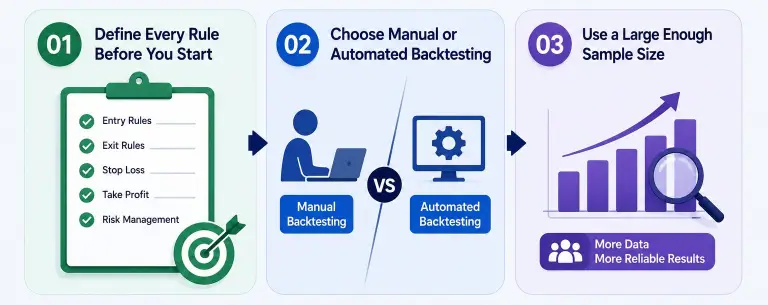
1. Define Every Rule Before You Start
Before opening a single historical chart, write down exact entry criteria, stop-loss and take-profit rules, position sizing, and any conditions that would invalidate a setup. Vague rules like “enter when it looks strong” make consistent backtesting impossible, since every decision becomes subjective in hindsight.
2. Choose Manual or Automated Backtesting
Manual backtesting involves moving through historical charts candle by candle, replaying price action without seeing what comes next. Automated backtesting, on the other hand, uses coded rules to simulate hundreds or thousands of trades much faster. Manual testing can help build a trader’s chart-reading skills and understanding of market behavior, while automated testing saves time and reduces execution bias. When learning how to backtest a forex strategy properly, many traders can benefit from using both approaches at different stages.
3. Use a Large Enough Sample Size
A handful of trades tells you almost nothing statistically meaningful. Most experienced traders aim for a minimum of 100–200 trades before drawing real conclusions, since smaller sample sizes are far more likely to be influenced by luck rather than genuine edge.
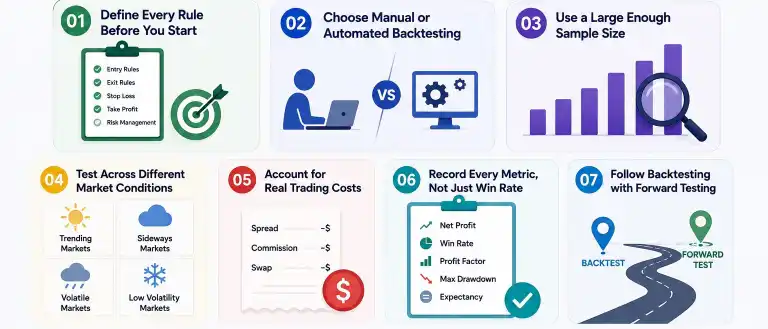
4. Test Across Different Market Conditions
A strategy that performs well only during strong trending conditions may struggle or fail in ranging or highly volatile markets. When learning how to backtest a forex strategy properly, it is important to test the strategy across different market phases — including trending, ranging, high-volatility, and low-volatility conditions. This provides a more realistic picture of how consistently the strategy may perform in changing market environments.
5. Account for Real Trading Costs
Spreads, commissions, swap costs, and slippage all quietly erode returns that look impressive on paper. A backtest that ignores these costs will almost always overstate real-world profitability, especially for strategies that trade frequently.
6. Record Every Metric, Not Just Win Rate
Win rate alone says very little without context. Metrics like drawdown, profit factor, expectancy, and risk-to-reward ratio give a much clearer picture of whether a strategy is genuinely sound. A strategy with a lower win rate but strong risk-to-reward can still be far more profitable than one that wins often but risks too much per trade.
7. Follow Backtesting with Forward Testing
A strategy that performs well historically should still be tested in real time on a demo account before committing any live capital. Forward testing can reveal execution issues, emotional reactions, and real-time market conditions that a historical backtest cannot fully capture. This additional step can help traders validate whether the strategy remains practical outside historical data.
A Real Example: Why Skipping Proper Backtesting Backfires
Picture a trader who creates a breakout strategy after seeing it work on a few recent charts and immediately trades it with full-size positions. Within two weeks, losses during a ranging market erase a month of gains because the strategy was never tested in sideways conditions.
A proper backtest covering at least 100 trades across different market phases could have exposed this weakness before real capital was at risk. This is also why traders should combine strategy testing with practical risk management tips for prop firm traders when deciding position sizes and managing drawdown risk..
Common Mistakes That Make Backtesting Unreliable
- Curve-fitting the strategy to past data: Adjusting rules repeatedly until they perfectly match historical results almost guarantees the strategy will fail on new, unseen data.
- Ignoring spreads and slippage:.
- Testing on too small a sample: Drawing conclusions from 10–15 trades is closer to guessing than genuine statistical validation.
- Only testing in favorable conditions:
- Skipping forward testing entirely: Jumping from a historical backtest straight into live trading removes an important layer of real-time validation.
Why Patience Matters in the Backtesting Process
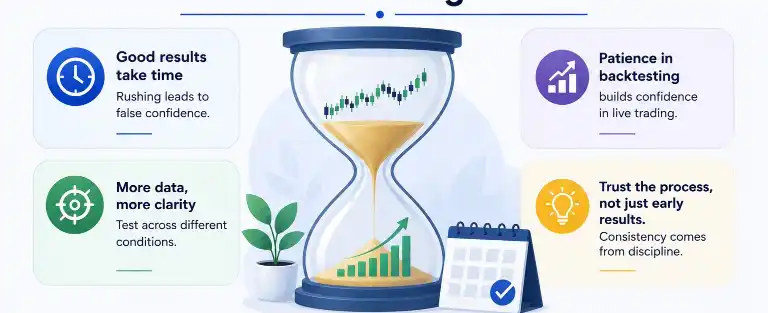
Proper backtesting takes far more time than most beginners expect, and rushing through it defeats the entire purpose. The same discipline needed to wait for a valid setup in live trading also applies here — resisting the urge to stop early once a strategy “looks good” after just a few dozen trades. This connects closely to the mindset covered in our guide on mastering patience for the perfect trade setup, since a rushed backtest often produces the same overconfidence that a rushed live entry does.
Final Thoughts
Understanding how to backtest a forex strategy properly is one of the highest-value skills a trader can build, because it replaces guesswork with evidence before real money is ever at risk. A strategy that survives a large, honest sample across different market conditions — with realistic costs factored in — gives a trader something far more valuable than confidence: it gives them a reason to actually trust their plan when live trading gets emotionally difficult.
FAQs
How many trades should a proper forex backtest include?
Most traders aim for a minimum of 100–200 trades to reach a statistically meaningful sample size before drawing conclusions about whether a strategy has a real edge.
Is manual or automated backtesting better?
Neither is strictly better — manual backtesting builds chart-reading skill and real-time decision practice, while automated backtesting is faster and removes human execution bias. Many traders use both at different stages of strategy development.
Does a good backtest guarantee future profits?
No. Backtesting shows how a strategy performed on historical data, not how it will perform in the future. That’s exactly why forward testing on a demo account is a necessary step before committing real capital.

