


Every new trader eventually asks the same question: why do currency pairs move in pips and points instead of simple whole-number changes like a stock price does? The answer comes down to how exchange rates are structured and quoted, and understanding it properly makes reading price charts, calculating risk, and comparing volatility across pairs far more intuitive. This guide breaks down exactly what pips and points are, how they’re calculated, and why they matter for every trade you place.
Even traders who have been in the markets for a while sometimes carry small misunderstandings about pip and point terminology, since brokers don’t always use the terms identically. Clearing this up properly early on prevents small miscalculations from quietly compounding into meaningfully wrong risk decisions later.
What Is a Pip in Forex Trading?
Move in pips and points begins with understanding what a pip is. A pip, short for “percentage in point,” is the standard unit used to measure price movement in most Forex currency pairs. For most pairs, one pip represents a change in the fourth decimal place (0.0001), while pairs involving the Japanese yen (JPY) typically use the second decimal place (0.01) because of the yen’s pricing convention.
What Is a Point (Pipette) in Forex Trading?
Understanding move in pips and points also means recognizing that many modern brokers quote prices with an additional decimal place beyond the standard pip. This extra decimal, commonly known as a pipette or, in some cases, a point, represents one-tenth of a standard pip and provides more precise pricing. Because broker terminology can vary, traders should confirm how their platform defines a point to avoid confusion when measuring price movements.
Why Currency Pairs Move in Pips and Points Instead of Whole Numbers

Currency pairs represent the exchange rate between two currencies, and because that rate typically changes by very small fractional amounts relative to 1.0000, a whole-number pricing system similar to stocks wouldn’t provide enough precision. Measuring movement in pips and points allows traders to see meaningful price changes clearly, even when the underlying exchange rate itself only shifts by a tiny fraction of a single unit of currency.
How Pip Value Is Calculated
Pip value depends on the currency pair being traded, the size of the position, and the account’s base currency. For a standard lot (100,000 units) on most major pairs quoted against the US dollar, a single pip is typically worth around $10, though this changes for mini and micro lots, as well as for pairs not directly quoted in dollars. Our complete guide to forex trading terms covers pip value calculation alongside other core terminology every trader should understand from the start.
Pips vs. Points vs. Pipettes: What’s the Difference?
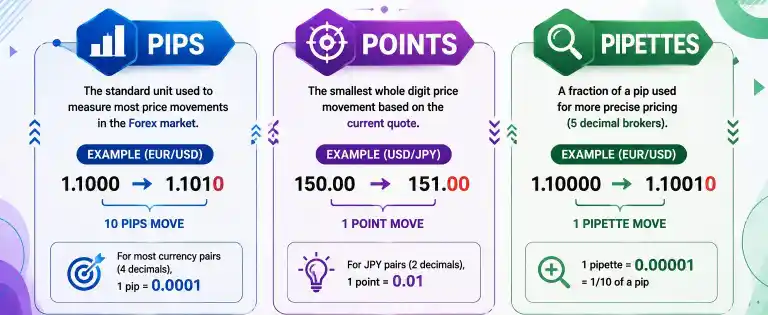
Understanding the move in pips and points is important because these terms are not always used consistently across brokers and trading platforms. A pip is the standard unit used to measure price movement in the Forex market, while a pipette (often referred to as a point by some brokers) represents one-tenth of a pip, providing greater pricing precision. Since some platforms use the term point differently depending on the asset class, traders should always confirm how their broker defines it instead of assuming the terminology is the same across all platforms.
Why Understanding Pip Movement Matters for Risk Management
Pips are the foundation of almost every risk calculation in forex trading. Stop-loss distances, position sizing formulas, and profit targets are all typically expressed in pips rather than in raw currency price. Without a solid grasp of how currency pairs move in pips and points, it becomes far harder to translate a chart-based stop-loss level into an actual, correctly sized position. How to Calculate Position Size Automatically .
A Practical Example of Pip Movement
Imagine EUR/USD moves from 1.0850 to 1.0900. That’s a 50-pip move, calculated from the change in the fourth decimal place. On a standard lot, where each pip is worth approximately $10, this represents about a $500 change in position value before spreads or commissions. On a mini lot, the same 50-pip movement would be worth roughly $50, as pip value changes according to position size.
This example shows why understanding move in pips and points is so important. The same price movement can produce very different profit or loss amounts depending on your trade size, making pips and points a key part of position sizing and risk management.
How Leverage Interacts With Pip Movement

Understanding move in pips and points also requires knowing how leverage affects trading results. While leverage does not change the number of pips a currency pair moves, it significantly affects how much that movement impacts your account balance. Higher leverage allows traders to control larger positions with the same amount of capital, so the same 50-pip move can have a much greater effect on account equity.
This relationship is often underestimated by new traders. Two traders can experience very different profits or losses from the same market movement simply because they use different levels of leverage and position sizes. Understanding how move in pips and points interacts with leverage helps traders manage risk more effectively and avoid unexpected losses.
How Different Currency Pairs Move Differently in Pips
Not all pairs move the same number of pips for a given percentage change, since pip value and typical daily range vary significantly by pair. More volatile pairs, or those involving emerging-market currencies, can move hundreds of pips in a single session, while more stable major pairs might average a smaller daily pip range under normal conditions. This is why traders often use a volatility measure alongside raw pip counts to judge whether a specific move is unusually large or simply normal for that pair. Our guide on how to use ATR in forex trading explains how to add this context to your pip-based analysis.
Common Mistakes When Reading Pip Movements
- Assuming pip value is identical across all pairs: Pip value changes based on the quote currency and position size, not just the number of pips moved.
- Confusing points and pips across different brokers: Since terminology isn’t fully standardized, always confirm what a specific platform means by “point” before relying on it for risk calculations.
- Ignoring yen-pair decimal differences: Forgetting that JPY pairs use a different decimal placement can lead to significant miscalculations in pip distance and position sizing.
- Treating pip count alone as a volatility measure: A large pip move on a naturally volatile pair may be completely normal, while the same pip move on a typically stable pair could be unusually significant.
Final Thoughts
Understanding why currency pairs move in pips and points isn’t just a technical curiosity — it’s foundational to reading charts, setting stop-losses, and calculating risk accurately on every single trade. Once pip and point measurement becomes second nature, translating between a chart-based observation and an actual position size or risk calculation becomes far more intuitive, removing one of the more common sources of confusion for newer traders and freeing up mental bandwidth for the parts of analysis that genuinely require judgment.
FAQs
Why do JPY pairs use a different pip decimal place?
This comes down to how the yen is valued relative to other major currencies — using the second decimal place instead of the fourth keeps pip movements in a similarly meaningful range compared to non-yen pairs. Without this adjustment, a single pip on a yen pair would represent a far smaller, less practically useful unit of measurement.
Is a point the same thing as a pip?
Not exactly. A point (or pipette) typically represents one-tenth of a standard pip, offering more precise pricing, though exact terminology can vary slightly between brokers. Always check your specific platform’s definition before relying on the term for risk calculations.
How do I calculate pip value for my trade?
Pip value depends on the currency pair, position size, and your account’s base currency — most trading platforms display this automatically, or it can be calculated using a standard pip value formula. Understanding this calculation directly feeds into accurate position sizing for every trade you place.

