


Understanding how professional traders manage risk in prop firms is often more valuable than learning another entry strategy. In a prop firm, the rules around daily loss and maximum drawdown mean that risk control decides how long you stay in the game. Experienced traders treat the account as something to protect first and grow second. This guide breaks down seven habits they commonly use, explains the reasoning behind each, and shows how you can apply them to your own evaluation or funded account. None of these habits guarantee a pass or a profit, but they reduce the chance of avoidable failure.
Why Risk Management Looks Different in a Prop Firm

In a personal account, a bad day hurts, but trading can usually continue. In a prop firm, a single breach of the daily loss limit or maximum drawdown can end the attempt immediately. This is why how professional traders manage risk in prop firms starts with controlling potential losses rather than chasing profits. They calculate how much they can afford to lose and adjust their position sizes accordingly.
Rules also vary between firms, so professionals check the exact terms, including drawdown calculations, floating losses, news trading and overnight holding restrictions.
7 Proven Habits for Managing Risk in Prop Firms

1. They Risk a Small Fixed Percentage Per Trade
Most professionals keep risk per trade small, often well under 1% of the account, so that a normal losing streak cannot threaten the limits. The exact number depends on the strategy and the firm’s rules, but the principle is consistent: the size must allow for several losses in a row. Our guide on risk management tips for prop firm traders explains how to set this number.
2. They Build a Personal Buffer Inside the Firm’s Limits
If the daily loss limit is 5%, how professional traders manage risk in prop firms often involves setting a personal limit of 2% or 3% and stopping once it is reached. The firm’s limit becomes the final safety barrier, while the personal buffer helps protect against slippage, sudden price spikes, and unexpected trade closures.
3. They Know the Exact Drawdown Rules in Dollars
Professionals convert percentages into dollar amounts before each session. They check whether the drawdown is static or trailing, and whether it is based on balance or equity. A trailing rule can leave much less room after a profitable run, so they recalculate their real buffer as the account changes.
4. They Size Positions From the Stop, Not From Confidence
As part of how professional traders manage risk in prop firms, the stop-loss is placed where the trade idea becomes invalid, and position size is calculated based on the planned risk. A wider stop means a smaller position, while a tighter stop allows a larger one. Confidence in a setup never changes the risk amount, keeping trade outcomes more consistent.
5. They Test Their Strategy Before Paying for a Challenge
Professionals want evidence before risking an entry fee. They backtest the rules, include realistic costs, and then forward test on demo. This gives them realistic expectations for drawdown and losing streaks, which feeds directly into their sizing. Our guide on how to backtest a forex strategy properly covers the steps.
6. They Plan Around News and Thin Liquidity
Spreads widen and price can jump around major releases. Professionals check the economic calendar before the session, reduce size or step aside around high-impact events, and confirm whether the firm restricts trading near news. Understanding why price moves before news is released helps them avoid treating early moves as reliable signals.
7. They Follow a Written Daily Routine and Stopping Rule
As part of how professional traders manage risk in prop firms, they review their trading plan before each session and stop after a set number of losses or reaching their daily loss buffer. They also record every trade and its reasoning to identify mistakes and avoid emotional decisions.
A Worked Example: Setting Limits on a Funded Account
Imagine a $100,000 account with a 5% daily loss limit ($5,000) and a 10% maximum drawdown ($10,000). To understand how professional traders manage risk in prop firms, consider the following personal risk rules:
- Risk per trade: 0.5%, equal to $500.
- Personal daily limit: 2%, or $2,000, comfortably below the firm’s $5,000 limit.
- Stopping rule: End the session after three consecutive losses or when the personal daily limit is reached.
- Worst case on a bad day: Four full-size losses of $500 each would reach the $2,000 personal limit. Trading stops with $3,000 of room remaining under the firm’s daily loss limit.
By comparison, the same trader risking 2% per trade without a personal loss limit could breach the $5,000 daily limit with just three losses. The trading strategy might remain identical, but the way risk is managed makes the difference.
Comparing Professional and Beginner Risk Habits
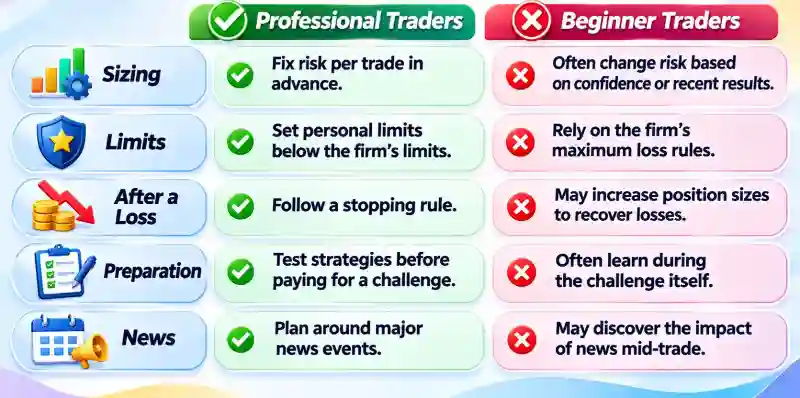
- Sizing: As part of how professional traders manage risk in prop firms, professionals fix risk per trade in advance, while beginners often change it based on confidence or recent results.
- Limits: Professionals set personal limits below the firm’s limits, while beginners rely on the firm’s maximum loss rules.
- After a Loss: Professionals follow a stopping rule, while beginners may increase position sizes to recover losses.
- Preparation: Professionals test their strategies before paying for a challenge, while beginners often learn during the challenge itself.
- News: Professionals plan around major news events, while beginners may discover their impact mid-trade.
Choosing Account Size and Pace Sensibly
A larger account is not always a better choice. A size that lets you trade comfortably, with risk that feels small, usually leads to calmer decisions than the biggest option available. Our guide on prop firm challenge capital explains how to think about this decision, and it also pairs well with a steady pace rather than a rush to the target.
Stops, Structure, and Execution Details
Professionals place stops using structure, not a fixed number of pips. They avoid sitting exactly at obvious highs and lows, where sweeps are common, and they size down when the stop is wider. Our guide on stop hunts in forex trading explains why obvious levels are exposed, and our beginner’s guide to market structure in forex trading shows how to identify logical invalidation points.
They also account for execution. Slippage, spreads, and fill quality all affect the real loss on a stopped trade, which is one more reason to keep a buffer. You can learn how fills work in our guide on how forex brokers execute your trades.
Patience as a Risk Tool
Every extra, low-quality trade adds risk without adding edge. Professionals often trade less than beginners expect, because they wait for setups that match their rules. Practicing that patience is a skill in itself, and our guide on mastering patience for the perfect trade setup offers practical ways to build it.
Common Risk Mistakes Even Experienced Traders Make
- Increasing size after a winning streak: Early success can lead to oversized trades that undo the gains.
- Moving a stop-loss further away: This turns a planned loss into a larger one and often leads to a breach.
- Ignoring correlated positions: Several trades on related pairs can behave like one large trade.
- Skipping the review habit: Without notes, the same errors repeat.
- Treating the firm’s limit as a target: The limit is a hard boundary, not a budget to spend.
Final Thoughts
How professional traders manage risk in prop firms comes down to small fixed risk, a personal buffer inside the firm’s limits, clear knowledge of the rules, tested strategies, planning around news, and a written routine with a stopping rule. These habits are simple, but they work because they remove emotional decisions at the moments when mistakes are most likely. Trading always involves the possibility of loss, and firm rules can change, so read the current terms carefully and only risk money you can afford to lose.
FAQs
How much should I risk per trade in a prop firm?
There is no single correct number, but many traders risk well under 1% of the account per trade. The right level depends on your strategy, its typical losing streaks, and the firm’s daily and total limits.
What is a personal daily limit and why use one?
It is a loss limit you set for yourself that is smaller than the firm’s limit. It gives you a buffer against slippage and emotional decisions, and it keeps the firm’s limit as a last line of defense.
Does good risk management guarantee I will pass a challenge?
No. It lowers the chance of avoidable failure, but market conditions, execution, and the specific rules of the firm still affect the outcome.
Should I trade during high-impact news in a prop firm?
Many professionals avoid it or reduce size, because spreads widen and price can move sharply. Check your firm’s rules first, since some restrict trading around news.

