


Prop firm account failures rarely come from a single dramatic event. In most cases, they come from a small set of repeated mistakes: oversized risk, rule breaches, emotional decisions, and a strategy that was never properly tested. The good news is that these mistakes are predictable, which means they can be planned for. This guide covers seven of the most common causes of failed evaluations and funded accounts, explains why each one happens, and shows practical ways to reduce the chance of repeating it.
Why Prop Firm Account Failures Happen So Often
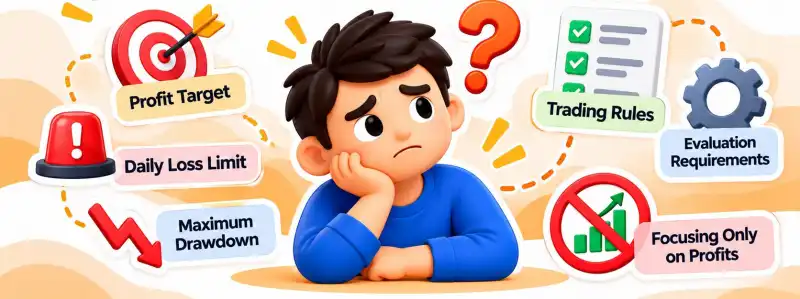
A prop firm evaluation is a rules-based test, not just a challenge to reach a profit target. Traders must stay within the daily loss limit and maximum drawdown while working toward the required target. This combination can make Prop Firm Account Failures more likely when traders focus only on making profits and overlook how much they can afford to lose. Many traders who fail may have a workable strategy, but their risk management is not strong enough to withstand a normal losing streak.
Prop firms also differ in their trading rules, drawdown calculations, and evaluation requirements. Reading the exact conditions of your challenge before placing the first trade is essential. No approach can eliminate the risk of failure, and no strategy guarantees a pass. The goal is to reduce avoidable mistakes through disciplined risk management, realistic profit expectations, and a clear understanding of the firm’s rules.
7 Costly Mistakes That Cause Prop Firm Account Failures
1. Risking Too Much Per Trade
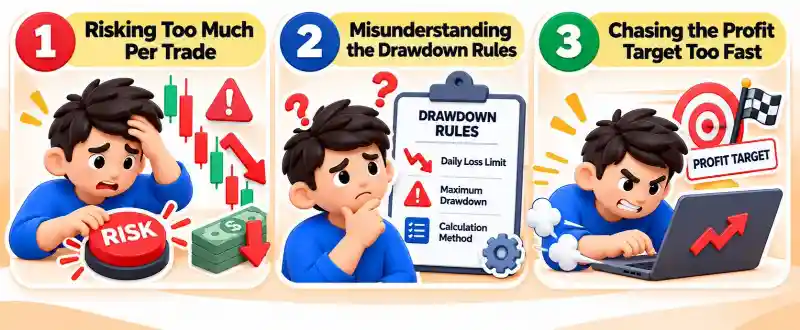
This is the most common cause of failure. A trader who risks 3% or 5% per trade can hit a daily loss limit in just two or three losing trades. Even a good strategy loses several times in a row, so the position size must be small enough to survive that. Many traders keep risk well below the daily limit so one bad day does not end the attempt. Our guide on risk management tips for prop firm traders explains how to set a sensible risk per trade.
2. Misunderstanding the Drawdown Rules
Some firms calculate drawdown from the starting balance, while others use trailing drawdown that follows your highest equity. This can contribute to Prop Firm Account Failures, as a trailing rule may leave less room for losses than traders expect after a profitable run. Daily loss limits may also include floating losses on open trades, not just closed positions. Carefully review the firm’s drawdown definitions and calculate your remaining risk buffer before each trading session to avoid unexpected rule violations.
3. Chasing the Profit Target Too Fast
When traders rush to reach a profit target within a few days, risk often increases and trade quality declines. Pressure from deadlines or entry fees can push them into taking weak setups, increasing the chances of Prop Firm Account Failures. A steadier approach, built around a clear trading plan and disciplined risk management, helps traders avoid unnecessary losses. If time limits are a concern, check the challenge terms beforehand, as some prop firms offer evaluations without a fixed time limit.

4. Trading Without a Tested Strategy
Using an untested idea in a paid evaluation is an expensive way to learn that it does not work. Before paying for a challenge, test your rules on historical data and then on a demo account. Include realistic costs in the test, and run enough trades to be meaningful. Our guide on how to backtest a forex strategy properly walks through this process step by step.
5. Revenge Trading After a Loss
After a losing trade, many traders feel the urge to recover their losses immediately. They increase position sizes, abandon their entry rules, or take trades they would normally avoid. This behaviour can quickly lead to Prop Firm Account Failures, especially when strict daily loss limits are in place. A simple way to control this impulse is to set a firm stopping rule, such as ending the trading session after two consecutive losses. This removes the pressure to make another decision when emotions are running high.
6. Trading Through High-Impact News Without a Plan
Spreads widen, liquidity thins, and price can spike in both directions around major releases. A stop-loss that looks safe can be passed through quickly, and the fill can be worse than expected. Some firms also restrict trading near news, so check the rules. To understand why movement can start early and reverse, read our guide on why price moves before news is released.
7. Placing Stops in Obvious Places
Stops sitting just beyond a clear high, low, or round number are easy targets for a quick sweep. When the account has a tight daily limit, one such stop-out can do real damage. Placing stops where the idea is truly invalid, and reducing size to match the wider distance, usually works better than using a tight stop. We explain this behavior in our guide on stop hunts in forex trading.
A Real Example: How Small Mistakes Combine
Imagine a trader attempting a $50,000 challenge with a 5% daily loss limit, equal to $2,500. The trader risks $1,000 per trade because the profit target feels difficult to reach. After the first loss, the trader takes another trade without a clear setup and loses again. A third rushed trade before a major news release suffers slippage on exit, pushing the account beyond its daily loss limit and causing failure.
This example shows how Prop Firm Account Failures can result from several small mistakes combined. If the trader had risked 0.5% per trade ($250) and stopped after two consecutive losses, the same two losing trades would have cost $500, leaving more room within the daily limit. Disciplined position sizing and a clear stopping rule can help prevent avoidable losses, although they cannot guarantee passing the challenge.
A Simple Pre-Trade Checklist
- Know your exact limits: Write down the daily loss limit and maximum drawdown in dollars, not just percentages.
- Calculate your risk per trade: Keep it small enough that several losses in a row do not threaten the account.
- Check the economic calendar: Know when high-impact news is due and whether the firm restricts trading around it.
- Confirm the setup matches your plan: If it does not fit your written rules, skip it.
- Set a daily stopping rule: Decide in advance how many losses end your day.
Choosing the Right Account Size and Pace
Account size changes how comfortable your risk feels. A larger account means each dollar of risk is a smaller percentage, but it also raises the target and the stakes. Choosing a size that lets you trade calmly, rather than the largest option available, often leads to better decisions. Our guide on prop firm challenge capital explains how to think about this choice.
Build Patience Into Your Process
Many failures happen because a trader acts on a weak setup out of boredom or pressure. Waiting for the exact conditions in your plan is a skill that can be practiced. Our guide on mastering patience for the perfect trade setup covers habits that help, such as limiting daily trades and reviewing each entry against a checklist.
Reading structure correctly also reduces low-quality entries. If you are still building that foundation, start with our beginner’s guide to market structure in forex trading.
Keep a Review Habit After Every Attempt
Whether you pass or fail, record what happened. Note which rule was broken, what you felt before the decision, and what you would change. Patterns appear quickly. If the same mistake shows up in several attempts, the issue is a habit, not bad luck, and a written fix is more useful than simply buying another challenge.
Final Thoughts
Prop firm account failures are usually the result of avoidable habits: oversized risk, unclear rules, rushing, untested strategies, emotional reactions, careless news trading, and poorly placed stops. Fixing them does not require a perfect strategy. It requires a written plan, small and consistent risk, and the discipline to follow it when a session gets uncomfortable. Trading always carries the possibility of loss, and a firm’s terms can change, so treat every challenge as a risk you can afford and read the current rules before you begin.
FAQs
What is the most common reason traders fail a prop firm challenge?
Breaching the daily loss limit or maximum drawdown through oversized or emotional trading is among the most common reasons. Position sizing that does not allow for a normal losing streak is usually behind it.
Is a trailing drawdown harder than a fixed drawdown?
It can be, because the limit rises as your equity rises, which shrinks the room for pullbacks after profitable stretches. Check how your firm calculates it before choosing a challenge.
Should I rush to hit the target quickly?
Generally no. Rushing tends to increase risk and lower trade quality. Check whether your challenge has a time limit, and aim for a steady pace that fits your plan rather than a fast one.
Can good risk management guarantee I pass?
No. It lowers the chance of avoidable failure, but market conditions, execution, and rule details still matter, and no method guarantees a pass.

