

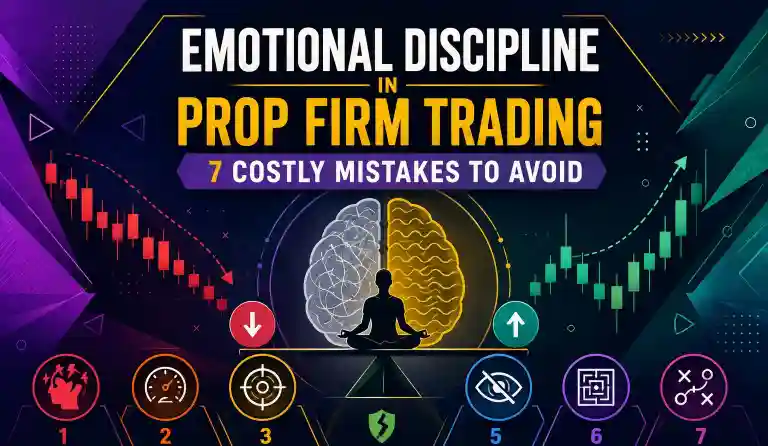
Emotional discipline in prop firm trading is arguably a bigger predictor of success than strategy quality. Prop firm evaluations are built around strict drawdown limits and defined rules, which means a single emotionally-driven decision can undo weeks of otherwise solid, rules-based trading. This guide explains exactly why emotional discipline matters so much in this specific context, and the seven costly mistakes that tend to follow when it slips.
What Emotional Discipline Actually Means in Prop Firm Trading
Emotional discipline isn’t about eliminating emotion entirely — that’s not realistic for any trader. It’s about recognizing an emotional impulse, whether it’s excitement, fear, or frustration, and still following your pre-defined plan instead of reacting in the moment. In Emotional Discipline in Prop Firm Trading, this means sticking to fixed risk percentages, entry criteria, and daily stopping points regardless of how the trading session is unfolding emotionally.
Why Emotional Discipline Matters More During an Evaluation
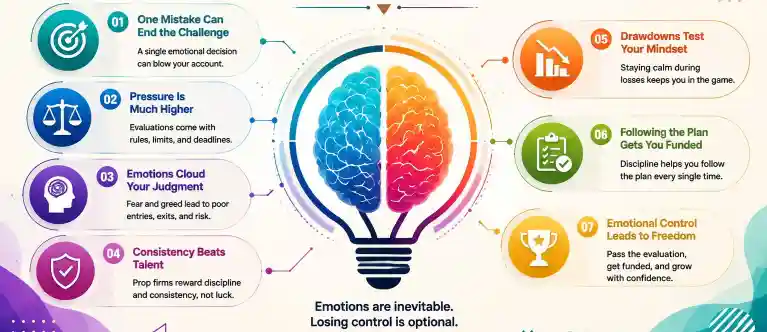
Standard live trading allows some room to recover from an emotional mistake over time. Prop firm evaluations don’t offer that same flexibility — a single rule breach caused by an emotional decision can end the entire attempt immediately, regardless of how strong the trader’s overall strategy is. This is the core reason emotional discipline in prop firm trading carries more weight than it might in an ordinary personal account: the cost of a single lapse is disproportionately high relative to a standard trading environment.
7 Costly Mistakes That Come From Poor Emotional Discipline
- Breaching the daily drawdown limit while chasing a loss: An emotional attempt to recover quickly often pushes risk past the firm’s daily threshold.
- Abandoning entry criteria after a string of wins: Overconfidence from recent success leads to trades that don’t match the tested strategy.
- Freezing during a valid setup out of fear after a previous loss: Hesitation caused by a recent bad trade can cause a trader to miss genuinely good setups entirely.
- Closing a winning trade too early out of anxiety: Fear of giving back an unrealized gain often cuts winners short before the plan’s actual target is reached.
- Holding a losing trade past the stop-loss, hoping for a reversal: This single decision has ended more evaluations than almost any strategic error.
- Increasing position size to “make up time” near a deadline: Evaluation time pressure often pushes traders into oversized risk that wouldn’t otherwise be taken.
- Ignoring a personal stopping rule because “just one more trade” feels justified: This is frequently how a controlled, disciplined day turns into a rule-breaching one.
A Real Example: How Emotional Discipline Decides an Evaluation
Consider two traders using the same strategy and account size, with both reaching their profit target three days before the end of a two-step evaluation. Emotional Discipline in Prop Firm Trading can make a major difference at this stage. Trader A reduces risk and focuses only on high-confidence setups, while Trader B continues trading at full size to build a larger buffer. On the second day, Trader B takes an oversized loss that breaches the daily drawdown limit and fails the evaluation.
The example shows why reaching a profit target does not mean risk should increase. Protecting progress and maintaining discipline can be just as important as reaching the target in the first place.
Both traders had identical technical skill and an identical strategy. The only difference was emotional discipline in prop firm trading under a specific kind of pressure — the pull to keep pushing after early success, discussed in more detail in our guide on why traders overtrade after a winning streak. This kind of outcome repeats constantly across funded trading, and it’s rarely the strategy that fails first.
How Emotional Discipline Compares to Written Risk Rules
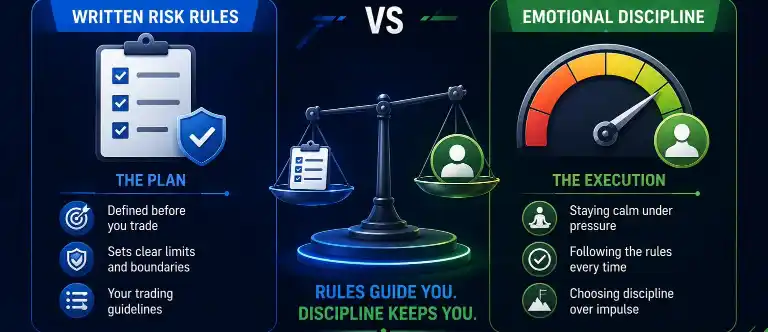
Written risk rules and Emotional Discipline in Prop Firm Trading work together, but they are not the same thing. A trader can have a perfectly well-designed risk management plan — fixed percentage per trade, clear stop-losses, defined daily limits — and still fail to follow it under pressure. Emotional Discipline in Prop Firm Trading is specifically the ability to execute those written rules consistently, even in the exact moments when following them feels counterintuitive, such as stopping trading during an unusually strong session or accepting a full stop-loss on a trade that “feels” like it is about to turn around.
This is why simply having a good plan on paper is not enough on its own. The plan defines what discipline should look like in practice, but the discipline itself determines whether that plan gets followed when it matters most — typically during the exact moments of a trading session when emotions are running highest and following the rules feels hardest. A trader may know exactly what the correct decision should be, but applying that decision consistently under pressure is what separates a written risk plan from genuine trading discipline.
How Emotional Discipline Differs From Just “Not Losing”
It’s a common misconception that Emotional Discipline in Prop Firm Trading means simply avoiding losing trades. In reality, disciplined traders experience losses regularly—the difference is that their losses remain within planned, predefined limits instead of turning into larger, emotionally driven losses. A trader with strong emotional discipline can accept a full stop-loss calmly and move on to the next planned opportunity, while a trader who lacks emotional control may turn the same loss into two or three additional impulsive trades in an attempt to recover it immediately.
In prop firm trading, this ability to accept losses without changing the original risk plan is especially important. A single losing trade does not necessarily threaten an evaluation, but the emotional decisions that follow it can quickly create a much larger drawdown.
This distinction connects directly to patterns covered in our guide on why traders overtrade after a winning streak and our guide to FOMO in forex trading — both are specific manifestations of the same underlying emotional discipline gap, just triggered by different situations.
Building Emotional Discipline as a Trainable Skill
Emotional discipline isn’t a fixed personality trait — it can be deliberately trained, the same way a technical skill is. Traders who journal consistently, review their emotional state alongside their trade outcomes, and practice specific pre-decided responses to common triggers (a loss, a win streak, approaching a deadline) tend to build this skill measurably faster than those relying on willpower alone in the moment. Our guide to trading journal metrics covers practical ways to track this alongside your standard performance data.
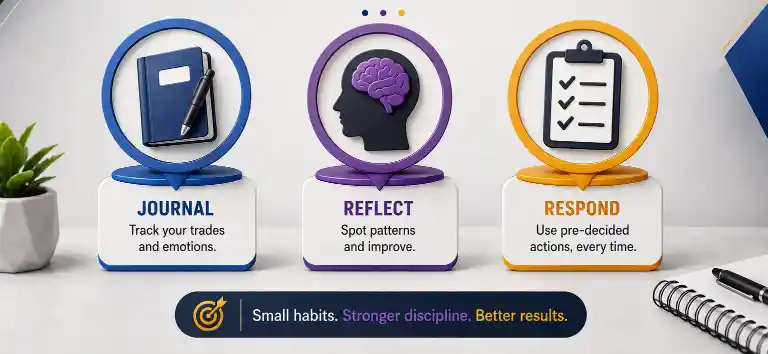
A Prop Firm Trader’s Daily Pre-Trading Routine for Building Discipline — a structured pre-session routine is one of the most effective ways to reduce emotional decision-making before it starts, rather than trying to manage it reactively once a session is already underway.
Tools That Support Emotional Discipline
- Written trading plans that remove ambiguity about what qualifies as a valid setup, reducing room for in-the-moment rationalization.
- Daily loss limit alerts that trigger automatically rather than relying on manual tracking during a stressful session.
- Pre-session checklists that confirm a trader is in the right mental state — rested, calm, not trading to “catch up” — before the first trade of the day.
- Post-session reviews that specifically log emotional state alongside trade outcomes, making patterns visible over time rather than staying anecdotal.
Consistent with the discipline principles covered in our complete guide to prop firm rules, treating these tools as non-negotiable parts of the process — not optional extras — is usually what separates traders who pass repeatedly from those who pass once and then struggle to stay funded.
Final Thoughts
Strategy quality matters in prop firm trading, but emotional discipline in prop firm trading is often the deciding factor between a passed evaluation and a failed one built on an otherwise sound approach. The seven mistakes covered here rarely stem from a lack of technical knowledge — they stem from a gap between what a trader knows they should do and what they actually do under pressure. Closing that gap, through structured routines, consistent journaling, and pre-decided responses to common emotional triggers, is one of the highest-value skills a funded trader can build, and it tends to compound in value the longer an account stays funded.
FAQs
Can emotional discipline really be trained, or is it just personality?
It can be trained. Structured routines, consistent journaling that tracks emotional state alongside outcomes, and pre-decided responses to common triggers measurably build this skill over time, regardless of a trader’s natural temperament or how long they’ve been trading.
What’s the most common emotional discipline failure in prop firm evaluations?
Holding a losing trade past its stop-loss while hoping for a reversal is one of the most common and most costly emotional discipline failures, frequently ending evaluations outright in a single decision.
Does emotional discipline matter less once an account is funded?
No — it typically matters just as much, if not more, since a rule breach on a funded account usually means losing it entirely rather than paying a reset fee, raising the real cost of any single emotional lapse.

