

Many traders have seen price move sharply in one direction before a major economic release, only for the actual announcement to trigger a reversal or a pause. Understanding Why Price Moves Before News Is Released is important because pre-news price action does not necessarily predict the upcoming result. These movements can reflect trader positioning, changing liquidity, risk management, and expectations ahead of scheduled events. This guide explores the main reasons behind pre-news price movements and the common mistakes traders make when treating them as a reliable signal.
What Pre-News Price Movement Actually Looks Like
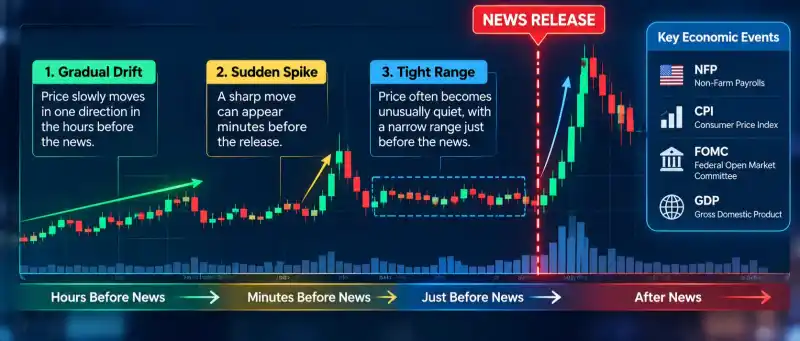
Pre-news price movement usually appears in three main forms, and each can reflect different market conditions.
1. Gradual Price Drift: Why Price Moves Before News Is Released can often be seen as a gradual price drift in one direction during the hours before a major release. This may occur as traders adjust their positions based on market expectations, economic forecasts, or recently released data. However, such a move does not necessarily mean the market already knows what the upcoming release will show.
2. Sudden Pre-News Spike: Sometimes price makes a sharp move just minutes before the announcement. This can be caused by changes in liquidity, large orders, position adjustments, or traders reacting to updated expectations. These spikes can be especially risky because they may quickly reverse once the actual data is released.
3. Tight Range Before the Release: In other cases, Why Price Moves Before News Is Released becomes less obvious because price may stay unusually quiet within a narrow range before the announcement. Traders may reduce exposure and wait for greater clarity, while lower liquidity can limit price movement. Once the news arrives, that range can break sharply as the market reacts to the new information.
These patterns should not automatically be interpreted as signals about the upcoming result. Pre-news price action can reflect positioning, expectations, and liquidity rather than a reliable prediction of the actual economic data.
6 Surprising Reasons Why Price Moves Before News Is Released
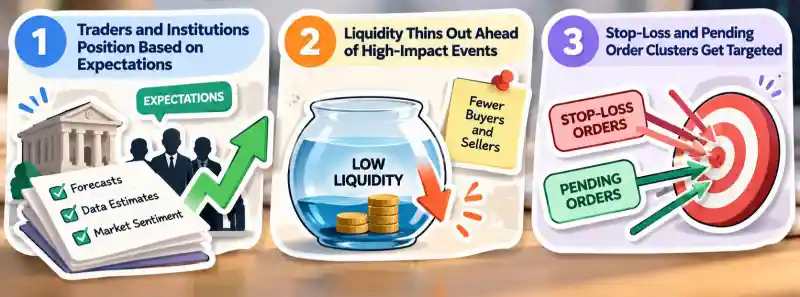
1. Traders and Institutions Position Based on Expectations
Economic releases come with market forecasts, and traders often position themselves around these expectations well before the actual announcement. If the consensus expects a strong employment figure, buying pressure on the related currency may build ahead of the release. This is one reason Why Price Moves Before News Is Released can be difficult to interpret—the market is often reacting to what it expects, not what it already knows.
2. Liquidity Thins Out Ahead of High-Impact Events
Many market makers and larger participants reduce their exposure or widen their spreads before major announcements to protect themselves from sudden volatility. With fewer orders resting in the market, even moderately sized orders can push price further than usual. This is why a small flow can look like a meaningful move. For a deeper look at how resting orders drive these moves, see our guide on the role of liquidity in forex price movement.
3. Stop-Loss and Pending Order Clusters Get Targeted
Thin liquidity makes it easier for price to sweep obvious highs and lows where stop-losses and pending orders are placed. This is another reason Why Price Moves Before News Is Released can be misleading. A sharp spike just before the announcement may be a liquidity grab rather than a genuine directional signal, which is why the move can often reverse once the actual data arrives.

4. Risk Reduction Closes Positions Early
Some traders and funds choose to close or reduce positions before high-impact events rather than hold through the volatility. This position squaring can cause price movement unrelated to the news itself, simply because many participants are exiting at the same time.
5. Related Markets and Earlier Releases Influence Sentiment
Data from other regions, earlier-session economic reports, central bank commentary, or moves in bond yields and equities can shift sentiment ahead of a scheduled release. Price may be responding to those related signals rather than anticipating the upcoming number itself.
6. Information Asymmetry Is a Real Consideration
Researchers and regulators have long studied whether some market participants act on information before it is broadly public. Evidence on how often this happens in currency markets is mixed, and it is not something retail traders can identify or rely on in real time. It is better treated as a reason for caution than as a trading edge.
A Real Example: Reading a Pre-News Move Wrongly
Imagine EUR/USD climbing steadily for ninety minutes before a US inflation report. A trader sees the rise and assumes the market already knows the number will be weak, so buys at the top just before the release. The report comes in close to expectations, volatility spikes briefly in both directions, and price drops back through the entire pre-news rally. The earlier rise reflected positioning and thin liquidity, not insight into the result. The trader was reading noise as information, a mistake that often happens when someone doesn’t understand how forex brokers execute your trades during fast, thin conditions, when fills can be much worse than expected.
How to Handle Pre-News Price Action More Carefully
- Treat pre-news moves as unreliable: A drift or spike before an announcement is not confirmation of the outcome, and it often reverses.
- Wait for the reaction, not the anticipation: Many experienced traders let the first volatile minutes pass and look for structure to form afterward. Our guide to market structure in forex trading covers how to read that structure once price settles.
- Expect wider spreads and slippage: Costs rise around events, which affects both entries and stop placement.
- Reduce size or stand aside: If you trade through news at all, smaller position sizes limit the damage from unpredictable swings.
- Look for sweeps near obvious levels: A quick push through a clear high or low followed by a reversal may be a liquidity grab, similar to patterns described in our guide to order blocks in forex trading.
Common Mistakes Traders Make Around News Events
- Chasing the pre-news move: Entering late in a drift usually means buying or selling into exhaustion rather than confirmation.
- Placing tight stops right before a release: Thin liquidity and sudden spikes make tight stops easy to hit before the real move even begins.
- Ignoring imbalances left behind: Fast news-driven moves often leave price gaps that price later revisits, a concept explained in our guide on the fair value gap in forex.
- Skipping risk rules around events: Volatility around news is one of the quickest ways to breach a daily loss limit, which is why the principles in our risk management tips for prop firm traders matter especially on high-impact days.
Final Thoughts
Understanding why price moves before news is released helps you avoid one of the most common traps in forex: treating pre-announcement movement as a hint about what is coming. In most cases, those moves come from positioning, thinning liquidity, risk reduction, and stop hunting rather than reliable foresight. Traders who respect that uncertainty, protect their risk, and wait for clear structure after the release tend to avoid the most expensive mistakes around news events. No approach removes the risk of loss, so position sizing and discipline remain more important than any prediction.
FAQs
Does price moving before news mean the result is already known?
No. Most pre-news movement reflects expectations, positioning, and thin liquidity rather than knowledge of the actual figure, and it frequently reverses after the release.
Is it safe to trade right before a high-impact release?
It carries elevated risk because of wider spreads, slippage, and sudden volatility. Many traders avoid opening new positions in the minutes before a major announcement, and anyone who does should use smaller size and clear risk limits.
Why does price often reverse right after the news comes out?
Pre-news positioning and liquidity sweeps can be unwound once the actual data removes uncertainty. Price may also react briefly in one direction before the broader market digests the number and settles into a different direction.

