


Most retail traders misunderstand market structure not because the concept is complicated, but because it’s usually taught as a simplified checklist rather than a genuine framework for reading institutional intent. Terms like “higher highs and higher lows” get repeated so often that traders start applying them mechanically, without understanding why structure actually shifts in the first place. That gap between memorizing the definition and understanding the mechanics is exactly where most costly mistakes begin.
What Market Structure Is Actually Meant to Show
Retail Traders Misunderstand Market Structure because market structure, at its core, is a map of who is currently in control of price—buyers or sellers—and where that control is likely to change hands. It is not simply a sequence of swing highs and lows; it can also provide clues about order flow, liquidity, momentum, and potential market reversals. When retail traders treat structure as nothing more than pattern spotting, they often miss the reasoning behind price movements and make decisions without considering the broader market context.
5 Costly Ways Retail Traders Misunderstand Market Structure
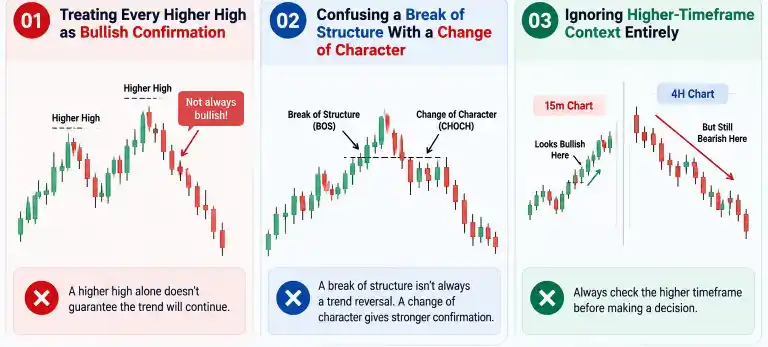
1. Treating Every Higher High as Bullish Confirmation
Many retail traders assume that as long as price is printing higher highs, the trend is automatically healthy. In reality, a higher high formed on weak momentum, low volume, or directly into a major liquidity pool can often be the exact point where smart money begins distributing into retail buying pressure — the opposite of what the pattern appears to suggest on the surface.
2. Confusing a Break of Structure With a Change of Character
A Break of Structure (BOS) occurs when price breaks a recent high or low, while a Change of Character (CHoCH) suggests a more meaningful shift in the prevailing trend. Treating every minor break as a trend reversal can lead to premature entries against the dominant market direction.
3. Ignoring Higher-Timeframe Context Entirely
A clean bullish structure on a 5-minute chart can mean little if the 4-hour or daily chart shows a clear bearish trend. This is where Retail Traders Misunderstand Market Structure by focusing on the timeframe that supports the trade they already want to take. A better approach is to use higher timeframes to establish the broader market bias, then use lower timeframes to look for suitable entries.
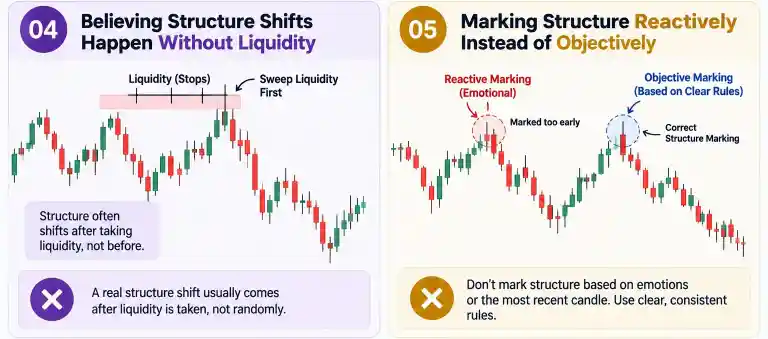
4. Believing Structure Shifts Happen Without Liquidity
Real structure shifts are rarely random — they typically follow a liquidity sweep, where price briefly pushes beyond an obvious high or low to trigger stop-losses before reversing. Traders who study structure in isolation, without factoring in liquidity, often mistake these sweeps for genuine breakdowns and get caught on the wrong side.
5. Marking Structure Reactively Instead of Objectively
It’s common for Retail Traders Misunderstand Market Structure to show up when traders redraw their structure lines after the price has already moved, adjusting them to fit the final direction. This hindsight bias can create a false sense of accuracy because the trader never tests whether their original structure analysis would have worked in real time, before the outcome was known.
A Real Example: Two Traders, Same Chart, Different Conclusions
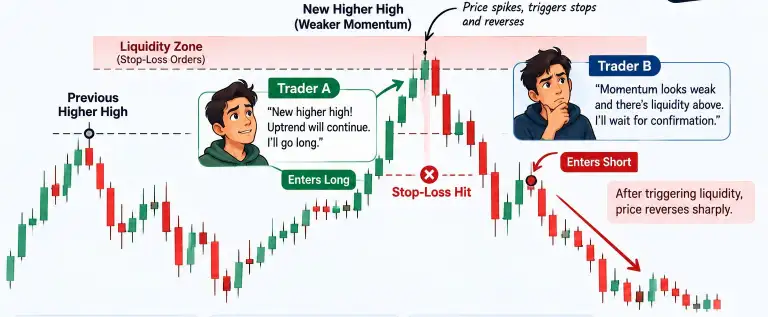
This example shows why Retail Traders Misunderstand Market Structure when they focus only on higher highs and lower lows. Imagine a currency pair making a new higher high, but with noticeably weaker momentum than the previous swing, near a level where stop-loss orders are likely clustered. Trader A sees the higher high and assumes the uptrend will continue, entering long near the top. Trader B notices the weakening momentum and potential liquidity above the level, so waits for confirmation.
Price briefly pushes above the level, triggers nearby stops, and then reverses sharply. Trader A’s stop-loss is hit, while Trader B waits for the reversal and enters short after confirmation. This highlights why market structure should be analyzed alongside momentum, liquidity, and price behavior, rather than relying on a single higher high or lower low.
How to Read Market Structure More Accurately
- Bilkul. Main tino internal links ke natural, SEO-friendly anchor names bana deta hoon, jise aap khud link kar sakti hain:
- Always check the higher timeframe first: Let the daily or 4-hour structure set the overall bias before analyzing lower timeframes.
- Watch momentum, not just price levels: A new high or low formed with weakening momentum is a warning sign, not automatic confirmation.
- Factor in liquidity before assuming a breakout is real: Ask whether the move is sweeping an obvious pool of stop-losses before treating it as genuine continuation. For more context, see The Role of Liquidity in Forex Price Movement.
- Mark structure in real time, not in hindsight: Practice labeling structure on the right edge of the chart, without the benefit of already knowing what happens next. You can also learn the basics in Market Structure in Forex Trading for Beginners.
- Understand where price may react: Combining structure with key order-flow zones can provide additional context. See What Is an Order Block in Forex Trading? for a deeper explanation.
Why This Misunderstanding Costs Real Money
Misreading market structure doesn’t just lead to the occasional bad trade — it tends to produce a pattern of entries against smart money at exactly the moments retail positioning is heaviest. Combined with poor risk management, these misreads compound quickly. This is closely tied to the sizing mistakes covered in our risk management tips for prop firm traders, since a structure misread paired with oversized risk is one of the fastest ways to breach a drawdown limit.
Final Thoughts
Retail traders misunderstand market structure most often because they learn it as a static pattern instead of a dynamic reflection of who controls the market at any given moment. Momentum, liquidity, and higher-timeframe context all shape whether a structural signal is genuine or a trap — and traders who slow down enough to read those pieces together, rather than reacting to the first higher high or lower low they see, tend to avoid the costliest and most repeated mistakes in this area.
FAQs
What’s the difference between a break of structure and a change of character?
A break of structure is a minor continuation signal, while a change of character suggests a deeper, more significant shift in the overall trend — treating the two the same is one of the most common sources of confusion.
Why do higher highs sometimes fail immediately?
A higher high formed on weak momentum or directly into a liquidity pool can act as a trap for retail buyers rather than genuine continuation, especially when institutional participants are using that move to enter in the opposite direction.

