

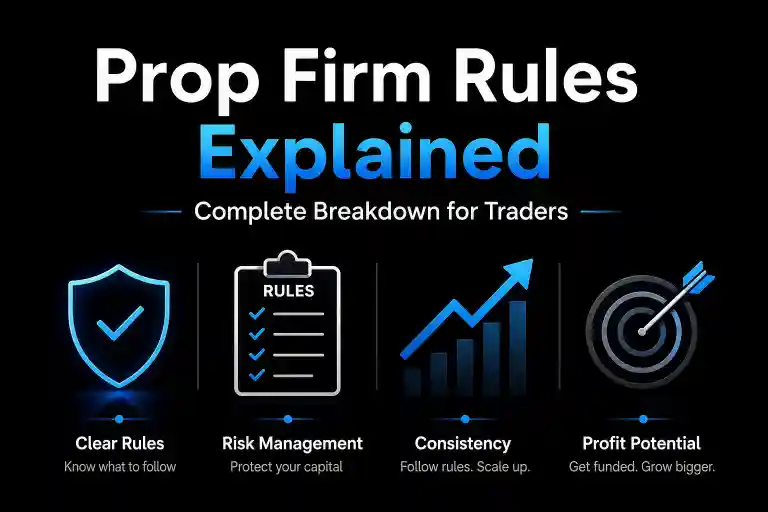
Prop Firm Rules Explained is one of the most important topics for traders who want to pass a funded trading challenge and maintain a funded account successfully. Many traders focus only on profits, but proprietary trading firms evaluate much more than just returns. They assess discipline, consistency, and risk management.
If you fail to follow even a single rule, your account can be disqualified instantly, regardless of how profitable your trades are. That is why understanding prop firm rules in detail is essential before starting any challenge.
What Are Prop Firm Rules
Prop Firm Rules Explained simply refers to the structured guidelines that traders must follow during both evaluation and funded stages. These rules define how traders manage risk, execute trades, and maintain consistency.
Prop firms are not just looking for profitable traders. They are looking for traders who can protect capital and follow a disciplined approach under real market conditions.
Key Prop Firm Rules Every Trader Must Know
1. Profit Target
One of the first elements in Prop Firm Rules Explained is the profit target. This is the percentage gain a trader must achieve to pass each phase of the evaluation.

- Phase 1: Usually between 8% to 10%
- Phase 2: Usually between 4% to 5%
Achieving the profit target alone is not enough. Traders must reach this goal while following all other rules without violation.
2. Daily Drawdown Limit
The daily drawdown limit is one of the most critical parts of Prop Firm Rules Explained. It restricts how much loss is allowed within a single trading day.
- Typically ranges between 4% to 5%
- Includes both open (floating) and closed losses
If this limit is exceeded, the account is automatically breached, and the challenge ends immediately.
3. Maximum Drawdown Limit
This rule defines the total allowable loss on the account. In Prop Firm Rules Explained, this is considered a long-term risk control measure.
- Usually between 8% to 10%
- Based on initial balance or equity
This rule ensures that traders do not take excessive risks over time and helps maintain account stability.
4. Minimum Trading Days
Another important concept in Prop Firm Rules Explained is the requirement for minimum trading days.
- Typically between 5 to 10 trading days
This rule prevents traders from passing challenges through a single lucky trade and encourages consistent performance.
5. Lot Size and Risk Consistency
Although not always strictly defined, consistency in position sizing is a key part of Prop Firm Rules Explained.
- Avoid sudden large lot sizes
- Maintain consistent risk per trade
- Follow a structured trading plan
Inconsistent trading behavior can indicate poor risk management and may lead to account review or failure.
6. News Trading Restrictions
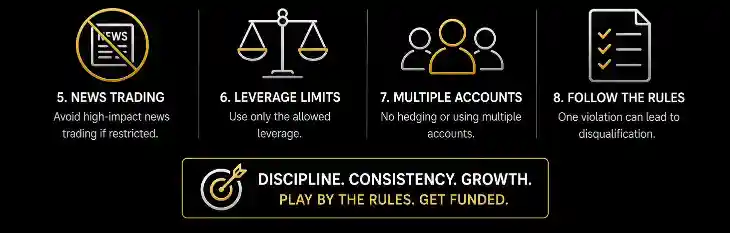
Some firms include rules related to trading during high-impact economic news events. In Prop Firm Rules Explained, this is an important area to review carefully.
- Avoid trading during major news releases
- Always check firm-specific policies
Violating this rule can result in disqualification, even if the trade is profitable.
7. Holding Trades Over the Weekend
Many prop firms restrict holding positions over weekends due to potential market gaps.
- Close all trades before Friday market close
- Avoid exposure to unpredictable price gaps
This rule is a standard part of Prop Firm Rules Explained and helps protect accounts from sudden volatility.
8. Use of Expert Advisors (EAs)
Automation rules vary between firms. As part of Prop Firm Rules Explained, traders should always verify whether automated systems are allowed.
- Some firms allow EAs
- Others restrict or limit their use
Using unauthorized tools can lead to immediate account termination.
Why These Rules Matter
Prop Firm Rules Explained are not designed to restrict traders but to ensure professional trading behavior. These rules help firms identify traders who can:
- Protect trading capital
- Maintain consistency over time
- Follow structured strategies
- Avoid emotional decision-making
From the firm’s perspective, consistency and risk control are more important than short-term profits.
Common Mistakes Traders Make
Even after understanding Prop Firm Rules Explained, many traders fail due to simple mistakes.
- Ignoring daily drawdown limits
- Overtrading to hit profit targets quickly
- Using excessive leverage without planning
- Breaking rules unintentionally due to lack of tracking
These mistakes often lead to account failure, even if the trader is technically skilled.
How to Stay Within Prop Firm Rules
Following Prop Firm Rules Explained requires discipline and planning. Here are some practical steps:
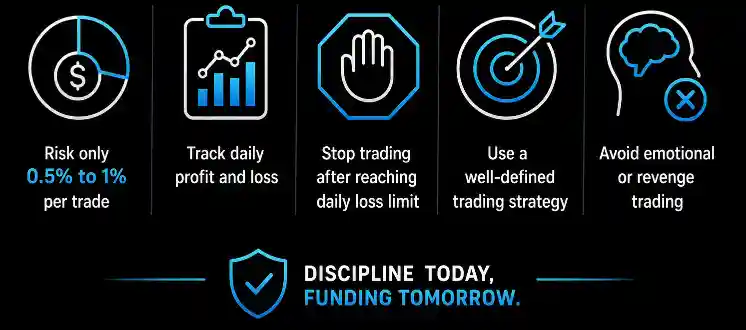
- Risk only 0.5% to 1% per trade
- Track daily profit and loss carefully
- Stop trading after reaching daily loss limit
- Use a well-defined trading strategy
- Avoid emotional or revenge trading
Consistency in execution is the key factor that determines long-term success in prop trading.
Final Thoughts
Prop Firm Rules Explained highlights that success in proprietary trading is not about aggressive profit-making but about controlled and disciplined trading. Traders who respect these rules have a significantly higher chance of passing evaluations and maintaining funded accounts.
By focusing on risk management, consistency, and structured execution, traders can align themselves with what prop firms truly value.
For a complete strategy on successfully passing evaluations, explore our guide on how to pass a prop firm challenge.

