

Revenge trading in forex is what happens when a loss stops feeling like a normal part of trading and starts feeling like something that needs to be immediately corrected. It’s rarely a calculated decision — it’s an emotional reaction disguised as one. This guide covers exactly why revenge trading happens, six dangerous signs that you’re in the middle of it, and practical ways to break the cycle before it does serious damage to an account.
What Is Revenge Trading in Forex?
Revenge trading in forex is the pattern of entering a new trade — often quickly, often oversized — with the specific goal of recovering a recent loss, rather than because a genuine setup has formed. The defining feature isn’t the trade itself; it’s the motivation behind it. A trader chasing a real setup and a trader revenge trading can place an identical position, but one is following a process and the other is reacting to pain.
Why Revenge Trading Happens
Revenge Trading in Forex often begins with a genuine emotional response to a loss. Frustration, disappointment, and a sense of unfairness—especially after a trade that felt like it should have worked—can create a strong urge to recover the loss immediately. The problem is that the action which provides temporary emotional relief, opening another trade without a clear setup, is often the opposite of the disciplined decision-making needed for long-term trading success.
6 Dangerous Signs of Revenge Trading in Forex
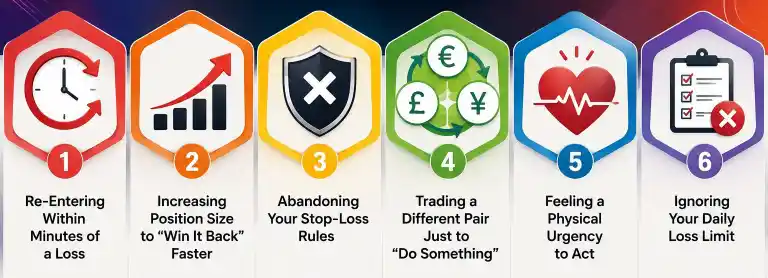
1. Re-Entering Within Minutes of a Loss
Jumping straight back into the market without any real analysis in between is one of the clearest indicators that the next trade is emotionally, not strategically, motivated.
2. Increasing Position Size to “Win It Back Faster”
Sizing up specifically to recover a previous loss in one trade ties position sizing directly to an emotional goal rather than your normal risk formula.
3. Abandoning Your Stop-Loss Rules
Widening or removing a stop-loss because “it just needs a little more room to work” is a common mistake among traders. In many cases, this behavior is a sign of Revenge Trading in Forex, as it reflects an unwillingness to accept a planned loss rather than a decision based on technical analysis or a structured trading plan.
4. Trading a Different Pair Just to “Do Something”
Switching to an unfamiliar or untested currency pair immediately after a loss, purely to feel active again, skips the analysis that would normally justify a trade on that pair.
5. Feeling a Physical Urgency to Act
A racing, restless feeling that a trade needs to happen right now — rather than a calm read of the chart — is a strong behavioral signal that emotion is driving the decision.
6. Ignoring Your Daily Loss Limit
Continuing to trade past a pre-set daily loss limit specifically because the day “isn’t over yet” is one of the most damaging signs, since it removes the one safeguard designed to stop this exact pattern.
Revenge Trading vs. a Justified Re-Entry
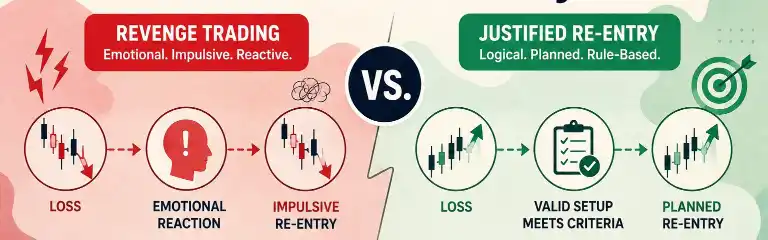
Not every trade taken shortly after a loss is driven by emotion. If your strategy genuinely produces a second valid setup a few minutes after the first trade closes, and that setup meets your normal entry criteria at your usual position size, it is simply the next trade in your process. Revenge Trading in Forex occurs only when a new position is opened as an emotional response to a previous loss rather than because it satisfies your trading plan.
A useful test is to ask whether you would have taken the same trade, with the same position size, if the previous trade had been a winner instead of a loser. If the honest answer is no—if the urgency or increased risk is specifically a reaction to the loss—then the decision is likely driven by emotion rather than your strategy.
Why Prop Firm Traders Are Especially Vulnerable
Revenge trading in forex carries extra danger for traders working through a funded evaluation, where a single oversized trade can breach a daily drawdown limit and end the challenge entirely — not just produce a bigger loss. The pressure of a challenge deadline can actually increase the pull toward revenge trading, since a loss doesn’t just feel like lost money, it feels like lost time and a lost opportunity to pass. Ironically, this is exactly the situation where the strict, non-negotiable risk rules covered in prop firm evaluations matter most, since they remove the room for an emotional decision to escalate into a disqualifying one.
How Revenge Trading Compounds a Single Loss
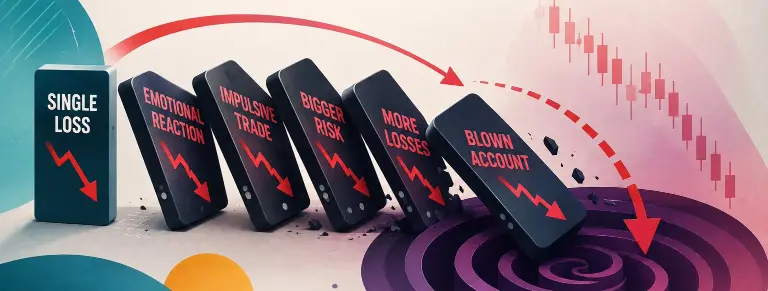
The real danger of revenge trading in forex isn’t the emotional discomfort — it’s the compounding effect on an account. A single well-managed loss, taken within a normal risk framework, is a routine part of any strategy. A revenge trade taken at 2-3x normal size, without a proper stop-loss, can turn that same routine loss into a serious drawdown in a matter of minutes. This pattern shares clear overlap with why traders overtrade after a winning streak — both are driven by a shift in risk perception, just triggered by opposite events.
How to Stop the Revenge Trading Cycle
- Set a hard rule: no new trade within a fixed cooling-off period after a loss — even 15-30 minutes away from the charts breaks the immediate emotional momentum.
- Treat your daily loss limit as non-negotiable, decided before the session starts, not adjusted based on how the day is going. Our guide to prop firm rules covers how strict daily drawdown limits are enforced in funded evaluations — the same discipline applies to any account.
- Journal the loss before taking another trade, specifically noting whether it was a normal, expected loss within your strategy or an actual mistake. Our guide to trading journal metrics covers what’s worth tracking here.
- Physically step away from the screen after a loss that triggers a strong emotional reaction — even a short walk interrupts the urgency that drives revenge trades.
- Recognize the specific warning signs from this list in real time — simply noticing “this is sign #1” can be enough to create a pause before acting.
Building this kind of discipline is closely tied to managing FOMO in forex trading as well, since both patterns come from letting an emotional trigger — fear of missing out, or the urge to recover a loss — override a tested process.
Real-World Example: How Revenge Trading Escalates
A trader loses a well-managed 1% trade that simply doesn’t work out. Frustrated, they immediately re-enter a similar setup at 2% risk, believing a larger position will recover the loss more quickly. This is how Revenge Trading in Forex often begins. When the second trade also ends in a loss, the trader is now down 3% instead of the original 1%, making the urge to recover even stronger.
A third oversized trade soon follows, turning what began as a routine losing trade into a significant drawdown in less than an hour. The problem isn’t that market conditions changed—it’s that the trader abandoned a disciplined trading process in response to the earlier loss.
Final Thoughts
Revenge trading in forex is one of the most predictable — and most preventable — ways a single manageable loss turns into a serious problem. The six signs covered here rarely appear in isolation; recognizing even one of them in the moment is often enough to interrupt the pattern before it compounds. A fixed cooling-off period and a hard daily loss limit are simple rules, but they’re specifically designed to work even when emotional discipline is at its weakest — which is exactly when they’re needed most, and exactly when most traders are least inclined to follow them without a pre-decided rule forcing the pause.
FAQs
Is revenge trading the same as overtrading?
They overlap, but revenge trading is specifically triggered by a loss and the urge to recover it, while overtrading can stem from other triggers too, including overconfidence after wins. Identifying which trigger applies to a specific bad trade helps target the actual cause rather than applying a generic fix.
How long should a cooling-off period be after a loss?
Even 15-30 minutes away from the charts is often enough to reduce the immediate emotional urgency, though some traders prefer to stop trading entirely for the rest of the session after a loss that triggers a strong reaction. The right length tends to depend on how intensely the individual trader reacts to losses.
Can a daily loss limit actually prevent revenge trading?
Yes, if it’s treated as strictly non-negotiable. A daily loss limit only works as a safeguard if it’s respected exactly when the emotional pull to keep trading is strongest, not adjusted in the moment to allow “just one more” attempt to recover.

