


A solid pre-trading routine for prop firm traders does more than prepare the charts — it prepares the trader. Most emotional discipline failures don’t start mid-session; they start with a trader who sits down unprepared, unclear on their limits, and reactive from the first trade onward. This guide walks through seven specific pre-trading habits that build discipline before the market even opens, based on how consistently funded traders actually structure their sessions.
Why a Pre-Trading Routine Matters for Prop Firm Traders
Prop firm evaluations leave very little room for recovery after a rule breach, which makes prevention far more valuable than correction. A structured pre-trading routine for prop firm traders shifts discipline from something you have to actively maintain under pressure mid-session to something that’s already decided before the first trade is placed. This single shift removes a significant amount of the in-the-moment decision-making where emotional mistakes tend to happen.
7 Steps for a Disciplined Pre-Trading Routine
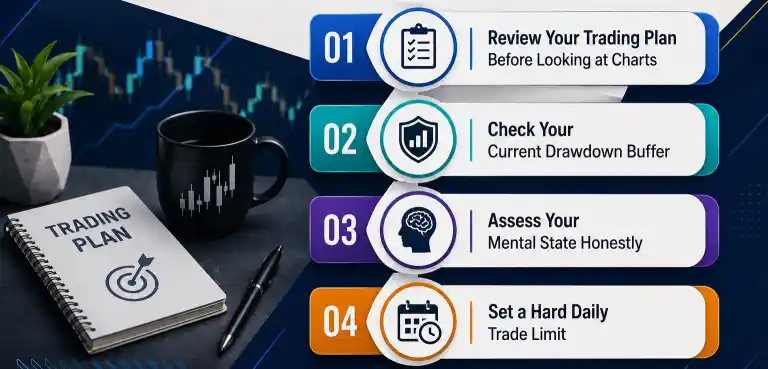
1. Review Your Trading Plan Before Looking at Charts
Opening the charts first, before reviewing your own rules, primes you to react to price rather than to your plan. Reading through your entry criteria and risk rules first — even briefly — keeps your process, not the day’s price action, driving your first decision.
2. Check Your Current Drawdown Buffer
Knowing exactly how much room remains before hitting a daily or maximum drawdown limit turns risk management from an abstract idea into a specific number you can reference throughout the session. Our complete guide to prop firm rules covers how these limits typically work if you need a refresher before building this step into your routine.
3. Assess Your Mental State Honestly
A short, honest check — am I rested, calm, and not trading to “catch up” on anything — catches a meaningful number of bad sessions before they start. Traders who skip this step often only recognize they were in a poor state to trade after the damage is already done.
4. Set a Hard Daily Trade Limit
Deciding your maximum number of trades (or a stopping point after consecutive losses) before the session starts removes the in-the-moment temptation to keep going “just one more trade.” This single habit directly protects against the overtrading patterns covered in our guide on why traders overtrade after a winning streak.
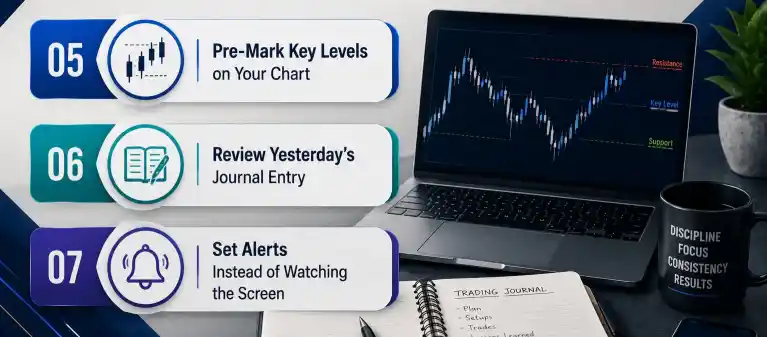
5. Pre-Mark Key Levels on Your Chart
Marking relevant support, resistance, and key market structure levels before the session begins helps traders follow a plan instead of making rushed decisions while prices are moving quickly. This simple preparation reduces real-time pressure and makes it easier to stay consistent with the Pre-Trading Routine for Prop Firm Traders.
6. Review Yesterday’s Journal Entry
A quick look at your most recent trades — what worked, what didn’t, and any emotional patterns noted — keeps recent lessons active rather than forgotten by the next session. Our guide to trading journal metrics covers what’s worth logging to make this step genuinely useful over time.
7. Set Alerts Instead of Watching the Screen
Configuring price alerts for your planned levels, rather than committing to constantly watching the chart, reduces the anxiety-driven checking behavior that often precedes FOMO-driven entries. This directly supports the control strategies covered in our guide to FOMO in forex trading.
Common Reasons Traders Skip Their Pre-Trading Routine
Even traders who fully understand the value of a structured routine skip it regularly, usually for a few predictable reasons. Time pressure is the most common — waking up late or starting the session already behind schedule makes a five-minute checklist feel like an obstacle rather than protection. Overconfidence after a strong previous session is another frequent cause, since the routine can start to feel unnecessary when recent results have been good, which is precisely the situation covered in our guide on why traders overtrade after a winning streak.
A third common reason is simply forgetting, particularly for traders who haven’t written the routine down anywhere and rely on memory alone. Treating the checklist as a literal, physical or digital list — rather than a mental habit — removes this specific failure point and makes the routine far more resistant to a rushed or distracted morning.
A Sample 5-Minute Pre-Trading Routine
- Re-read the entry criteria and risk rules.
- Check your current drawdown buffer.
- Check your mental state and make sure you are rested, calm, and not chasing trades.
- Set a maximum number of trades for the day.
- Mark the key support, resistance, and other important chart levels.
- Review your previous day’s trading journal.
- Set price alerts so you don’t need to constantly watch the charts.
A routine this short has no real excuse to be skipped on a normal morning, which is exactly the point — a pre-trading routine for prop firm traders only protects an account if it’s actually realistic enough to survive the mornings when discipline matters most.
Adapting the Routine to Evaluation Deadlines
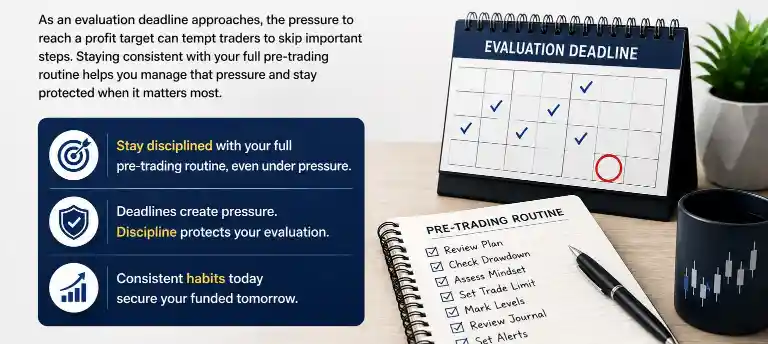
As an evaluation deadline approaches, the need to follow a Pre-Trading Routine for Prop Firm Traders becomes even more important. The pressure to reach a profit target can tempt traders to skip steps such as checking their drawdown buffer or reviewing their risk limits because they feel these precautions might slow down their final push. Recognizing this tendency as a predictable part of evaluation pressure makes it easier to follow the complete routine consistently, even when deadlines are approaching and the consequences of a single rule violation are at their highest.
What to Do If You Fail the Pre-Trading Checklist
Not every trading day will pass every part of the routine — and that’s exactly why having one matters. If the mental state check reveals genuine fatigue or frustration from a previous session, the more disciplined choice may be to reduce position size, skip the session, or practice on a demo account instead of forcing a live trade. A Pre-Trading Routine for Prop Firm Traders only provides real value when traders are willing to act on what it reveals, even when the right decision is to stay out of the market for the day.
Building the Routine Into a Genuine Daily Habit
A checklist only works when it is used consistently, so the routine should be simple enough to fit into busy or stressful mornings. Keeping the Pre-Trading Routine for Prop Firm Traders to around five or ten minutes, rather than creating an overly detailed process that gets skipped when time is limited, makes it much easier to maintain over the long term. Writing the routine down as a clear checklist instead of trying to remember all seven steps also reduces the chance of missing something, especially during high-pressure mornings when following the full routine matters most.
Final Thoughts
A consistent pre-trading routine for prop firm traders shifts the hardest part of discipline — staying rule-bound under pressure — to a calmer moment before the session even begins. None of these seven steps are individually complicated, but together they remove a significant share of the in-the-moment decisions where emotional trading mistakes tend to originate. Building this routine once, and protecting it even on inconvenient days, tends to produce measurably steadier evaluation results than relying on discipline alone once the session is already underway.
FAQs
How long should a pre-trading routine take?
Most effective routines take five to ten minutes — long enough to cover the key checks without becoming elaborate enough to skip on busy mornings. The sample template above is designed to fit comfortably within that window.
Should I trade if my mental state check reveals I’m not in a good headspace?
Many disciplined traders choose to reduce size, skip the session, or use a demo account instead of forcing a live session when this happens, treating the check as genuinely actionable rather than a formality that gets overridden whenever it’s inconvenient.
Does this routine change once an account is funded?
The core steps typically stay the same, though many funded traders keep the drawdown buffer check even more front-of-mind, since a rule breach on a funded account usually means losing it entirely rather than paying a reset fee.

