

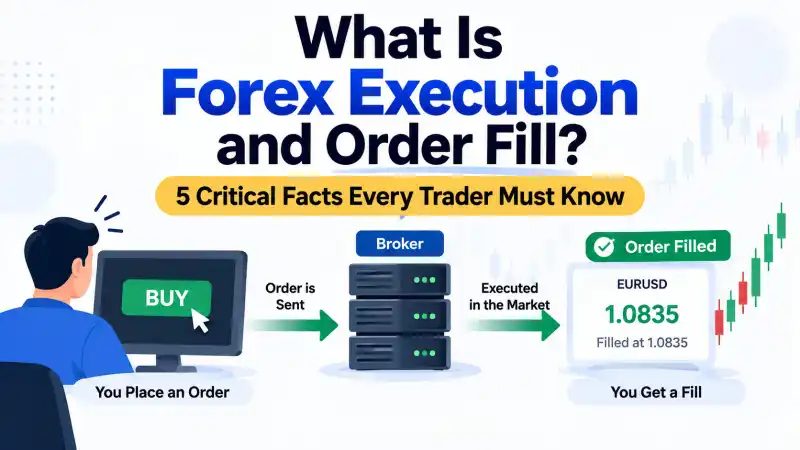
Forex execution and order fill refer to what actually happens the moment you click “buy” or “sell” — how your broker processes that request, matches it against available liquidity, and confirms the final price your trade is filled at. Most beginners assume their trade fills instantly at the exact price shown on screen, but understanding forex execution and order fill properly explains why the real fill price sometimes differs, why slippage happens, and why the type of execution your broker uses matters far more than most traders realize.
What Forex Execution and Order Fill Actually Mean
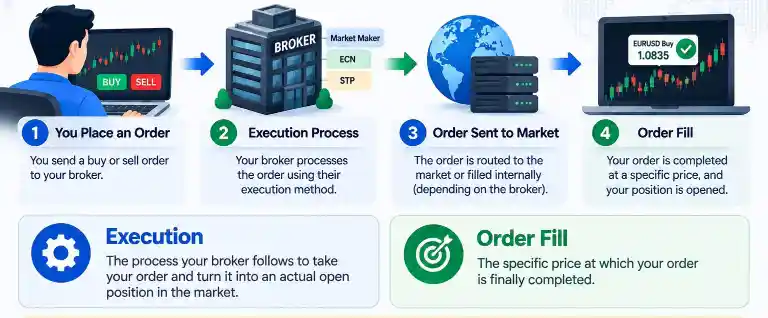
Forex execution and order fill are closely connected concepts in trading. Execution is the process your broker uses to receive and process your order, while the order fill is the price at which that order is actually completed. Depending on the broker and execution model, the final fill may differ slightly from the price you initially saw because of market movement or slippage.
Fast and reliable execution can be especially important during periods of high volatility, when prices can change quickly. Traders should therefore consider factors such as execution speed, slippage, requotes, liquidity, and the broker’s overall execution policy when evaluating a trading account.
5 Critical Facts About Forex Execution and Order Fill
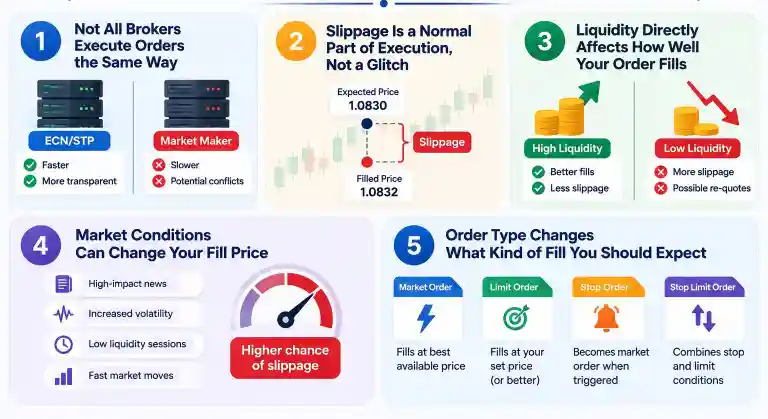
1. Not All Brokers Execute Orders the Same Way
Brokers generally use either market execution or instant execution models. Market execution fills your order at the best available price at the moment of execution, which may differ slightly from the price you clicked. Instant execution attempts to fill at the exact requested price or reject the trade entirely if that price is no longer available. Understanding which model your broker uses changes what kind of fill behavior you should expect.
2. Slippage Is a Normal Part of Execution, Not a Glitch
Slippage happens when your order fills at a different price than requested, usually because the market moved during the tiny gap between clicking and execution. It’s more common during high volatility, major news releases, or when trading in low-liquidity conditions, and it can work in your favor just as often as against you, depending on market direction at that exact moment.
3. Liquidity Directly Affects How Well Your Order Fills
Your order needs enough opposite-side liquidity resting at your requested price to fill cleanly. When liquidity is thin, larger orders may fill across multiple price levels instead of one clean price, which is part of why understanding the role of liquidity in forex price movement helps explain unexpected fill behavior, especially during volatile sessions.
4. Requotes Happen When Your Requested Price Is No Longer Available
A requote occurs when the price moves before your order reaches the broker’s system, and the broker offers you a new price instead of filling at the old one. This is more common with instant execution models during fast-moving markets, and understanding this in advance prevents confusion when it happens.
5. Order Type Changes What Kind of Fill You Should Expect
Market orders prioritize speed and typically fill quickly but with more exposure to slippage. Limit orders guarantee price but not execution, meaning they may not fill at all if the market never reaches your specified level. Choosing the right order type for the situation is just as important as the entry idea itself.
A Real Example: Watching Execution in Action
Picture placing a market buy order on GBP/USD right as a major news release hits. The price on screen shows one number, but by the time your order actually processes, price has already moved several pips due to the sudden volatility and thinning liquidity. Your order fills a few pips worse than expected — this is slippage caused by execution speed and liquidity conditions colliding at the worst possible moment. This is exactly why many experienced traders avoid placing market orders in the seconds immediately surrounding high-impact news.
How Forex Execution and Order Fill Connect to Broker Choice
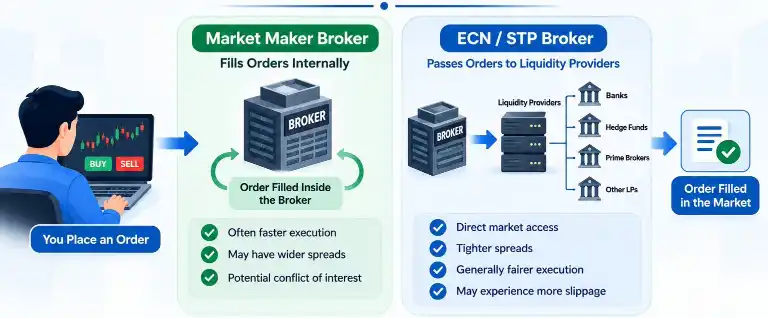
Different brokers route orders differently — some act as market makers filling orders internally, while others pass orders directly to liquidity providers. This routing decision affects fill speed, slippage frequency, and overall execution quality. For a deeper look at how this process actually works behind the scenes, see our guide on how forex brokers execute your trades, which breaks down the mechanics traders rarely think about until a fill doesn’t go as expected.
Common Mistakes Traders Make Around Execution
- Assuming every fill will match the displayed price exactly: This expectation ignores normal market movement between order placement and execution, especially during volatile periods.
- Placing market orders directly into major news events: This is one of the most common ways traders experience unexpectedly large slippage.
- Ignoring order type differences: Using a market order when a limit order would better suit the situation, or vice versa, often leads to unnecessary slippage or missed entries.
- Not accounting for execution costs in a trading system: A backtested system that ignores realistic slippage and fill behavior can look far more profitable on paper than it performs in live conditions, a gap worth checking through how to backtest a forex strategy properly.
Final Thoughts
Forex execution and order fill aren’t just background technical details — they directly affect the real price you actually trade at, which matters more than most beginners initially realize. Understanding execution models, slippage, liquidity, and order types helps set realistic expectations for how trades actually play out, rather than assuming every order fills perfectly at the exact price shown on screen.
FAQs
Is slippage always a bad thing?
No. Slippage can move in a trader’s favor just as easily as against it, since it simply reflects the market price at the moment of execution rather than always being unfavorable.
Why do brokers sometimes requote a price?
A requote happens when the market price changes before your order reaches the broker’s system, most commonly with instant execution models during fast-moving conditions.
Does execution speed matter for every type of trader?
It matters more for short-term traders like scalpers, where small price differences have a larger relative impact, compared to longer-term traders who are less affected by minor execution timing differences.

