


Understanding why traders overtrade after a winning streak explains one of the most counterintuitive patterns in trading: accounts often suffer their worst drawdowns right after their best performance stretches. It seems backwards — shouldn’t confidence built from real wins lead to better decisions? In practice, the opposite tends to happen, and the psychology behind it is well documented. This guide breaks down exactly why this happens and the five costly mistakes that typically follow.
What Happens Psychologically After a Winning Streak?
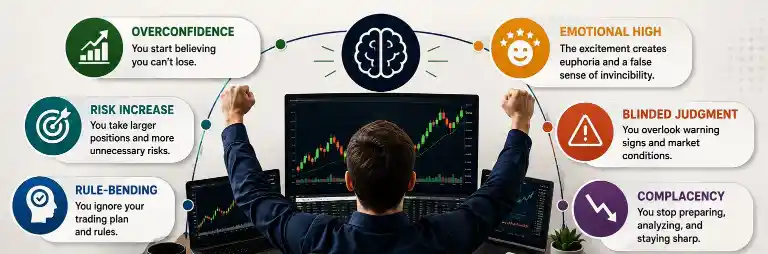
Why traders overtrade after a winning streak often has less to do with strategy and more to do with psychology. A series of winning trades does more than increase account equity—it gradually changes how a trader perceives risk. Losses that once felt significant begin to seem smaller compared to recent gains, a behavioral finance concept often referred to as the “house money effect.” As confidence grows, traders may unknowingly become more comfortable taking larger or more frequent trades.
This shift usually happens gradually and without the trader realizing it. A position size that once felt too aggressive can start to seem perfectly reasonable after several consecutive wins, simply because recent profits create a false sense of financial cushioning. This psychological change is one of the main reasons why traders overtrade after a winning streak, and it can affect even experienced traders who normally follow disciplined risk management.
Why Traders Overtrade After a Winning Streak: The Core Reasons
Overconfidence Bias
Several consecutive wins can create the feeling that a trader has “figured out” the market, when in reality most winning streaks include a meaningful amount of normal variance. This overconfidence often shows up as taking larger positions or skipping usual confirmation steps, since the trader trusts their own judgment more than their tested process.
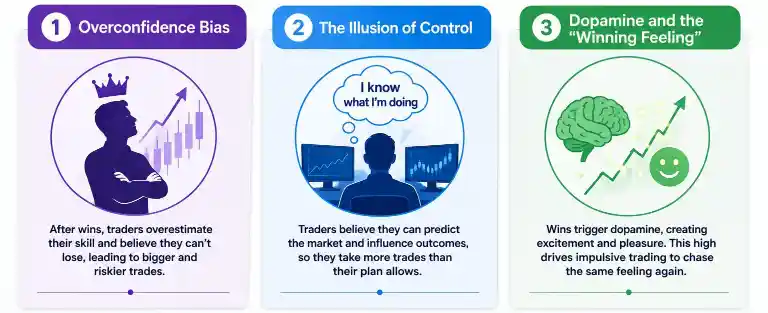
The Illusion of Control
Winning repeatedly can create a false sense that outcomes are being controlled through skill alone, downplaying the role that market conditions and simple probability played in the results. This illusion makes it easy to justify taking trades outside a normal strategy, since recent success feels like proof the trader can “read” the market in the moment.
Dopamine and the “Winning Feeling”
Each winning trade delivers a small dopamine response, and repeated wins can create a pull toward chasing that feeling again — independent of whether the next setup is actually valid. This is part of why traders overtrade after a winning streak even when they consciously know their usual criteria haven’t been met.
5 Costly Mistakes That Follow a Winning Streak
- Increasing position size without a plan: Sizing up “because it’s working” rather than because the strategy or risk tolerance has genuinely changed.
- Abandoning the trading plan’s entry criteria: Taking trades that don’t meet the usual setup requirements, trusting instinct over process.
- Ignoring the daily or weekly trade limit: Continuing to trade well past a planned stopping point because the day “feels good.”
- Skipping the trading journal: Winning streaks often coincide with traders logging trades less consistently, right when tracking matters most.
- Treating recent wins as proof of skill rather than partly luck: This mindset makes it harder to recognize when conditions shift and the same approach stops working.
A Real-World Example: How a Winning Streak Unravels
One of the easiest ways to understand why traders overtrade after a winning streak is through a practical example. Imagine a trader who has just completed six consecutive winning trades while consistently risking 1% of their account on each position.
On the seventh trade, instead of following the same risk plan, the trader increases the risk to 3%, believing the setup is “too good to miss.” The trade results in a loss. Frustrated, the trader immediately opens another oversized position to recover the loss, this time skipping the usual trade confirmation process.
This chain of events—a larger-than-planned trade followed by an emotional recovery attempt—is a common reason profitable trading periods quickly turn into losing ones. None of the individual trades are necessarily disastrous on their own, but abandoning consistent risk management allows small mistakes to compound. This illustrates why traders overtrade after a winning streak and how a moment of overconfidence can erase weeks of disciplined progress.
Why This Pattern Is Especially Common in Prop Firm Evaluations
The psychology behind why traders overtrade after a winning streak often becomes even more noticeable during funded trading evaluations. A trader who reaches a strong profit level early in a challenge may feel tempted to push harder in an attempt to secure a pass, rather than becoming more conservative. Ironically, this is often when discipline matters most, as daily drawdown limits still apply regardless of how close the trader is to the profit target.

Recognizing this psychological tendency helps explain why technically skilled traders sometimes fail evaluations they were well positioned to pass. Setting a rule to reduce position size after reaching a certain profit threshold, instead of increasing it, may feel counterintuitive, but it is often a more effective way to protect trading capital and maintain consistency.
How to Recognize You’re Starting to Overtrade
A few warning signs tend to show up before an account actually suffers real damage. Trading more frequently than usual without a clear reason, feeling reluctant to stop for the day even after hitting a normal profit target, and noticing that position sizes have crept up gradually rather than through a deliberate decision are all early indicators. These same discipline principles apply broadly across strategy types — our forex trading strategy for beginners guide covers how consistent rule-following, rather than chasing results, builds sustainable performance over time. The Psychology of FOMO in Forex Trading – 7 Dangerous Signs and How to Control It — recognizing these overlapping patterns early is often what separates a temporary lapse from a full account drawdown.
Practical Ways to Protect Gains After a Winning Streak
- Set a hard daily or weekly trade limit and treat it as non-negotiable, regardless of how the session is going.
- Keep position sizing tied to a fixed formula rather than adjusting based on recent results — our guide to prop firm rules covers how strict risk discipline is enforced in funded evaluations, which applies just as well to personal accounts.
- Log every trade, especially during a winning stretch — a consistent trading journal makes it much harder to unconsciously drift from your usual process. Our guide to trading journal metrics covers what’s worth tracking.
- Review your last few trades for criteria drift — periodically checking whether recent entries still match your original setup rules catches early slippage before it compounds.
- Consider stepping away after an unusually strong session, treating a big win day the same way a disciplined trader treats a big loss day — as a signal to pause and reassess rather than push further.
These same discipline principles apply broadly across strategy types — our forex trading strategy for beginners guide covers how consistent rule-following, rather than chasing results, builds sustainable performance over time. Revenge Trading — Why It Happens and How to Stop It
Final Thoughts
The pattern behind why traders overtrade after a winning streak isn’t a character flaw — it’s a well-documented psychological response that affects even experienced traders. The difference between traders who protect their gains and those who give them back usually comes down to whether they have specific, pre-decided rules in place before the winning streak happens, not just good intentions in the moment. Building safeguards — trade limits, fixed position sizing, and consistent journaling — while things are going well is far easier than trying to regain discipline mid-drawdown, and it’s a habit worth building long before your next strong run begins.
FAQs
Is it normal to overtrade after winning several trades in a row?
Yes. It’s a well-documented psychological pattern tied to overconfidence and shifting risk perception, not a sign of poor character or lack of skill. Recognizing that this response is common and predictable is often the first step toward building safeguards against it.
How can I tell if my winning streak is skill or luck?
Reviewing whether your recent wins still matched your original entry criteria, or whether you started taking looser setups, is a practical way to separate genuine edge from a temporary favorable run. A trading journal makes this comparison far easier than relying on memory alone.
What’s the simplest rule to prevent overtrading after wins?
A fixed daily or weekly trade limit, decided in advance and treated as non-negotiable, is one of the simplest and most effective safeguards against this pattern, since it removes the in-the-moment decision entirely.

