

Hidden rules in prop firm challenges are one of the biggest reasons many traders fail evaluation phases even when their trading strategy performs well. In recent years, proprietary trading firms have become extremely popular because they offer traders access to larger capital without requiring massive personal deposits.
Many traders are attracted to prop firms because they see an opportunity to trade funded accounts worth thousands or even hundreds of thousands of dollars. However, what many beginners do not realize is that prop firm challenges often contain strict trading conditions, hidden restrictions, and psychological traps that are not fully understood at the beginning.
A trader may have a profitable strategy and still fail a challenge because they misunderstood drawdown rules, violated trading consistency requirements, or ignored account restrictions hidden inside the firm’s terms and conditions.
This guide explains the most important hidden rules in prop firm challenges, how these rules affect traders in real-world conditions, and what every trader should understand before purchasing an evaluation account.
Quick Summary: Hidden Rules in Prop Firm Challenges
| Rule | Why It Matters |
|---|---|
| Daily Drawdown Limits | Can end accounts quickly during volatile sessions |
| Maximum Overall Drawdown | Protects firms from large losses |
| Consistency Rules | Prevents gambling-style trading |
| News Trading Restrictions | Some firms limit high-impact event trading |
| Holding Trades Overnight | Can violate challenge conditions |
| Minimum Trading Days | Forces longer evaluation periods |
| Lot Size Restrictions | Limits aggressive trading behavior |
| Copy Trading Restrictions | Many firms prohibit account copying |
| Payout Conditions | Profit withdrawals may contain hidden conditions |
| Psychological Pressure | Challenge environments affect decision-making |
What Are Prop Firm Challenges
Before understanding the hidden rules in prop firm challenges, it is important to understand how prop firms operate.
Proprietary trading firms, commonly called prop firms, provide traders with access to funded accounts after passing an evaluation process.
Typically, traders must:
- Reach a profit target
- Stay within drawdown limits
- Follow specific trading rules
- Maintain account consistency
If traders pass the challenge successfully, the prop firm may offer access to a funded trading account where profits are shared between the trader and the company.
While this model appears attractive, many firms design challenges in ways that are psychologically difficult for inexperienced traders.
1. Daily Drawdown Limits Are More Dangerous Than Many Traders Realize
One of the most important hidden rules in prop firm challenges is the daily drawdown rule.
Most prop firms limit how much money traders can lose in a single trading day.
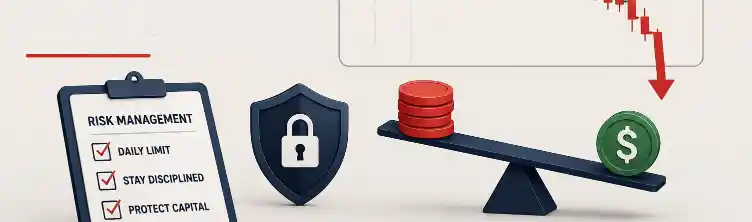
For example:
- 5% daily drawdown
- 4% daily loss limit
- Static daily loss threshold
Many beginners misunderstand how daily drawdown is calculated.
Some firms calculate drawdown based on:
- Balance
- Equity
- Floating losses
- End-of-day calculations
This creates confusion because a trader may appear safe based on balance while equity temporarily violates the rule during market volatility.
Many traders fail prop challenges simply because they misunderstood drawdown calculations.
2. Maximum Overall Drawdown Can Quietly End Your Challenge
Another major hidden rule in prop firm challenges involves maximum account drawdown.
This rule limits the total amount traders can lose before the challenge account is terminated.
For example:
- 10% maximum loss
- 8% trailing drawdown
- Static equity protection rules
Trailing drawdown rules are especially dangerous for inexperienced traders.
In some cases, as profits increase, the drawdown threshold also moves upward.
This means traders can accidentally violate rules even after previously being profitable.
Understanding whether drawdown is:
- Static
- Trailing
- Balance-based
- Equity-based
is extremely important before starting any prop firm challenge.
3. Consistency Rules Often Catch Aggressive Traders
Many traders focus only on profit targets while ignoring consistency requirements.
Some firms limit how much profit can come from a single trade or trading day.
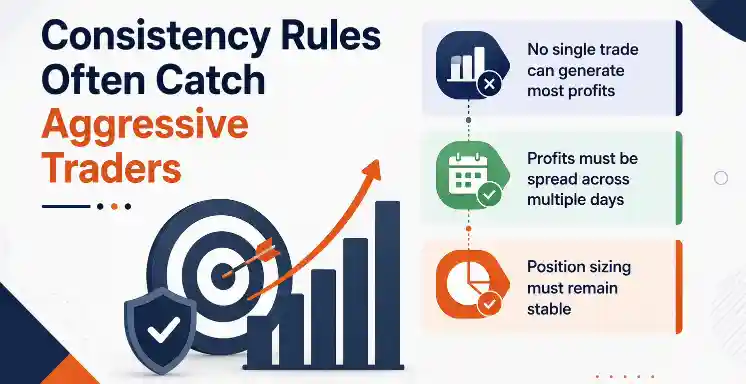
For example:
- No single trade can generate most profits
- Profits must be spread across multiple days
- Position sizing must remain stable
These hidden rules in prop firm challenges are designed to prevent gambling-style trading behavior.
Traders who attempt aggressive “one-shot” strategies often fail consistency checks even if they technically reach the profit target.
4. News Trading Restrictions Can Invalidate Trades
Many prop firms restrict trading during major economic news events.
This is one of the most overlooked hidden rules in prop firm challenges.
Restricted events may include:
- NFP (Non-Farm Payroll)
- FOMC meetings
- CPI inflation reports
- Interest rate decisions
Some firms prohibit:
- Opening trades before news releases
- Closing trades immediately after events
- Holding positions during high volatility
Violating these rules may result in:
- Profit removal
- Challenge failure
- Account suspension
Traders should always read event-related restrictions carefully.
5. Overnight and Weekend Holding Rules Matter
Some prop firms allow overnight positions, while others prohibit them completely.
Weekend holding restrictions are also common.

These hidden rules in prop firm challenges can affect:
- Swing traders
- Gold traders
- Index traders
- News traders
Holding positions through weekends can create gaps and liquidity risks, which is why some firms restrict this behavior.
Traders who ignore overnight restrictions may accidentally violate challenge conditions.
6. Minimum Trading Days Force Slower Evaluations
Many beginners believe they can pass challenges within one or two trading sessions.
However, some firms require:
- 5 minimum trading days
- 10 active trading sessions
- Consistent participation requirements
This hidden rule exists because prop firms want to evaluate trading consistency over time rather than allowing traders to pass through one lucky trade.
Traders should understand that prop firm evaluations are often designed to test patience as much as profitability.
7. Lot Size Restrictions Can Affect Strategy Performance
Some prop firms quietly limit position sizing behavior.
For example:
- Maximum lot size restrictions
- Scaling limitations
- Grid trading bans
- Martingale restrictions
These hidden rules in prop firm challenges can directly affect high-frequency or aggressive trading systems.
Some traders fail evaluations because their strategy violates risk-control policies rather than because of losses.
8. Copy Trading and EA Restrictions Are Common
Many prop firms monitor account activity for suspicious behavior.
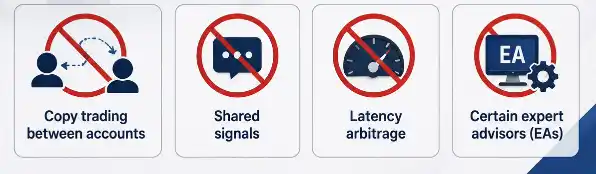
Some firms prohibit:
- Copy trading between accounts
- Shared signals
- Latency arbitrage
- Certain expert advisors (EAs)
Even if a trader is profitable, violating automation or copying restrictions may result in:
- Payout denial
- Account termination
- Permanent bans
This is why traders should always review the firm’s automation policies carefully.
9. Payout Rules Are Not Always Simple
One of the most misunderstood hidden rules in prop firm challenges involves payout structures.
Many traders assume profits become instantly withdrawable after passing the challenge.
However, payout conditions may include:
- Minimum trading periods
- Consistency checks
- Profit split adjustments
- Withdrawal thresholds
- Identity verification procedures
Some firms also reserve the right to investigate suspicious trading activity before processing payouts.
This is why understanding payout conditions is just as important as understanding trading rules.
10. Psychological Pressure Is the Biggest Hidden Challenge
Perhaps the most important hidden rule in prop firm challenges is psychological pressure.
Many traders perform well on personal accounts but struggle during evaluations because challenge environments create emotional stress.

Common psychological problems include:
- Fear of violating drawdown limits
- Overtrading to hit targets faster
- Revenge trading after losses
- Avoiding valid setups due to pressure
Prop firm challenges are not only testing strategy performance. They also test emotional discipline.
This is why many experienced traders approach challenges slowly and focus more on consistency than speed.
Trader Insight: Why Many Good Traders Still Fail Challenges
Many profitable traders still fail prop firm evaluations.
This usually happens because:
- Rules are misunderstood
- Risk management changes under pressure
- Traders become overly aggressive
- Profit targets create emotional mistakes
Professional traders understand that passing a challenge often requires a different mindset than normal trading.
Instead of chasing fast profits, experienced traders prioritize:
- Capital preservation
- Consistency
- Low drawdowns
- Controlled execution
Reality Check: Are Prop Firm Challenges Worth It
Prop firm challenges can provide opportunities for disciplined traders, but they are not easy shortcuts to guaranteed income.
Some benefits include:
- Access to larger trading capital
- Reduced personal capital risk
- Structured trading environment
- Potential profit-sharing opportunities
However, traders should also understand the risks:
- Strict rule enforcement
- Psychological pressure
- Challenge fees
- Difficult consistency requirements
- Changing firm policies
Prop firm trading is generally more suitable for disciplined traders who already understand risk management and emotional control.
How to Reduce the Risk of Failing a Prop Firm Challenge
- Read Every Rule Carefully: Many traders fail because they ignore detailed terms and conditions.
- Focus on Risk Management: Protecting capital matters more than hitting targets quickly.
- Avoid Overleveraging: Large position sizes increase emotional pressure and drawdown risk.
- Trade Slowly and Consistently: Many successful prop traders prioritize consistency over aggressive growth.
- Understand News Restrictions: Economic events can trigger accidental rule violations.
Common Beginner Mistakes in Prop Firm Challenges
- Ignoring drawdown calculations
- Using excessive leverage
- Trying to pass challenges too quickly
- Overtrading after losses
- Not understanding payout rules
- Violating consistency requirements
- Trading emotionally under pressure
Final Verdict
Hidden rules in prop firm challenges are one of the main reasons many traders struggle to pass evaluations consistently.
While prop firms offer access to larger capital, they also create structured environments designed to control risk and discourage reckless trading behavior.
Many beginners focus only on profit targets while ignoring the importance of drawdown management, consistency requirements, and emotional discipline.
Successful prop firm traders usually approach challenges differently. Instead of trying to pass quickly, they focus on protecting capital, following rules carefully, and maintaining emotional stability during difficult market conditions.
Understanding the hidden rules in prop firm challenges before purchasing an evaluation account can help traders avoid unnecessary mistakes and approach funded trading more realistically.

