

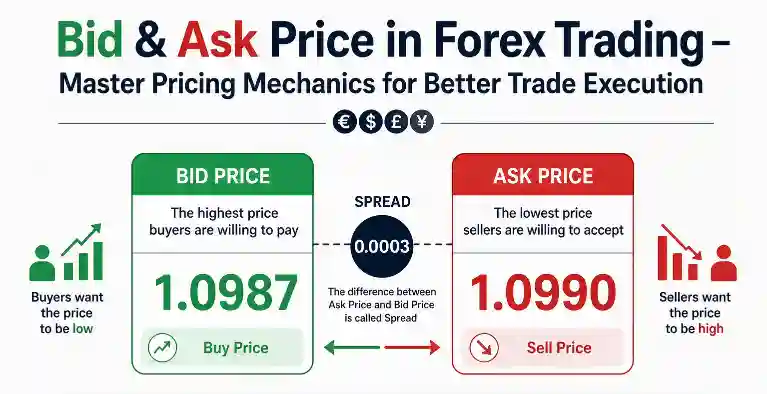
Bid & Ask Price in Forex Trading is one of the most important concepts every trader must understand before placing real trades. While many beginners focus on strategies, indicators, or signals, they often ignore how prices actually work inside the market.
This is where confusion begins.
If you have ever opened a trade and immediately noticed a small loss, or wondered why your trade executed at a slightly different price than expected, the answer almost always lies in bid and ask pricing.
This guide is designed not just to explain definitions, but to help you truly understand how pricing works in real trading conditions — the way experienced traders see it.
Quick Summary: Bid & Ask Price in Forex Trading Explained
| Concept | Explanation |
|---|---|
| Bid Price | The price at which the market is willing to buy from you |
| Ask Price | The price at which the market is willing to sell to you |
| Spread | The difference between ask and bid price (your trading cost) |
| Buy Trade Entry | Executed at ask price |
| Sell Trade Entry | Executed at bid price |
| Initial Loss | Caused by spread difference |
This table gives a quick overview, but understanding how this works in real trading situations is what truly matters.
Understanding Bid & Ask Price in Real Market Terms
In the forex market, every transaction involves two sides — a buyer and a seller. Because of this, there cannot be a single price.
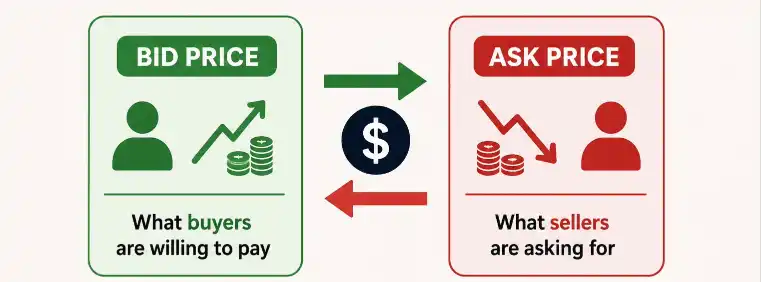
Instead, there are always two prices:
- Bid Price: What buyers are willing to pay
- Ask Price: What sellers are asking for
Think of the market as a constantly moving negotiation between participants. Prices are not fixed — they are continuously adjusting based on supply and demand.
The presence of two prices allows trades to happen instantly without waiting for a matching order.
Real-Life Example: Currency Exchange Perspective
To understand Bid & Ask Price in Forex Trading more clearly, consider a real-world example.
Imagine you are at a currency exchange counter at an airport.
- They will buy your currency at a lower price
- They will sell currency at a higher price
This difference is how they earn money.
Forex brokers operate in a very similar way.
For example:
GBP/USD = 1.2500 / 1.2503
- You sell at 1.2500 (bid)
- You buy at 1.2503 (ask)
The 3-pip difference is the spread — your cost of entering the trade.
Reality Check: Why This Concept Matters More Than Indicators
Many beginners believe success in trading comes from finding the right indicator or strategy.
However, experienced traders understand that execution matters just as much as strategy.
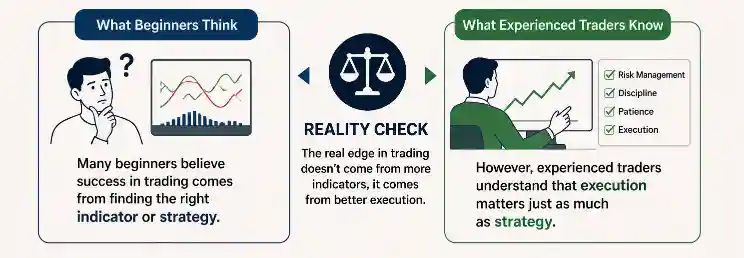
You can have a perfect trade idea, but if you ignore:
- Spread size
- Entry pricing
- Market conditions
Your results can still suffer.
Bid & Ask Price in Forex Trading directly impacts every trade you place — regardless of your strategy.
Why Every Trade Starts in Loss
This is one of the most common beginner questions.
When you open a trade:
- You enter at one price
- Your trade is evaluated at another
For a buy trade:
- You enter at ask price
- Your position is measured using bid price
Since the bid price is lower, your trade starts negative.
This is not a platform issue — it is simply how the market operates.
Understanding Spread in Practical Terms
The spread is calculated as:
Spread = Ask Price – Bid Price
Even though spreads seem small, they have a long-term impact on performance.
For example:
- Scalpers are heavily affected by spread
- Frequent traders pay more in total spread cost
- Wider spreads reduce profitability
This is why professional traders always consider spread before entering trades.
How Bid & Ask Affect Buy Trades
When placing a buy trade:
- You enter at the ask price
- You exit at the bid price
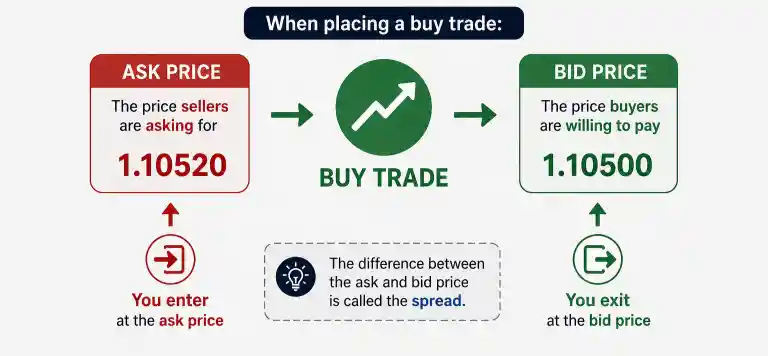
Example:
Buy EUR/USD at 1.1050 (ask)
Bid price = 1.1048
Your trade starts -2 pips.
Price must move above 1.1050 (bid level) for profit to begin.
How Bid & Ask Affect Sell Trades
For sell trades:
- You enter at bid price
- You exit at ask price
Again, spread must be covered before profit appears.
This is why both buy and sell trades are equally affected by pricing mechanics.
Why Charts Can Mislead Beginners
Most trading charts display only the bid price.
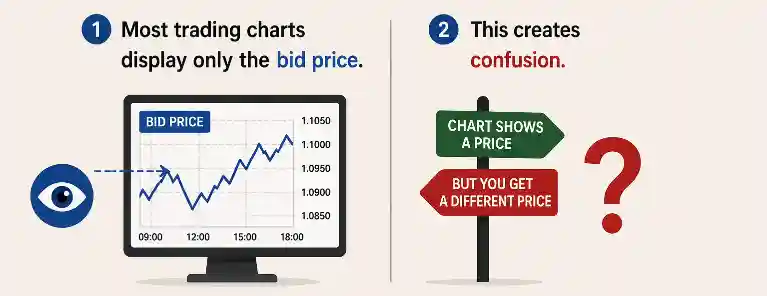
This creates confusion because:
- Buy trades execute at ask price
- Stop-loss or take-profit may trigger based on unseen ask levels
This leads traders to believe:
- “My stop-loss was hit too early”
- “My entry was inaccurate”
In reality, the missing ask line is the reason.
Enabling the ask line can significantly improve your understanding of execution.
Hidden Reality: Spread Expansion
One important factor beginners overlook is that spreads are not fixed.
They can widen significantly during:
- High-impact news events
- Market open/close hours
- Low liquidity conditions
- Unexpected volatility
During these times:
- Trade cost increases
- Stop-loss levels may be hit unexpectedly
- Execution becomes less predictable
Risk Explanation for Beginners
Understanding Bid & Ask Price in Forex Trading is not just about theory — it directly affects your risk.
Key risks include:
- Entering trades with high spread
- Incorrect stop-loss placement
- Overtrading during volatile conditions
Beginners often underestimate how small costs accumulate over time.
Managing spread is part of risk management.
Pros and Cons of Bid & Ask Pricing
Advantages
- Allows instant trade execution
- Reflects real market supply and demand
- Provides liquidity to the market
Limitations
- Creates immediate trade cost
- Can widen unpredictably
- Confuses beginners due to dual pricing
Who Should Focus on This Concept
This concept is especially important for:
- New traders learning execution basics
- Scalpers and intraday traders
- Anyone trading during news events
Even long-term traders benefit from understanding pricing mechanics.
Safety Analysis: Is This a Risk or a Normal Market Feature
Bid and ask pricing is not a risk created by brokers — it is a normal part of how financial markets function.

However, risk increases when:
- Trading with brokers offering unstable spreads
- Trading during high volatility without preparation
- Ignoring execution conditions
Choosing a reliable broker and understanding spread behavior reduces this risk.
Common Trader Mistakes
- Ignoring spread before placing trades
- Using tight stop-loss without considering spread
- Trading during news without experience
- Blaming strategy instead of execution issues
Most of these mistakes come from not understanding how pricing works.
Practical Tips from Trading Experience
- Always check spread before entering a trade
- Trade during high liquidity sessions
- Avoid major news if you are a beginner
- Enable ask line on your platform
- Test execution in demo account first
These habits may seem simple, but they improve consistency over time.
Trader Insight: What Actually Improves Performance
From real trading experience, one pattern becomes clear:
Many traders fail not because their strategy is wrong, but because they ignore execution.
Understanding Bid & Ask Price in Forex Trading helps you:
- Set realistic entry points
- Avoid unnecessary losses
- Interpret charts more accurately
This is a foundational skill that separates beginners from more experienced traders.
Final Verdict
Bid and ask pricing is not just a basic concept — it is the foundation of how every trade works.
Once you understand this properly:
- Trade execution becomes clearer
- Confusion around losses reduces
- Decision-making improves
Instead of focusing only on indicators, building a strong understanding of market mechanics like pricing can significantly improve your trading results over time.
Before understanding bid and ask pricing in detail, it is also important to understand Currency Pairs in Forex Trading, because every bid and ask value is directly linked to how currency pairs are quoted in the market.

