


Currency Pairs in Forex Trading form the foundation of every decision a trader makes in the market. Unlike stocks or commodities where you analyze a single asset, forex trading is always about comparing two economies through their currencies.
This comparison is what creates movement, opportunity, and risk.
Many beginners initially treat currency pairs as simple symbols like EUR/USD or GBP/JPY. But in real trading, each pair represents a relationship between two economies, two central banks, and two sets of market expectations.
This guide goes beyond basic definitions and helps you understand how currency pairs behave in real market conditions, how to choose them, and how they impact your trading performance.
Quick Overview: Currency Pairs in Forex Trading
| Component | Explanation |
|---|---|
| Base Currency | The first currency in the pair (what you are buying or selling) |
| Quote Currency | The second currency (used to measure value) |
| Exchange Rate | Shows how much quote currency equals one unit of base currency |
| Buy Trade | Buying base currency, selling quote currency |
| Sell Trade | Selling base currency, buying quote currency |
This structure applies to every single trade in forex.
Understanding Currency Pairs in Forex Trading (Beyond the Basics)
A currency pair is not just a quote — it is a reflection of economic strength between two countries.

When you look at a pair like EUR/USD, you are not just looking at price movement. You are observing:
- The economic condition of the Eurozone vs the United States
- Interest rate differences between central banks
- Market expectations about future growth
- Global risk sentiment
This is why Currency Pairs in Forex Trading move constantly — they reflect real-world financial changes happening every second.
How Currency Pairs Actually Work in Trading
Every trade in forex involves two simultaneous actions:
- Buying one currency
- Selling another currency
For example:
- Buying EUR/USD = Buying Euro, selling US Dollar
- Selling EUR/USD = Selling Euro, buying US Dollar
This dual mechanism is what makes forex different from other markets.
You are not just predicting direction — you are predicting relative strength.
Reading Currency Pair Quotes Like a Trader
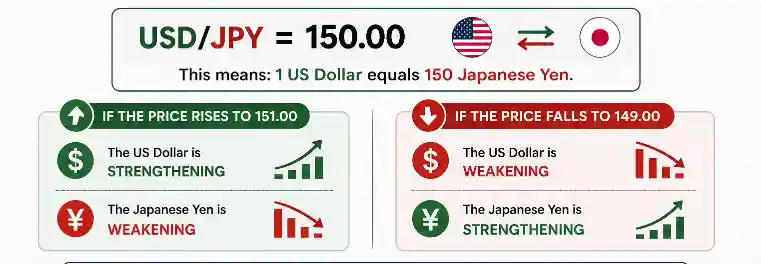
Let’s break this down with a practical example:
USD/JPY = 150.00
This means:
1 US Dollar equals 150 Japanese Yen.
If the price rises to 151.00:
- The US Dollar is strengthening
- The Japanese Yen is weakening
If the price falls to 149.00:
- The US Dollar is weakening
- The Japanese Yen is strengthening
Understanding this relationship is key to interpreting market direction.
Types of Currency Pairs in Forex Trading
1. Major Currency Pairs
Major pairs dominate the forex market in terms of volume and liquidity.
They always include the US Dollar.
Examples:
- EUR/USD
- GBP/USD
- USD/JPY
- USD/CHF
Reality Check: These pairs are not easier because they are “safe,” but because they have consistent liquidity and tighter spreads.
2. Minor (Cross) Currency Pairs
These pairs exclude the US Dollar.
Examples:
- EUR/GBP
- EUR/JPY
- GBP/JPY
They often show stronger movements due to cross-currency dynamics.
Important: Volatility can increase risk if not managed properly.
3. Exotic Currency Pairs
Exotic pairs involve one major currency and one from an emerging economy.
Examples:
- USD/TRY
- USD/ZAR
- EUR/THB
Reality Check:
- Wider spreads
- Lower liquidity
- Higher unpredictability
These are generally not suitable for beginners.
What Actually Moves Currency Pairs
Understanding Currency Pairs in Forex Trading requires knowing what drives price.
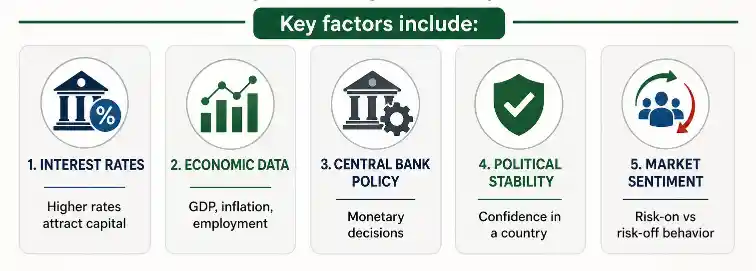
Key factors include:
- Interest Rates: Higher rates attract capital
- Economic Data: GDP, inflation, employment
- Central Bank Policy: Monetary decisions
- Political Stability: Confidence in a country
- Market Sentiment: Risk-on vs risk-off behavior
For example:
If US interest rates rise while European rates stay low, USD tends to strengthen against EUR.
Reality Check: Why Beginners Struggle With Currency Pairs
Most beginners focus on memorizing pairs instead of understanding relationships.
This leads to:
- Random trade decisions
- Overtrading multiple pairs
- Ignoring fundamental drivers
Experienced traders, on the other hand, ask:
“Which currency is stronger right now — and why?”
This shift in thinking changes everything.
How to Choose the Right Currency Pair
Not all pairs suit every trader.
Your choice should depend on:
- Trading style (scalping, intraday, swing)
- Risk tolerance
- Market session you trade
For beginners:
- Start with EUR/USD or USD/JPY
- Avoid exotic pairs initially
- Focus on consistency, not variety
Hidden Factors Beginners Often Ignore
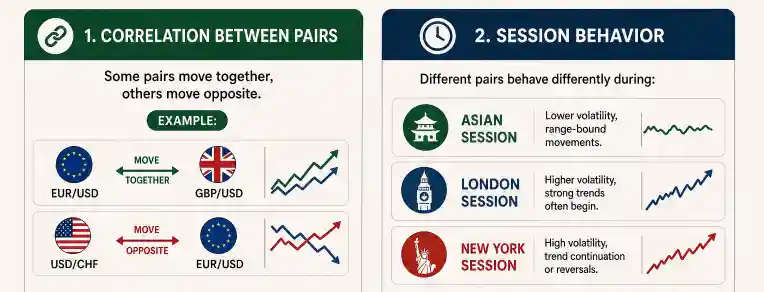
Correlation Between Pairs
Some pairs move together, others move opposite.
Example:
- EUR/USD and GBP/USD often move similarly
- USD/CHF often moves opposite to EUR/USD
Ignoring this can double your risk unknowingly.
Session Behavior
Different pairs behave differently during:
- Asian session
- London session
- New York session
Understanding timing improves execution.
Risk Explanation for Beginners
Every currency pair carries a different level of risk.
Risk depends on:
- Volatility
- Spread size
- Liquidity
For example:
- EUR/USD = Lower spread, stable movement
- GBP/JPY = High volatility, larger swings
- USD/TRY = Unpredictable and risky
Choosing the wrong pair can increase losses even with a good strategy.
Pros and Cons of Trading Different Currency Pairs
Advantages
- Diverse opportunities across global markets
- Ability to trade based on economic conditions
- Flexible trading styles
Limitations
- Complex relationships between currencies
- Different behavior across sessions
- Risk increases with unfamiliar pairs
Practical Tips to Improve Currency Pair Selection
- Focus on 1–2 pairs initially
- Track economic news for those pairs
- Avoid switching pairs frequently
- Understand pair behavior before risking money
- Use demo accounts to test different pairs
Consistency matters more than variety.
Trader Insight: What Actually Improves Results
From real trading experience, one pattern is clear:
Traders who specialize in a few pairs perform better than those who try to trade everything.
Why?
- They understand behavior patterns
- They recognize volatility cycles
- They react faster to market changes
Currency Pairs in Forex Trading are not just symbols — they have personalities. Learning those personalities gives you an edge.
Who Should Focus on Which Pairs
- Beginners: EUR/USD, USD/JPY
- Intermediate Traders: GBP/USD, EUR/JPY
- Advanced Traders: Cross pairs and selected exotics
This progression helps manage risk while building experience.
Final Verdict
Currency pairs are the backbone of forex trading. Every trade you take is a reflection of how one currency performs against another.
Understanding Currency Pairs in Forex Trading at a deeper level allows you to:
- Make informed trading decisions
- Reduce unnecessary risk
- Improve consistency over time
Instead of trying to trade everything, focus on understanding a few pairs deeply. Over time, this approach builds confidence and clarity in your trading journey.
Related Topic: Understanding Bid & Ask Price
To better understand how currency pricing works, you should also learn about Bid & Ask Price in Forex Trading. This concept explains how trades are executed and why spreads affect your entry and exit.

