

Scalping strategy in forex is one of the fastest-paced trading approaches used in the currency market. Instead of holding trades for hours or days, scalpers aim to capture small price movements within minutes or even seconds.
Many traders are attracted to scalping because of the possibility of frequent trading opportunities and quick trade execution. However, despite its popularity, scalping strategy in forex is often misunderstood by beginners who assume fast trading automatically means faster profits.
In reality, scalping requires discipline, emotional control, quick decision-making, and strong risk management. Small mistakes can accumulate rapidly because scalpers usually place multiple trades during active market sessions.
This guide explains how scalping strategy in forex works, common scalping methods traders use, ideal market conditions, major beginner mistakes, risk management principles, and whether scalping may suit your trading personality in 2026.
Quick Summary: Scalping Strategy in Forex
| Feature | Explanation |
|---|---|
| Trading Style | Short-term rapid trading |
| Trade Duration | Seconds to minutes |
| Main Goal | Capture small price movements |
| Common Timeframes | 1-Minute, 5-Minute Charts |
| Risk Level | High if poorly managed |
| Best Market Conditions | High liquidity and volatility |
| Important Skills | Discipline, speed, focus, risk management |
What Is Scalping Strategy in Forex
Scalping strategy in forex is a short-term trading approach where traders attempt to profit from small market movements repeatedly throughout the trading session.
Unlike swing traders or position traders who may hold trades for days or weeks, scalpers usually:
- Enter and exit trades quickly
- Focus on small price movements
- Take multiple trades daily
- Trade during active market sessions
The idea behind scalping is that small gains can accumulate over time when combined with disciplined execution.
However, because profits per trade are often small, scalping usually requires high precision and consistent trade management.
How Scalping Works in Forex Trading
Scalpers typically focus on highly liquid currency pairs where spreads remain relatively tight.
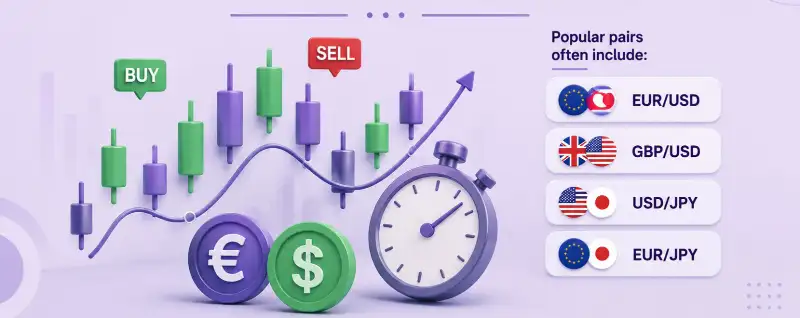
Popular pairs often include:
- EUR/USD
- GBP/USD
- USD/JPY
- EUR/JPY
Scalpers look for short-term momentum and attempt to capture small movements before exiting the market quickly.
Many scalpers target:
- 5–15 pip moves
- Quick breakout reactions
- Momentum continuation setups
- Short-term support and resistance reactions
Because of the fast pace, execution quality becomes extremely important.
Why Scalping Attracts Forex Traders
Many traders are interested in scalping strategy in forex because it offers:
- Frequent trading opportunities
- Quick trade results
- Limited overnight exposure
- Active market participation
Some traders also prefer scalping because they dislike holding positions for long periods.
However, fast trading also creates emotional and psychological challenges that beginners often underestimate.
Most Common Scalping Strategies in Forex
1. Moving Average Scalping
This is one of the most popular methods used by beginner scalpers.
Traders use short-term moving averages to identify momentum direction and potential entry points.
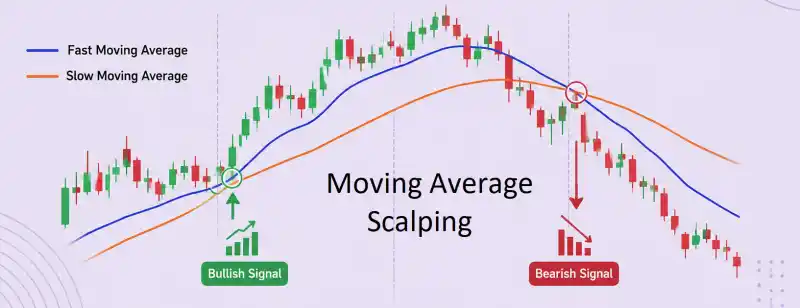
For example:
- Fast moving average crossing above slow moving average may signal bullish momentum
- Fast moving average crossing below may signal bearish momentum
However, false signals are common during ranging markets.
2. Support and Resistance Scalping
Some traders use short-term support and resistance zones to identify quick reaction opportunities.
Price rejection near important levels may create short-term scalping setups.
This method usually requires fast execution and careful stop-loss placement.
3. Breakout Scalping
Breakout scalpers attempt to capture strong momentum after price breaks key levels.
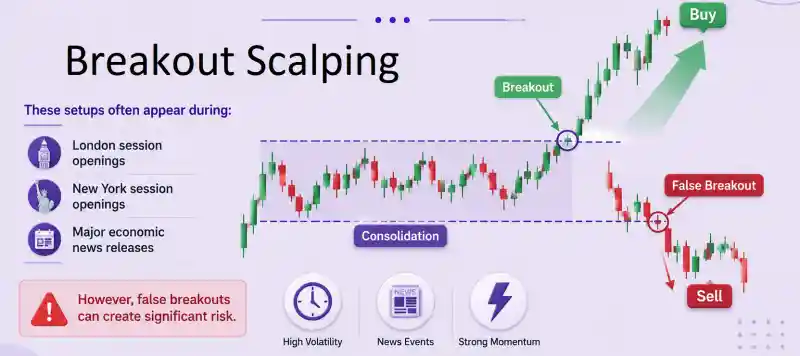
These setups often appear during:
- London session openings
- New York session openings
- Major economic news releases
However, false breakouts can create significant risk.
4. Trend Scalping
Trend scalpers trade in the direction of the dominant short-term trend.
Instead of predicting reversals, they focus on momentum continuation.
Many experienced scalpers prefer trend-following approaches because they may reduce unnecessary countertrend risk.
Best Timeframes for Scalping Strategy in Forex
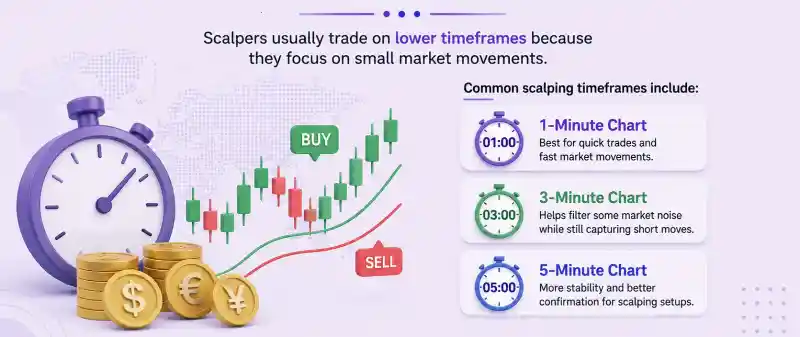
Scalpers usually trade on lower timeframes because they focus on small market movements.
Common scalping timeframes include:
- 1-Minute Chart
- 3-Minute Chart
- 5-Minute Chart
Some traders combine multiple timeframes to improve market context.
For example:
- 5-minute chart for overall direction
- 1-minute chart for trade entries
Best Trading Sessions for Scalping
Market liquidity and volatility are extremely important for scalping strategy in forex.
Most scalpers prefer active trading sessions where price movement becomes faster.
Popular Scalping Sessions
- London Session
- New York Session
- London-New York Overlap
These sessions often provide:
- Higher liquidity
- Faster price movement
- Tighter spreads
- Better trade execution conditions
Trader Insight: Why Scalping Is Mentally Demanding
Many beginners believe scalping is easier because trades close quickly.
In reality, scalping strategy in forex can become mentally exhausting.
Scalpers often need to:
- Monitor charts continuously
- Make rapid decisions
- Control emotional reactions
- Handle frequent wins and losses
- Maintain concentration for long periods
Emotional discipline becomes extremely important because poor decisions can accumulate rapidly during fast trading conditions.
This is one reason many traders eventually transition toward slower trading styles after experimenting with scalping.
Risk Management in Scalping Strategy in Forex
Risk management is one of the most important parts of successful scalping.
Because scalpers often trade frequently, uncontrolled losses can build up quickly.
Important Risk Management Rules
- Use stop losses consistently
- Avoid excessive leverage
- Limit emotional revenge trading
- Control position sizes carefully
- Avoid overtrading during poor conditions
Many beginner scalpers fail because they focus entirely on entries while ignoring risk control.
Why Spreads Matter in Scalping
Spread costs are extremely important in scalping strategy in forex.
Since scalpers target small price movements, large spreads can significantly reduce profitability.
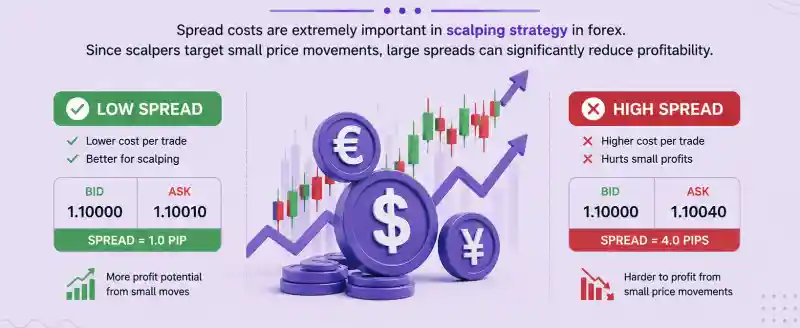
For example:
- A 5-pip target becomes less attractive if spreads consume 2–3 pips
This is why scalpers usually prefer:
- Highly liquid currency pairs
- Low-spread trading sessions
- Fast trade execution
Common Beginner Mistakes in Forex Scalping
- Overtrading: Many beginners take too many trades without proper setups.
- Using Excessive Leverage: High leverage magnifies losses quickly during fast-moving conditions.
- Ignoring Trading Costs: Spread and commission costs can affect scalping profitability significantly.
- Trading Without a Plan: Scalping requires structured decision-making, not emotional reactions.
- Revenge Trading After Losses: Fast losses often trigger emotional overtrading behavior.
Advantages of Scalping Strategy in Forex
- Frequent trading opportunities
- Limited overnight risk exposure
- Quick trade feedback
- Potentially reduced long-term market uncertainty
Some traders enjoy the active nature of scalping because it keeps them highly engaged with the market.
Disadvantages of Scalping Strategy in Forex
- Mentally exhausting
- Requires strong concentration
- High emotional pressure
- Spread costs become important
- Overtrading risk increases
- Fast losses can accumulate quickly
Scalping is not suitable for every personality type.
Who Should Consider Scalping?
Scalping strategy in forex may suit traders who:
- Prefer fast-paced environments
- Can maintain concentration for long periods
- Handle emotional pressure well
- Enjoy active market participation
- Understand risk management properly
Traders who prefer slower analysis or less screen time may prefer swing trading or position trading instead.
How Experienced Scalpers Approach the Market
Professional scalpers usually focus heavily on:
- Discipline
- Trade quality
- Fast execution
- Risk control
- Consistent routines
Experienced traders understand that scalping success rarely comes from gambling behavior or emotional trading.
Instead, consistency and structured execution often matter more than aggressive risk-taking.
Safety Analysis: Is Scalping Risky
Scalping can become risky if traders use excessive leverage or trade emotionally.
The fast pace of scalping increases the likelihood of:
- Emotional mistakes
- Overtrading
- Rapid losses
- Stress-related decision-making
However, disciplined traders who manage risk carefully may reduce unnecessary mistakes over time.
Understanding emotional control is just as important as understanding technical setups.
Final Verdict
Scalping strategy in forex remains one of the most active and fast-paced trading styles in the currency market.
While scalping offers frequent opportunities and quick market participation, it also demands discipline, emotional control, fast execution, and proper risk management.
Many beginners are attracted to scalping because of the potential for rapid results, but the psychological pressure and trading speed often become more difficult than expected.
Successful scalpers usually focus more on consistency, structured decision-making, and controlled risk exposure rather than aggressive gambling behavior.
For traders willing to develop patience, discipline, and emotional control, scalping strategy in forex may become a useful short-term trading approach.

