

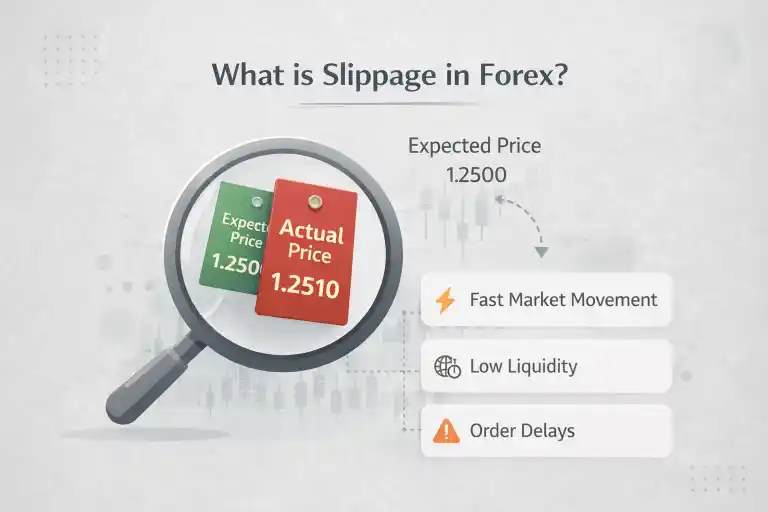
Slippage in forex is one of the most important concepts every beginner trader must understand before entering the market. It refers to the difference between the price you expect when placing a trade and the actual price at which your trade is executed.
Many new traders assume that orders are always filled at the exact price they see on their screen. However, in real market conditions, prices move quickly, and this is where slippage comes into play.
This guide will help you understand what slippage in forex is, why it happens, its types, and how you can manage it effectively as a trader.
What Does Slippage in Forex Mean
Slippage in forex occurs when there is a gap between your intended trade price and the execution price. This usually happens in fast-moving markets where prices change within milliseconds.
For example, if you place a buy order at a certain price, but the market moves before your order is executed, your trade may be filled at a slightly different price.
This difference is known as slippage, and it can work both in your favor or against you.
Types of Slippage in Forex
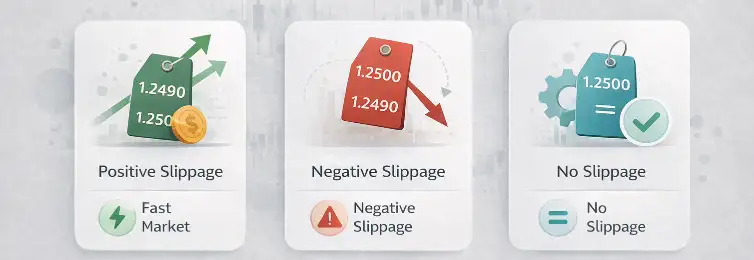
There are two main types of slippage in forex trading that every trader should understand:
1. Positive Slippage
Positive slippage happens when your trade is executed at a better price than expected. This means you get an advantage from the price movement.
- You place a buy order at 1.1000
- Your trade gets executed at 1.0998
- You gain extra value due to better pricing
This type of slippage benefits traders, although it is less talked about compared to negative slippage.
2. Negative Slippage
Negative slippage occurs when your trade is executed at a worse price than expected. This leads to a slightly higher cost or reduced profit.
- You place a buy order at 1.1000
- Your trade gets executed at 1.1003
- You lose a few extra pips due to price movement
This is the more common type of slippage and can impact your overall trading performance if not managed properly.
Why Slippage Happens in Forex Trading
Understanding the causes of slippage in forex can help you avoid unexpected outcomes. Slippage mainly occurs due to the following reasons:
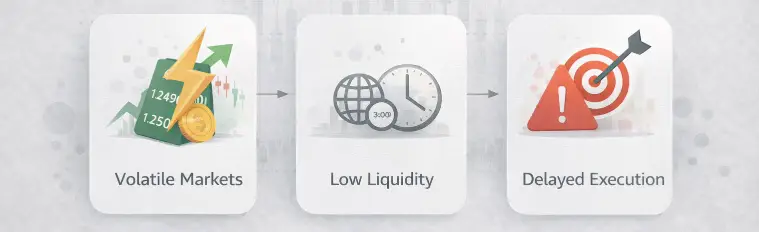
- High Market Volatility: Rapid price movements can cause execution delays.
- Low Liquidity: Fewer buyers and sellers lead to price gaps.
- Fast Price Changes: Prices can shift within milliseconds.
- Major Economic Events: News releases can trigger sudden movements.
- Execution Speed: Slow trade execution increases slippage chances.
These factors are a normal part of the forex market and cannot be completely eliminated.
Slippage and Market Conditions
Slippage in forex is not random—it is closely linked to market conditions. It becomes more noticeable during specific situations:
- High-impact news releases (interest rates, inflation data, GDP)
- Market opening and closing hours
- Unexpected global events
During stable market periods, slippage is usually minimal because price movements are slower and more predictable.
How Slippage in Forex Affects Your Trades
Slippage directly impacts your trading results, especially if you trade frequently or use tight stop losses.
Here’s how it can affect your trades:
- Increased Trading Costs: Negative slippage can reduce profits.
- Unexpected Losses: Trades may close at worse prices.
- Execution Differences: Entry and exit points may vary.
Even small differences in price can accumulate over multiple trades, affecting your long-term performance.
Slippage and Stop Loss Orders
One of the most important areas where slippage in forex plays a role is in stop loss execution.
Many beginners believe their stop loss will always execute at the exact level they set. However, during fast market movements, this is not always possible.

- Your stop loss may be triggered at a worse price
- This can lead to larger-than-expected losses
This is why traders must consider market volatility when setting stop loss levels.
How to Reduce Slippage in Forex
While slippage in forex cannot be completely avoided, there are practical ways to reduce its impact:
- Avoid trading during major news announcements
- Trade during high liquidity sessions like London and New York
- Choose brokers with fast and reliable execution
- Avoid trading low-volume or exotic currency pairs
- Use limit orders instead of market orders when possible
These simple adjustments can significantly improve your trade execution quality.
Common Mistakes Traders Make
Many beginner traders ignore slippage, which can lead to poor trading decisions. Here are some common mistakes:
- Ignoring slippage in trading plans
- Trading during high volatility without preparation
- Using extremely tight stop losses
- Choosing brokers with poor execution speed
Avoiding these mistakes can help you build a more consistent trading strategy.
Pro Tips for Beginners
If you are new to trading, keep these practical tips in mind when dealing with slippage in forex:
- Accept that slippage is a normal part of trading
- Always plan trades with a small buffer
- Avoid overtrading in unstable market conditions
- Focus on long-term strategy instead of small price differences
These habits will help you manage risk more effectively and stay consistent.
Final Thoughts
Slippage in forex is a natural and unavoidable part of trading in real market conditions. Whether it works in your favor or against you, it is something every trader experiences.
The key is not to avoid slippage completely, but to understand it and manage its impact through proper planning, strategy, and discipline.
By learning how slippage works, you prepare yourself for realistic trading conditions and reduce unexpected surprises in your trading journey.
To better manage trade execution, you should also learn about Volatility in Forex and Stop Loss in Forex, as both directly influence slippage in the market.

