


Most beginners focus entirely on entries and exits while ignoring spread, commission, and swap — the three quiet costs that sit behind every single trade. Individually, each one looks small enough to dismiss. Combined and repeated across dozens or hundreds of trades, spread, commission, and swap can be the difference between a strategy that looks profitable on paper and one that actually survives real trading conditions. Understanding exactly how these costs work is essential before judging whether any trading system is genuinely viable.
What Spread, Commission, and Swap Actually Are
Spread
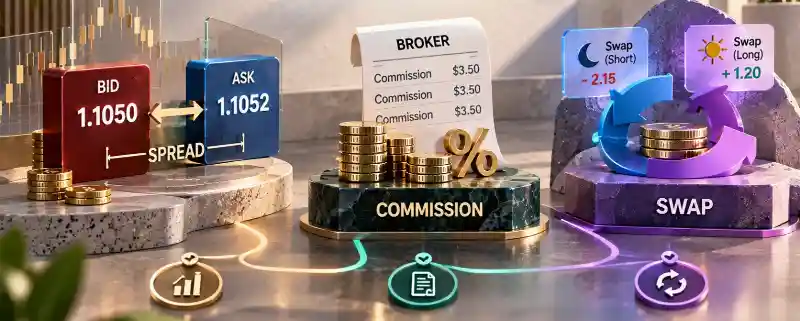
The spread is the difference between the bid (sell) and ask (buy) price of a currency pair. It’s effectively a built-in cost paid the moment a trade opens, since a position starts slightly in the negative equal to the spread size.
Commission
Commission is a separate fee some brokers charge per trade, usually on raw spread or ECN-style accounts, calculated per lot traded rather than built into the price itself.
Swap
Swap, also called rollover, is the interest charged or credited for holding a position open overnight, based on the interest rate differential between the two currencies in the pair. It applies every night a position stays open past the market’s daily rollover time.
6 Costly Truths About How These Costs Affect Profitability
1. Spread Costs Compound With Trading Frequency
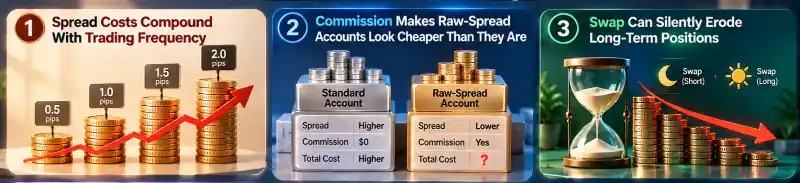
A trader who takes 5 trades a day pays the spread cost five times daily, every single day. Strategies with high trade frequency, like scalping, need a genuinely strong edge just to overcome this repeated cost — a small edge can be completely erased by spread alone.
2. Commission Makes Raw-Spread Accounts Look Cheaper Than They Are
Raw-spread or ECN accounts advertise tighter spreads, but the commission charged per lot often makes the real total cost similar to, or sometimes higher than, a standard account with a wider spread and no commission. Comparing total cost per trade — spread plus commission — matters more than looking at either number alone.
3. Swap Can Silently Erode Long-Term Positions
Swing traders and position traders holding trades for days or weeks accumulate swap charges that can meaningfully reduce overall returns, especially on pairs with a large negative swap rate. A profitable-looking long-term trade can end up far less profitable once weeks of swap charges are subtracted.
4. Costs Vary Significantly Between Brokers
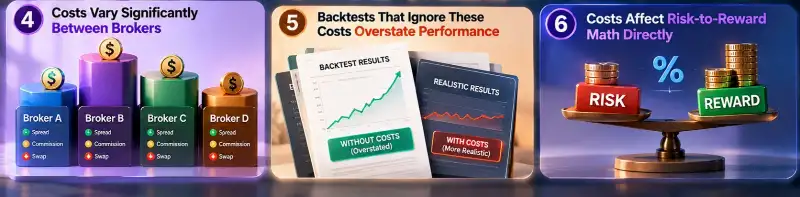
Spread, commission, and swap rates aren’t standardized — they differ meaningfully between brokers and even between account types at the same broker. A strategy that’s profitable at one broker’s cost structure can become marginal or unprofitable at another’s, which is why understanding how forex brokers execute your trades matters just as much as comparing headline spread numbers.
5. Backtests That Ignore These Costs Overstate Performance
A backtest run without factoring in realistic spread, commission, and swap will almost always show better results than live trading ever will. This gap is one of the most common reasons a strategy that looked strong in testing disappoints once real costs are applied, which is exactly why how to backtest a forex strategy properly includes accounting for real trading costs as a required step, not an optional one.
6. Costs Affect Risk-to-Reward Math Directly
A trade planned with a 1:2 risk-to-reward ratio on paper effectively shrinks once spread and commission are subtracted from the realized profit. Traders who don’t factor this in often overestimate their actual edge, especially on shorter timeframes where the cost represents a larger percentage of the total expected move.
A Real Example: The Same Strategy, Two Different Outcomes
Picture a scalping strategy that backtests at a 55% win rate with a 1:1.5 risk-to-reward ratio, showing solid theoretical profitability. Once the trader accounts for a 1.2-pip spread and $3 commission per lot across dozens of trades per week, the strategy’s actual edge shrinks dramatically, turning what looked like a solid system into one that barely breaks even. The strategy itself wasn’t flawed — the backtest simply never accounted for spread, commission, and swap in the first place.
How to Reduce the Impact of These Costs
- Match trading style to cost structure: High-frequency strategies benefit from lower total cost accounts, while longer-term strategies should pay closer attention to swap rates on the specific pairs being held.
- Compare total cost, not just spread: Always calculate spread plus commission together when comparing account types or brokers.
- Check swap rates before holding overnight: Some pairs carry significantly higher negative swap than others, which matters for anything held longer than a day.
- Include realistic costs in every backtest: Never judge a strategy’s viability without factoring in what it will actually cost to execute repeatedly in live conditions.
Why This Matters More With Fast Execution
Costs interact directly with how and when your orders fill. A trade that slips a pip or two on entry, combined with spread and commission, changes the real cost basis of every position. Understanding forex execution and order fill alongside these costs gives a much more complete picture of what a trade actually costs from click to close, rather than looking at spread in isolation.
Final Thoughts
Spread, commission, and swap rarely get the attention they deserve, yet they directly determine whether a strategy’s theoretical edge survives contact with real trading conditions. Ignoring these costs during planning and backtesting is one of the fastest ways to be genuinely surprised by the gap between expected and actual results. Traders who factor these costs in from the start build far more realistic expectations — and far more durable trading systems — than those who only think about entries and exits.
FAQs
Which cost usually has the biggest impact on profitability?
It depends on trading style. Spread and commission matter most for high-frequency traders, while swap has a bigger impact on traders holding positions for days or weeks.
Can swap ever work in a trader’s favor?
Yes. Depending on the interest rate differential and trade direction, swap can sometimes be credited rather than charged, though this varies by pair and by broker.
Do all brokers charge commission?
No. Many standard accounts build the cost into a wider spread instead of charging separate commission, while ECN or raw-spread accounts typically charge commission alongside a much tighter spread.

