

FOMO in forex trading — the fear of missing out (FOMO) on a move already underway — is one of the most common reasons disciplined traders abandon their own rules mid-session. It doesn’t feel like recklessness in the moment; it feels like urgency. This guide breaks down exactly what FOMO looks like in practice, seven dangerous signs that you’re trading on it, and practical ways to bring it back under control.
What Is FOMO in Forex Trading?
FOMO in forex trading happens when a trader enters (or exits) a position primarily because of anxiety about missing a move, rather than because a genuine, pre-defined setup has formed. It’s driven by watching price action in real time — seeing a pair run without you, or watching other traders post gains — rather than by objective analysis. The trade itself might occasionally work out, but the decision-making process behind it is fundamentally different from a planned entry.
Why FOMO in Forex Trading Is So Powerful
FOMO taps into loss aversion — the psychological tendency to feel the pain of a missed gain almost as strongly as an actual loss. When price moves quickly in one direction, the brain registers “not participating” as a kind of loss, even though no capital has actually been risked yet. This is what makes FOMO in forex trading so difficult to resist purely through willpower; it isn’t a rational calculation being overridden, it’s an emotional response that happens before conscious analysis kicks in.
7 Dangerous Signs You’re Trading on FOMO
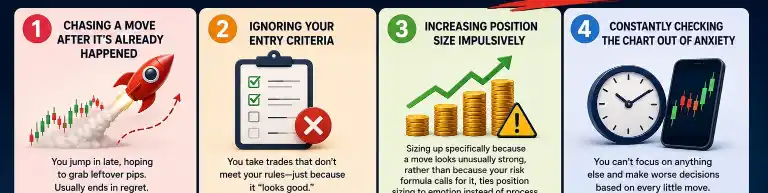
1. Chasing a Move After It’s Already Happened
Entering a trade because price has already run significantly, rather than because your setup formed at a logical point, is the clearest sign of FOMO-driven entry.
2. Ignoring Your Entry Criteria
If you find yourself entering without your usual confirmation — a specific candle pattern, indicator alignment, or structural break — and justifying it as “this one’s obvious,” that justification is often FOMO talking.
3. Increasing Position Size Impulsively
Sizing up specifically because a move looks unusually strong, rather than because your risk formula calls for it, ties position sizing to emotion instead of process.
4. Constantly Checking the Chart Out of Anxiety
Refreshing the chart every few seconds during a strong move, rather than checking it at planned intervals, is a behavioral sign that anxiety — not analysis — is driving your attention.
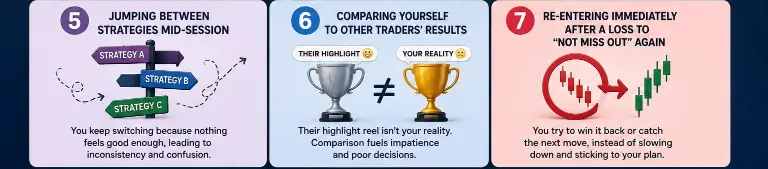
5. Jumping Between Strategies Mid-Session
Abandoning your usual strategy to chase a completely different setup because “this looks too good to pass up” often signals FOMO overriding your normal process.
6. Comparing Yourself to Other Traders’ Results
Seeing other traders post wins on a move you missed can trigger a strong urge to force a similar trade yourself, even when your own setup hasn’t formed.
7. Re-Entering Immediately After a Loss to “Not Miss Out” Again
This sign overlaps with revenge trading, but the underlying driver is often FOMO specifically — the fear that the market will keep moving without you if you don’t get back in immediately.
The Psychological Roots of FOMO
FOMO in forex trading is closely tied to two well-studied biases: loss aversion, discussed above, and social proof — the tendency to feel more confident in a decision simply because others appear to be making it too. Social media and trading communities can amplify this significantly, since seeing screenshots of other traders’ wins in real time creates a constant stream of “missed opportunity” signals, whether or not those results are representative or even accurate.
FOMO vs. Genuine Momentum Trading
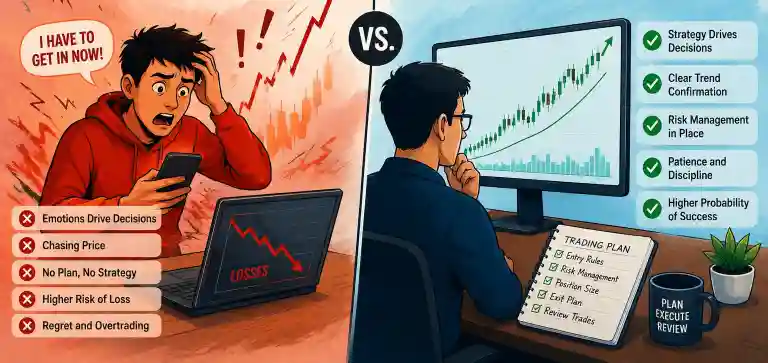
Understanding FOMO in Forex Trading also means recognizing that not every fast entry into a moving market is driven by emotion. Momentum and breakout strategies are legitimate approaches that intentionally enter after a move has already started. The key difference is not how quickly the trade is placed, but whether it follows a pre-defined, tested strategy or is simply a reaction to watching price move without a plan. A momentum trader has clear entry criteria, confirmation signals, and invalidation levels established before entering the trade, even if the setup appears similar to a FOMO entry.
This distinction is important because some traders justify emotionally driven entries by calling them “momentum trades” after the fact, despite having no tested momentum strategy. A useful way to evaluate your decision is to ask whether you could clearly explain your entry criteria before placing the trade, rather than only after the outcome is known.
How FOMO Shows Up Differently Across Trading Styles
FOMO in forex trading doesn’t look identical for every type of trader. Scalpers tend to experience it as a rapid, repeated urge to jump into every small move throughout the session, since their short holding periods mean missed opportunities feel constant. Swing traders more often experience FOMO around major news events or multi-day trends, where a single missed move can represent a much larger potential gain relative to their normal trade size.
Understanding which pattern applies to your own trading style makes it easier to build a targeted safeguard — a scalper might benefit most from stricter per-session trade limits, while a swing trader might get more value from a strict rule about not entering mid-trend without a pullback confirmation, regardless of how strong the move already looks.
How to Control FOMO in Forex Trading
- Write your entry criteria down and treat it as a checklist — if a trade doesn’t check every box, it doesn’t get taken, regardless of how the chart looks in the moment.
- Limit real-time exposure to trading social media during active trading hours, since it’s one of the biggest amplifiers of FOMO.
- Use price alerts instead of watching charts constantly — this removes the anxiety-driven checking behavior described in sign #4.
- Accept that missed moves are a normal cost of discipline, not a failure — every strategy that filters out bad trades will also occasionally filter out some good ones.
- Keep a journal specifically noting FOMO-driven trades so you can measure their actual win rate against your planned trades over time. Our guide to trading journal metrics covers how to track this kind of pattern.
These control strategies work best alongside the broader consistency principles covered in our forex trading strategy for beginners guide, since FOMO is ultimately a consistency problem as much as an emotional one.
Real-World Example: FOMO in Action
A trader watches a currency pair rally 60 pips in fifteen minutes without a position open. Despite no valid setup on their own strategy, they enter late, reasoning that “it’s still going.” Price reverses shortly after, filling their late entry near the top of the move. The loss that follows often triggers exactly the kind of impulsive re-entry described in sign #7 — closely related to the pattern covered in why traders overtrade after a winning streak, since both patterns share the same underlying loss of discipline once emotion takes over from process.
Final Thoughts
FOMO in forex trading isn’t a sign of weak discipline in general — it’s a specific, predictable psychological response that even experienced traders have to actively manage. Recognizing the seven signs covered here, and building simple structural safeguards like written entry criteria and reduced real-time chart exposure, does far more to control FOMO than relying on willpower alone in the heat of a fast-moving market. Over time, these safeguards become habits rather than active effort, which is ultimately what separates traders who occasionally slip into FOMO from those who consistently trade around it.
FAQs
Is FOMO the same as overtrading?
They’re closely related but not identical. FOMO is the emotional trigger — fear of missing a move — while overtrading is often the resulting behavior, though overtrading can also stem from other causes like overconfidence after wins. Understanding which trigger applies to a specific bad trade helps target the right fix rather than applying a generic discipline rule that doesn’t address the actual cause.
Can experienced traders still struggle with FOMO?
Yes. FOMO in forex trading affects traders at every experience level, since it’s driven by a psychological response rather than a lack of technical knowledge. Experienced traders often manage it better not because they feel it less, but because they’ve built specific structural safeguards against acting on it.
What’s the single most effective way to reduce FOMO?
Writing down specific entry criteria in advance and treating it as a strict checklist tends to be the most effective single safeguard, since it removes the in-the-moment judgment call that FOMO exploits. Pairing this with reduced exposure to real-time trading social media further reduces how often the urge is triggered in the first place.

