

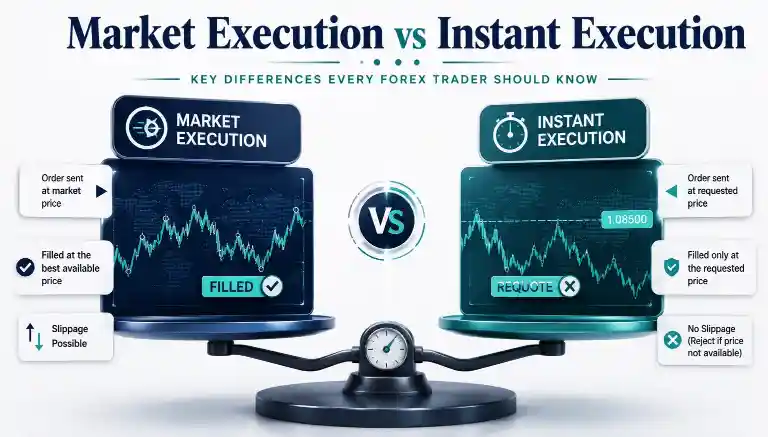
Every time you place a trade in the Forex market, your order must be executed before you can enter or exit a position. Most traders pay close attention to the price at which they buy or sell, but very few consider how their order is actually executed behind the scenes. In reality, the execution method used by your broker can influence your trading experience, particularly during periods of high market activity.
Two of the most common execution methods offered by Forex brokers are Market Execution and Instant Execution. Although both methods allow traders to open and close positions, they operate differently and may produce different outcomes under changing market conditions.
Many beginners assume these execution methods are simply different names for the same process. However, each method follows its own order handling procedure, which affects price confirmation, requotes, execution speed, and the possibility of slippage.
Understanding the difference between these execution models can help traders choose the right account type, interpret broker specifications correctly, and develop realistic expectations about how orders behave during both normal and volatile market conditions.
In this guide, we will compare Market Execution vs Instant Execution, explain how each method works, discuss their advantages and limitations, and help you determine which execution model may better suit your trading style.
Why Understanding Order Execution Matters in Forex Trading
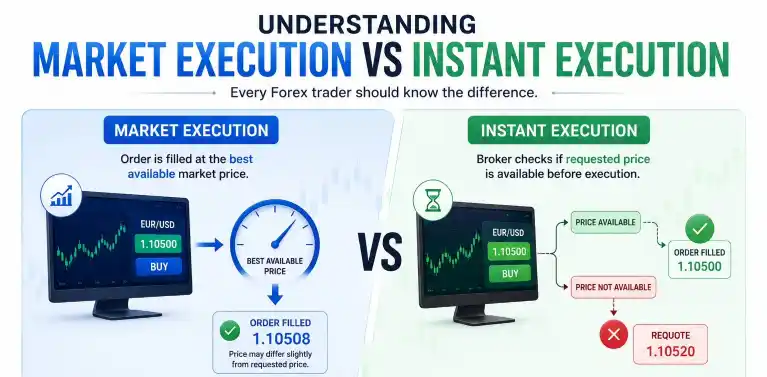
Understanding Market Execution vs Instant Execution is important for every Forex trader because the way an order is processed can directly affect the price at which a trade is executed, particularly during fast-moving market conditions.
Every successful trade begins with sending an order to the market. However, different execution methods handle orders differently. For example, after identifying a buying opportunity on EUR/USD through technical analysis, you may place a Buy order expecting to enter at 1.10500.
With Market Execution, the order is typically filled at the best available market price, even if it differs slightly from the requested price. With Instant Execution, the broker first checks whether your requested price is still available before executing the trade or returning a requote.
While these differences may seem small during normal market conditions, they become much more significant during periods of high volatility, when prices can change multiple times within a second.
Understanding Market Execution vs Instant Execution helps traders know what to expect when placing orders, reducing confusion during fast market movements and allowing them to choose the execution method that best suits their trading style.
Key Takeaway: There is no single execution method that is right for every trader. Understanding Market Execution vs Instant Execution enables you to make informed decisions based on your trading strategy, market conditions, and risk management approach.
What Is Market Execution?
When comparing Market Execution vs Instant Execution, it is important to understand how Market Execution works. Market Execution is an order execution method in which a broker fills a trade at the best available market price as soon as the order reaches the market.
Rather than guaranteeing the exact price displayed when you click Buy or Sell, the broker prioritizes fast execution using the available market liquidity. If market prices remain stable, the execution price is often very close to the requested price.
However, if the market moves while the order is being processed, the trade may be executed at a different price. This price difference is known as slippage and can be either positive or negative, depending on market conditions.
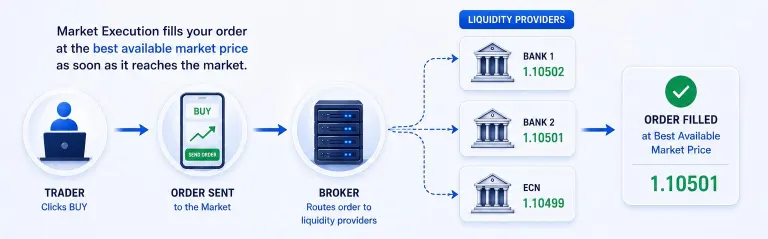
Unlike Instant Execution, Market Execution typically does not require the broker to request additional confirmation when the price changes. Instead, the order is executed at the best available price, making this method well suited for traders who prioritize speed and reliable order execution in fast-moving markets.
This understanding of Market Execution provides an important foundation for comparing Market Execution vs Instant Execution and choosing the execution method that best matches your trading style.
How Market Execution Works
To better understand this process, consider the following sequence.
- The trader submits a market order.
- The order reaches the broker’s trading server.
- The broker routes the order to available liquidity.
- The order is executed at the best available market price.
Because the market is constantly moving, the final execution price may differ slightly from the price displayed when the order was submitted.
This approach is widely used by ECN and STP brokers because their goal is to execute trades based on available market liquidity rather than guaranteeing a specific quoted price.
Professional Trader Insight: Professional traders generally accept small execution price differences during active markets because obtaining immediate execution is often more valuable than waiting for exact price confirmation.
What Is Instant Execution?
When comparing Market Execution vs Instant Execution, Instant Execution follows a different approach to processing orders. With this method, the trader requests that the trade be executed at the exact price displayed on the trading platform.
Before completing the order, the broker checks whether the quoted price is still available. If it is, the trade is executed at the requested price. However, if the market has moved and the quoted price is no longer available, the broker may reject the original request and provide a new price.
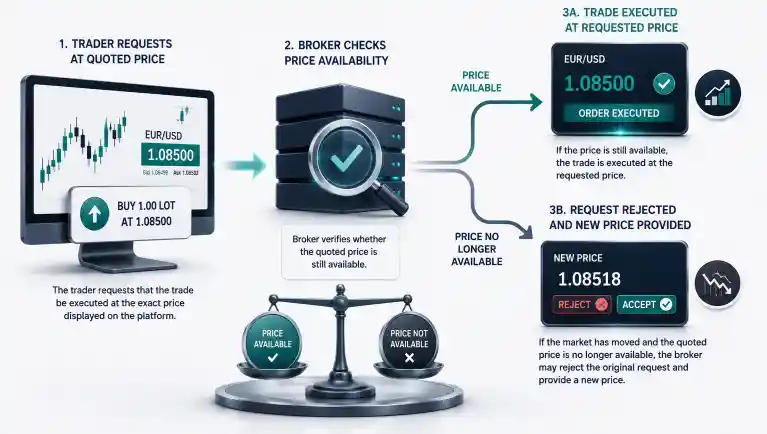
This process is known as a requote. The trader can then choose to accept the updated price or cancel the order altogether.
Unlike Market Execution, which prioritizes speed, Instant Execution focuses on price confirmation before the trade is completed. Understanding this difference is essential when evaluating Market Execution vs Instant Execution, as each method offers distinct advantages depending on market conditions and your trading strategy.
How Instant Execution Works
The order flow typically follows these steps.
- The trader submits an order at a quoted price.
- The broker verifies whether that price remains available.
- If available, the order is executed immediately.
- If unavailable, a requote may be issued.
- The trader either accepts or rejects the new price.
This additional confirmation process explains why Instant Execution may sometimes feel slower during fast-moving markets.
Instead of automatically executing at the next available price, the broker first requests approval for the updated quote.
Market Execution vs Instant Execution: Understanding the Key Differences
Although both execution methods ultimately allow traders to enter and exit positions, their underlying processes differ considerably.
| Feature | Market Execution | Instant Execution |
|---|---|---|
| Execution Price | Best available market price | Requested quoted price |
| Requotes | Normally not used | Possible |
| Slippage | Possible | Less common before a requote, depending on broker policies |
| Order Speed | Usually faster | Depends on price confirmation |
| Suitable During Volatility | Generally better | May generate additional requotes |
Neither method is universally superior.
The choice depends on market conditions, broker technology, and individual trading preferences.
Key Takeaway: Market Execution prioritizes immediate execution, while Instant Execution prioritizes confirming the requested price before the trade is completed.
How Slippage Affects Both Execution Types
Although both execution methods may involve price differences under certain market conditions, the way those differences occur is different.
With Market Execution, price changes are generally accepted automatically because the objective is to fill the order using the best available market price.
With Instant Execution, the broker first checks whether the requested quote still exists. If the market has moved significantly, the broker may provide a requote instead of immediately filling the order.
This distinction explains why traders sometimes experience different execution behavior depending on the type of trading account they use.
It is also important to remember that execution quality depends not only on the execution method itself but also on market liquidity, volatility, broker infrastructure, and order routing technology.
When Market Execution Is Often Preferred
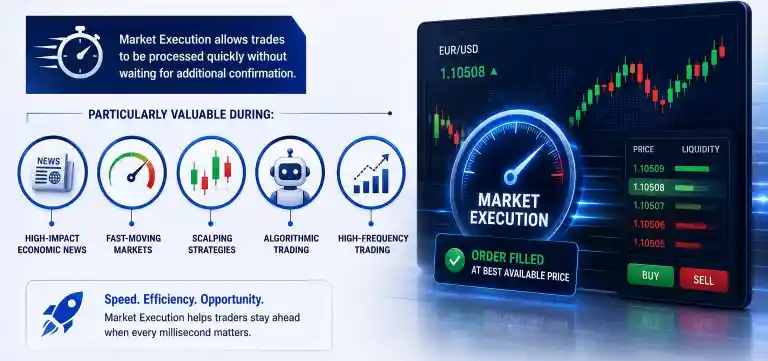
Many professional traders prefer Market Execution because it allows trades to be processed quickly without waiting for additional confirmation.
This can be particularly valuable during:
- High-impact economic news.
- Fast-moving markets.
- Scalping strategies.
- Algorithmic trading.
- High-frequency trading.
Although slight price differences may occasionally occur, immediate execution often outweighs the inconvenience of waiting for requotes when markets are moving rapidly.
When Instant Execution May Be More Suitable
When comparing Market Execution vs Instant Execution, it’s important to remember that there is no single execution method that suits every trading style. While Market Execution is commonly used by many Forex brokers, Instant Execution can be a better choice in certain situations.
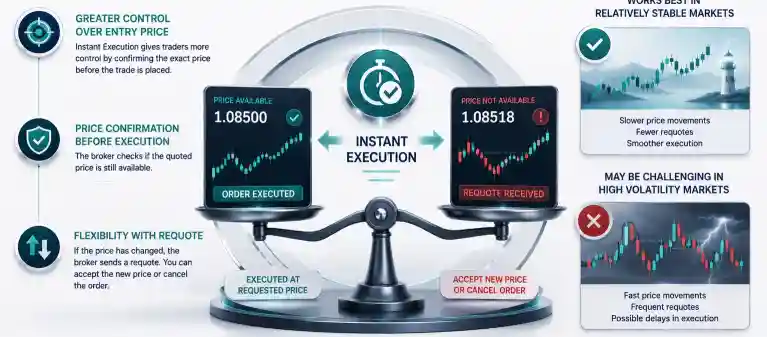
Instant Execution is often preferred by traders who want greater control over their entry price. Before executing an order, the broker checks whether the quoted price is still available. If the market has moved, the broker may issue a requote, giving the trader the option to accept the new price or cancel the order.
This execution method can work well in relatively stable market conditions, where price movements are slower and requotes are less common. However, during periods of high volatility, frequent requotes may delay order execution and make it harder to enter the market at the desired time.
Key Takeaway: Understanding Market Execution vs Instant Execution helps traders choose the execution method that best matches their trading strategy. Instant Execution offers greater price confirmation, but this added control may result in slower trade execution when markets move quickly.
Market Execution vs Instant Execution for Different Trading Styles
The importance of each execution method depends largely on your trading strategy and the amount of time your trades remain open.
| Trading Style | Recommended Execution Method | Reason |
|---|---|---|
| Scalping | Market Execution | Fast execution is generally more important than waiting for price confirmation. |
| Day Trading | Market Execution | Quick entries and exits help traders respond to changing market conditions. |
| Swing Trading | Either Method | Small execution differences often have less impact on larger price targets. |
| Position Trading | Either Method | Long-term trades usually focus more on overall market direction than a few pips of entry difference. |
There is no universal execution method that suits every trader. Your preferred execution type should align with your trading objectives, strategy, and tolerance for requotes or price differences.
Real-World Trading Examples
Example 1: Market Execution During High Volatility
Suppose a trader places a Buy order on GBP/USD immediately after the Bank of England announces an unexpected interest rate increase.
The market moves rapidly, and the requested price is no longer available.
Using Market Execution, the broker processes the order at the next available market price without asking for additional confirmation. Although the execution price may differ slightly from the requested price, the trader enters the market without delay.
Example 2: Instant Execution During Stable Conditions
Another trader opens a position on EUR/USD during a quiet trading session with relatively stable price movement.
The requested price is still available when the order reaches the broker’s server, so the trade is executed exactly as requested without any requote.
These examples illustrate that the effectiveness of each execution method depends largely on market conditions rather than one method being inherently better than the other.
How Broker Execution Models Influence Order Execution
The execution method offered by a broker is often connected to its overall execution model and trading infrastructure.
Many ECN (Electronic Communication Network) and STP (Straight Through Processing) brokers primarily use Market Execution because they route client orders directly to liquidity providers or the broader market.
Some brokers, particularly those offering dealing desk services, may also provide Instant Execution accounts where quoted prices are confirmed before execution.
Regardless of the execution method, reliable brokers invest heavily in modern trading servers, stable network infrastructure, and efficient order-routing technology to improve execution quality.
When comparing brokers, traders should evaluate more than just spreads or commissions. Regulation, execution consistency, platform reliability, and transparency are equally important factors.
Common Beginner Mistakes
Mistake 1: Assuming One Execution Method Is Always Better
Many beginners search for the “best” execution method without considering their own trading style. In reality, both methods have advantages and limitations depending on market conditions.
Mistake 2: Confusing Requotes with Slippage
Although both involve price differences, requotes and slippage are not the same.
A requote asks the trader to approve a new price before execution, while slippage occurs when an order is executed at the next available market price after the requested price is no longer available.
Mistake 3: Ignoring Market Conditions
Even the best execution technology cannot prevent rapid price movement during major economic events.
Understanding market volatility helps traders develop realistic expectations regarding execution quality.
Mistake 4: Choosing a Broker Based Only on Low Spreads
Low spreads are attractive, but execution quality depends on several additional factors, including liquidity providers, server performance, order-routing technology, and regulatory oversight.
Tips for Choosing the Right Execution Method
If you are selecting between Market Execution and Instant Execution, consider the following practical guidelines:
- Choose Market Execution if your strategy depends on entering trades quickly.
- Consider Instant Execution if confirming the requested price is more important than immediate execution.
- Review your broker’s execution policy before opening an account.
- Test execution quality using a demo account or a small live account before increasing position sizes.
- Remember that execution quality should be evaluated over many trades rather than based on one isolated experience.
Professional Trader Insight: Experienced traders rarely choose a broker based solely on execution type. Instead, they evaluate the broker’s overall reliability, regulation, pricing transparency, and long-term execution consistency.
Final Thoughts
Understanding Market Execution vs Instant Execution helps traders choose the execution method that best fits their trading style and market conditions. While Market Execution prioritizes fast order execution, Instant Execution focuses on price confirmation before a trade is placed.
There is no universally better option. By understanding Market Execution vs Instant Execution and choosing a well-regulated broker with reliable execution, traders can make more informed decisions and trade with greater confidence.

