


Daily Drawdown vs Maximum Drawdown is a comparison that every Forex trader, especially those trading funded or prop firm accounts, should understand. Risk management plays a crucial role in long-term trading success, and drawdown limits are among the most important rules traders must follow to protect their accounts.
While many traders focus on developing profitable strategies, managing risk effectively is what helps preserve trading capital over time. This is particularly important in funded accounts, where exceeding drawdown limits can result in losing the account regardless of previous profits.
Although both daily drawdown and maximum drawdown are designed to control risk, they measure losses in different ways. Understanding how each rule works can help traders manage positions more effectively, avoid unnecessary rule violations, and maintain consistent trading discipline.
In this guide, we explain the difference between Daily Drawdown vs Maximum Drawdown, how each rule is calculated, why prop firms enforce these limits, and practical ways to stay within acceptable risk parameters.
What Is Daily Drawdown

Daily drawdown is the maximum amount a trader is permitted to lose during a single trading day. This rule is commonly used by prop firms to limit excessive losses and encourage disciplined risk management.
Depending on the firm’s policy, the daily drawdown is typically calculated using either the account balance or account equity at the start of the trading day. For example, if a funded account starts the day with a balance of $100,000 and has a 5% daily drawdown limit, the maximum allowable loss for that day would be $5,000.
Exceeding this limit may result in a rule violation or the loss of a funded account, regardless of previous trading performance. By setting a daily loss limit, prop firms encourage traders to avoid emotional decision-making and stop trading after significant losses rather than attempting to recover them through excessive risk-taking.
What Is Maximum Drawdown
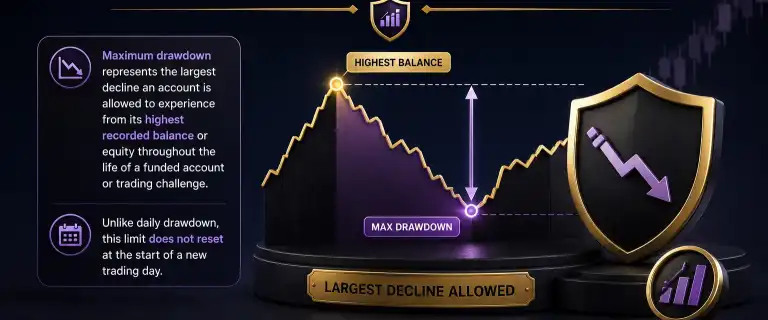
Maximum drawdown represents the largest decline an account is allowed to experience from its highest recorded balance or equity throughout the life of a funded account or trading challenge. Unlike daily drawdown, this limit does not reset at the start of a new trading day.
Its primary purpose is to protect the firm’s capital by ensuring that overall account losses remain within a predefined limit. For example, if a $100,000 funded account has a 10% maximum drawdown, the account value must not fall below $90,000 at any point.
Whether losses occur in a single day or accumulate gradually over several weeks, exceeding the maximum drawdown limit is generally considered a rule violation and may result in account termination. This rule encourages traders to focus on consistent long-term risk management rather than short-term trading results.
Daily Drawdown vs Maximum Drawdown: Understanding the Key Differences
Although both rules limit trading losses, they serve different purposes and are calculated differently.
| Feature | Daily Drawdown | Maximum Drawdown |
|---|---|---|
| Time Period | One trading day | Entire account duration |
| Resets Daily | Yes | No |
| Main Purpose | Control daily losses | Protect total account capital |
| Common Use | Funded accounts and evaluations | Funded accounts and evaluations |
The most important difference is that daily drawdown measures short-term losses, while maximum drawdown measures the total decline experienced by the account.
Understanding Daily Drawdown vs Maximum Drawdown helps traders build better risk management habits and avoid unexpected rule violations.
Why Prop Firms Use Both Drawdown Rules
Prop firms provide traders with access to significantly larger trading capital than many individuals could afford on their own. To protect this capital, firms enforce strict risk management rules, making it important for traders to understand Daily Drawdown vs Maximum Drawdown before trading a funded account.
Daily drawdown helps limit losses within a single trading session, reducing the likelihood of emotional or excessive risk-taking after a series of losing trades. Maximum drawdown, in contrast, protects the overall account by limiting the total loss allowed over the lifetime of the account.
By applying both rules, prop firms assess not only a trader’s ability to generate profits but also their consistency in managing risk. Successful trading is not just about achieving profitable trades—it also requires protecting capital through disciplined and responsible risk management.
How Daily Drawdown Is Calculated
The calculation method varies slightly among prop firms, so traders should always review the firm’s official rules before beginning an evaluation.
In general, daily drawdown is calculated using one of the following methods:
- Percentage of the starting account balance for the day.
- Percentage of account equity, including floating profits and losses.
- Static daily loss limits.
For example, imagine a trader begins the day with an account balance of $50,000 and the firm’s daily drawdown limit is 5%.
The maximum loss permitted during that day would be:
- Starting Balance: $50,000
- Daily Drawdown Limit: 5%
- Maximum Daily Loss: $2,500
If the trader’s realized and unrealized losses exceed $2,500 during that trading session, the daily drawdown rule may be breached.
This is why traders should monitor both open positions and closed trades throughout the day.
How Maximum Drawdown Is Calculated
Maximum drawdown represents the largest decline from the highest account value reached during the evaluation or funded account period.
Some firms use a static drawdown, while others apply a trailing maximum drawdown that moves upward as the account grows.
For example:
- Initial Account Balance: $100,000
- Maximum Drawdown Limit: 10%
- Lowest Permitted Balance: $90,000
If the account balance eventually grows to $108,000, some firms may continue using the original drawdown limit, while others adjust the drawdown based on the new account high.
Because each firm has its own calculation method, traders should understand these rules before placing trades.
Failing to understand how maximum drawdown works is one of the most common reasons traders lose funded accounts despite having profitable trading strategies.
Examples of Daily Drawdown vs Maximum Drawdown
Understanding drawdown rules becomes much easier when viewed through practical examples. The following scenarios demonstrate how both rules work in real trading situations.
Example 1: Daily Drawdown
Suppose you are trading a funded account with the following conditions:
- Account Balance: $100,000
- Daily Drawdown Limit: 5%
- Maximum Daily Loss Allowed: $5,000
You begin the trading day with an account balance of $100,000.
Your first trade loses $2,000.
Your second trade loses another $1,500.
Your total loss for the day is now $3,500, leaving you with $1,500 of remaining daily risk.
If your next trade loses $2,000, your total daily loss becomes $5,500. Although your overall account balance remains well above the maximum drawdown limit, you have exceeded the daily drawdown limit and would likely violate the firm’s trading rules.
This example shows why traders must monitor their losses throughout the day instead of focusing only on overall account performance.
Example 2: Maximum Drawdown
Now consider a different scenario.
- Account Balance: $100,000
- Maximum Drawdown Limit: 10%
- Minimum Allowed Balance: $90,000
During the first week, the trader loses $3,000.
During the second week, another $2,000 is lost.
During the third week, the trader loses an additional $6,000.
The total loss now reaches $11,000.
Although the trader never exceeded the daily drawdown limit on any individual trading day, the total account balance has fallen below the maximum drawdown threshold.
In this case, the trader violates the maximum drawdown rule because the overall account decline exceeds the permitted limit.
These examples demonstrate why understanding Daily Drawdown vs Maximum Drawdown is essential for anyone trading funded accounts or prop firm evaluations.
Common Mistakes Traders Make with Drawdown Rules
Many drawdown violations occur because traders misunderstand the rules rather than because they lack trading skill.
- Ignoring Floating Losses: Some prop firms calculate drawdown based on account equity, meaning unrealized losses on open positions may count toward the drawdown limit. Ignoring floating losses can lead to unexpected rule violations.
- Risking Too Much on a Single Trade: Taking excessive risk on one trade can quickly consume both daily and maximum drawdown limits. Many experienced traders limit their risk to a small percentage of account equity to better manage losing streaks.
- Trying to Recover Losses Immediately: Increasing position size after a series of losses, often referred to as revenge trading, can result in even larger losses. Taking a break after a losing session is generally a more disciplined approach.
- Misunderstanding Prop Firm Rules: Each prop firm has its own drawdown calculation method, including balance-based, equity-based, static, or trailing drawdown models. Reviewing the firm’s rules carefully can help avoid unnecessary account breaches.
How to Stay Within Drawdown Limits

Managing drawdown is largely about consistency rather than finding perfect trade entries. Several practical habits can help traders stay within risk limits.
- Risk a Fixed Percentage Per Trade: Many traders risk only 0.5% to 1% of their account on each trade to help preserve capital during losing periods.
- Set a Personal Daily Loss Limit: Rather than trading until the firm’s maximum daily drawdown is reached, many professionals stop trading after reaching their own predefined daily loss limit.
- Avoid Overtrading: Taking trades without clear setups can increase drawdown unnecessarily. Focusing on high-quality opportunities is generally more effective than increasing trade frequency.
- Review Your Trading Journal: Regularly reviewing past trades helps identify recurring mistakes, improve decision-making, and reduce the likelihood of future drawdown violations.
Risk Management Tips for Funded Account Traders
Managing drawdown successfully requires discipline, planning, and consistency.
Some practical risk management techniques include:
- Always use stop-loss orders.
- Never risk your full daily drawdown on one trade.
- Avoid increasing position size after losses.
- Monitor both balance and equity throughout the trading session.
- Understand your firm’s specific drawdown calculations before trading.
- Prioritize long-term consistency over short-term gains.
Professional traders understand that preserving capital is just as important as generating profits.
Remaining within drawdown limits allows traders to continue participating in the market and benefit from future opportunities.
Final Thoughts
Understanding Daily Drawdown vs Maximum Drawdown is essential for anyone trading a funded or prop firm account. Although both rules are designed to manage risk, they serve different purposes—daily drawdown limits losses within a single trading day, while maximum drawdown controls the total loss allowed over the life of the account.
Traders who understand these limits and apply disciplined risk management are generally better equipped to protect their capital and avoid unnecessary rule violations. By managing position sizes responsibly and following a consistent trading plan, traders can build habits that support long-term success in the Forex market.

