


One of the biggest challenges new Forex traders face is determining the right moment to enter a trade. A setup may look perfect on one chart, only to fail moments later because the broader market trend is moving in the opposite direction. This often happens when traders focus on a single timeframe and ignore the bigger market picture.
Professional traders rarely make trading decisions based on just one chart. Instead, they analyze multiple timeframes to understand the market from different perspectives before entering a position. This approach is known as multi-timeframe analysis.
A well-structured multi-timeframe analysis strategy for Forex trading can help traders identify the overall trend, locate high-probability trading opportunities, and improve entry timing. Rather than relying solely on indicators or short-term price movements, traders use multiple charts to build a complete understanding of market conditions.
In this guide, we will explore how multi-timeframe analysis works, why experienced traders use it, and how you can apply a practical multi-timeframe approach to improve your trading decisions.
What Is Multi-Timeframe Analysis in Forex Trading?
Multi-timeframe analysis is the process of analyzing the same currency pair across different chart timeframes before making a trading decision.
Instead of focusing exclusively on a single chart, traders examine higher, medium, and lower timeframes to gain additional context about market direction and structure.
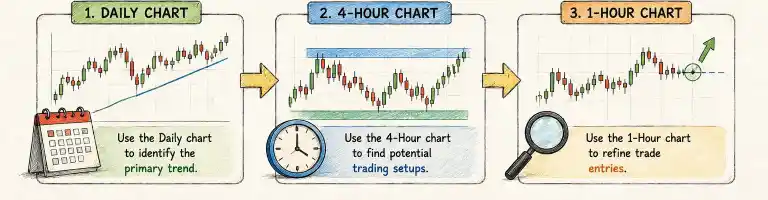
For example, a trader may:
- Use the Daily chart to identify the primary trend.
- Use the 4-Hour chart to find potential trading setups.
- Use the 1-Hour chart to refine trade entries.
Each timeframe provides different information. The higher timeframe reveals the broader market direction, while lower timeframes help identify precise entry and exit opportunities.
This process allows traders to align their trades with larger market forces rather than making decisions based solely on short-term price fluctuations.
Why Multi-Timeframe Analysis Matters in Forex Trading

Markets move in trends that exist across multiple time horizons.
A currency pair may be in a strong bullish trend on the Daily chart while experiencing a temporary pullback on the 15-minute chart. Traders who focus only on the lower timeframe may mistakenly believe the market is bearish.
This is one of the primary reasons why many beginners struggle with consistency.
By applying a multi-timeframe analysis strategy for Forex trading, traders gain a clearer understanding of where short-term price movements fit within the larger market structure.
Benefits of multi-timeframe analysis include:
- Better trend identification
- Improved trade timing
- Reduced false signals
- More informed decision-making
- Enhanced risk management
- Greater confidence in trade setups
When multiple timeframes support the same trading idea, the setup often carries greater significance than a signal appearing on only one chart.
How a Multi-Timeframe Analysis Strategy for Forex Trading Works
The basic principle behind multi-timeframe analysis is simple.
Traders start with a higher timeframe to determine the overall market direction and gradually move to lower timeframes to identify entry opportunities.
Each chart serves a specific purpose.
| Timeframe | Primary Purpose |
|---|---|
| Daily | Identify overall market trend |
| 4-Hour | Locate trading setups |
| 1-Hour | Refine trade entries |
This structured approach helps traders avoid taking trades that conflict with the dominant trend.
Selecting the Right Timeframes
There is no universal combination of timeframes suitable for every trader. The ideal selection depends largely on trading style.
For Swing Traders
- Weekly Chart – Long-term trend
- Daily Chart – Setup identification
- 4-Hour Chart – Entry timing
For Day Traders
- 4-Hour Chart – Overall trend
- 1-Hour Chart – Setup identification
- 15-Minute Chart – Entry execution
For Scalpers
- 1-Hour Chart – Market direction
- 15-Minute Chart – Setup identification
- 5-Minute Chart – Entry timing
The objective is to maintain a logical relationship between timeframes rather than switching randomly between charts.
Step 1: Identify the Higher Timeframe Trend
The first step in any multi-timeframe analysis strategy for Forex trading is determining the dominant market trend.
The higher timeframe provides valuable context because it reflects the actions of larger market participants, including institutions and long-term investors.

When analyzing the higher timeframe, traders typically look for:
- Higher highs and higher lows in an uptrend
- Lower highs and lower lows in a downtrend
- Major support and resistance levels
- Overall market structure
This analysis establishes the directional bias that will guide lower timeframe decisions.
Step 2: Find Trading Setups on the Intermediate Timeframe
After identifying the broader trend, traders move to an intermediate timeframe.
This chart is used to locate potential trading opportunities that align with the higher timeframe direction.
For example, if the Daily chart shows a strong uptrend, the trader may use the 4-Hour chart to look for pullbacks into support levels.
At this stage, traders often evaluate:
- Trend continuation patterns
- Support and resistance reactions
- Price action signals
- Breakout opportunities
The goal is to find setups that support the higher timeframe trend rather than fighting against it.
Step 3: Use Lower Timeframes for Precise Entries
Once a potential setup is identified, traders move to a lower timeframe to refine their entry. This step can significantly improve risk-to-reward ratios because it allows more precise stop-loss placement.
A key benefit of a Multi-Timeframe Analysis Strategy for Forex Trading is that it helps traders align lower timeframe entries with the broader market trend identified on higher timeframes.
Instead of entering blindly, traders wait for confirmation such as:
- Bullish or bearish engulfing candles
- Pin bars
- Breaks of short-term structure
- Momentum shifts
- Retests of key levels
Lower timeframe analysis helps improve entry efficiency while maintaining alignment with the larger market trend.
A Practical Example of Multi-Timeframe Analysis
Consider a scenario where EUR/USD is trending higher on the Daily chart, with a clear pattern of higher highs and higher lows indicating bullish market structure.
Using a Multi-Timeframe Analysis Strategy for Forex Trading, the trader then moves to the 4-Hour chart and identifies a pullback into a significant support area. Rather than entering immediately, the trader waits for additional confirmation on the 1-Hour chart.
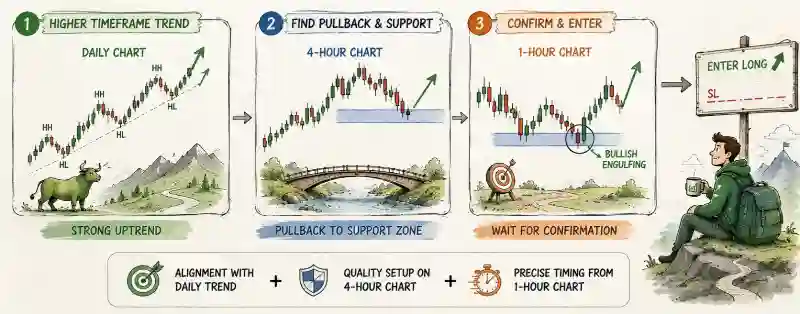
After a bullish engulfing candle forms near the support zone, the trader enters a long position and places a stop loss below the recent swing low. This approach helps align the trade with the higher timeframe trend while improving entry precision and risk management.
This trade benefits from:
- Alignment with the Daily trend
- A quality setup on the 4-Hour chart
- Precise timing from the 1-Hour chart
This example illustrates how a multi-timeframe analysis strategy for Forex trading can improve both trade selection and entry quality.
Common Mistakes Traders Make with Multi-Timeframe Analysis
- Risking Too Much to Recover Losses: Some traders increase their position size after losses in an attempt to recover quickly, often leading to larger drawdowns and additional losses.
- Ignoring Stop Losses: Removing, moving, or widening stop-loss orders can expose a trading account to unnecessary risk and increase the impact of losing trades.
- Using Excessive Leverage: While leverage can increase potential returns, it can also magnify losses significantly when used without proper risk management.
- Inconsistent Risk Levels: Risking different percentages on different trades makes performance difficult to evaluate. Consistent risk helps create more stable and predictable trading results over time.
Combining Multi-Timeframe Analysis with Risk Management
Even the strongest multi-timeframe setup can fail.
This is why proper risk management remains essential.
Traders should:
- Use stop-loss orders on every trade.
- Risk a consistent percentage of account equity.
- Avoid increasing position size after losses.
- Focus on long-term consistency rather than individual trades.
Multi-timeframe analysis improves decision quality, but risk management protects trading capital.
Why Professional Traders Use Multi-Timeframe Analysis
Professional traders understand that markets operate on multiple levels simultaneously.
Large institutions often influence higher timeframe trends, while short-term traders create temporary fluctuations within those trends.

By using multiple charts, traders can better understand this relationship and avoid making decisions based solely on short-term noise.
One reason a multi-timeframe analysis strategy for Forex trading remains popular among experienced traders is that it provides context. Instead of reacting emotionally to every market movement, traders can make decisions based on a structured analysis process.
Final Thoughts
A multi-timeframe analysis strategy for Forex trading is one of the most effective ways to improve trade selection and entry timing. By examining higher, intermediate, and lower timeframes together, traders gain a more complete understanding of market conditions.
The higher timeframe identifies the dominant trend, the intermediate timeframe reveals potential setups, and the lower timeframe helps refine entries. This structured approach reduces reliance on guesswork and helps traders align their decisions with the broader market direction.
While no trading method guarantees success, incorporating multi-timeframe analysis into your trading routine can improve consistency, enhance confidence, and provide a clearer perspective on market behavior.
For many experienced traders, learning to view the market through multiple timeframes represents an important step toward more disciplined and professional trading.

