


Many beginner traders spend countless hours studying indicators, candlestick patterns, and trading strategies while overlooking one of the most important forces driving the Forex market: liquidity.
Understanding liquidity can dramatically improve a trader’s ability to read price action, identify potential market turning points, and avoid common trading mistakes. In fact, many experienced traders believe that understanding liquidity is more valuable than relying on dozens of technical indicators.
The Forex market is often described as the most liquid financial market in the world, with trillions of dollars changing hands every day. However, liquidity is not distributed evenly throughout the market. It shifts between trading sessions, accumulates around key price levels, and often becomes the driving force behind significant market movements.
For traders who understand how liquidity affects Forex price movement, market behavior often becomes easier to interpret. What may appear to be random price fluctuations frequently have a logical explanation when viewed through the lens of liquidity.
This guide explains what liquidity is, how it influences currency prices, where liquidity is commonly found, and how traders can use liquidity concepts to identify potential trading opportunities.
What Is Liquidity in Forex Trading?
In Forex trading, liquidity refers to the ability to buy or sell a currency pair quickly without causing a significant change in its price.
A highly liquid market contains a large number of buyers and sellers actively participating at various price levels. Because there are plenty of market participants willing to transact, orders can usually be executed efficiently with minimal price disruption.

On the other hand, low-liquidity conditions occur when there are fewer market participants. In such environments, price can move more aggressively because there are fewer orders available to absorb buying or selling pressure.
The Forex market generally enjoys high liquidity compared to most other financial markets. Major currency pairs such as EUR/USD, GBP/USD, and USD/JPY typically experience substantial trading volume throughout the trading day.
However, liquidity conditions can still vary significantly depending on the time of day, market session, economic events, and overall market sentiment.
Why Liquidity Is Important in Forex Trading
Liquidity directly influences how prices move.
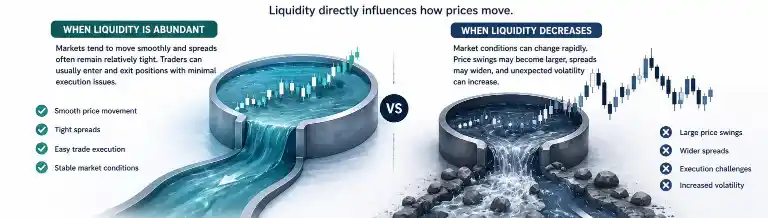
When liquidity is abundant, markets tend to move smoothly and spreads often remain relatively tight. Traders can usually enter and exit positions with minimal execution issues.
When liquidity decreases, market conditions can change rapidly. Price swings may become larger, spreads may widen, and unexpected volatility can increase.
Understanding how liquidity affects Forex price movement helps traders recognize why markets sometimes move aggressively despite the absence of major news events.
Liquidity influences:
- Price movement speed
- Market volatility
- Spread size
- Trade execution quality
- Stop-loss behavior
- Breakout reliability
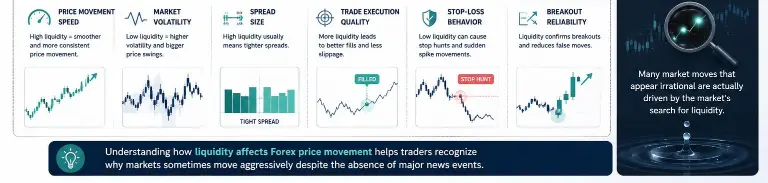
Many market moves that appear irrational are actually driven by the market’s search for liquidity.
How Liquidity Affects Forex Price Movement
The Forex market operates through a constant interaction between buyers and sellers. For large market participants such as banks, hedge funds, and institutional traders, executing significant orders requires sufficient liquidity.
If a large institution wants to buy a substantial amount of a currency pair, it needs enough sellers willing to take the opposite side of that transaction. When liquidity is not immediately available, price may move toward areas where a greater concentration of orders exists.
This process helps explain how liquidity affects Forex price movement and why price often appears to target specific levels before reversing direction. Rather than moving randomly, the market frequently seeks areas where enough buy and sell orders are available to facilitate larger transactions.
Understanding how liquidity affects Forex price movement allows traders to view price action through the lens of order flow and market participation, providing deeper insight into the forces that influence market behavior.
Where Liquidity Is Commonly Found
Liquidity tends to accumulate around areas where many traders place orders.
These locations often become important zones for future price movement.
Previous Highs and Lows

One of the most common liquidity zones is found above recent highs and below recent lows.
Many retail traders place stop-loss orders beyond these levels because they are considered logical technical locations.
As a result, clusters of orders often build around these areas.
When price reaches these levels, liquidity becomes available, attracting larger market participants.
Psychological Round Numbers
Round numbers such as 1.1000, 1.2000, or 150.00 frequently attract significant market attention.
Traders often place entries, exits, and stop-loss orders around these levels, creating concentrated liquidity pools.

Support and Resistance Levels
Traditional support and resistance zones often contain substantial liquidity because many traders base their decisions on these technical levels.
The more visible a level becomes, the more likely it is to attract orders.
Session Highs and Lows
The highs and lows formed during major trading sessions frequently become liquidity targets.
Institutional participants often monitor these levels because they represent areas where stop orders may be concentrated.
Liquidity Grabs and Stop Hunts Explained
One concept frequently discussed among price action traders is the liquidity grab.
A liquidity grab occurs when price temporarily moves beyond a key level to trigger stop-loss orders before reversing direction.
Many traders refer to this behavior as a stop hunt.
From a liquidity perspective, these movements are not necessarily designed to target retail traders personally. Instead, they often occur because large market participants require liquidity to execute their positions.

For example, if a significant amount of buy-side liquidity exists above a recent high, price may briefly move above that high, triggering stop-loss orders and breakout entries.
Once sufficient liquidity becomes available, price may reverse and continue in the opposite direction.
Understanding how liquidity affects Forex price movement can help traders avoid entering trades at vulnerable locations.
The Relationship Between Liquidity and Volatility
Liquidity and volatility are closely connected.
When liquidity is abundant, price movement often becomes more orderly because large transactions can be absorbed without causing significant disruption.
When liquidity decreases, volatility tends to increase.
This is commonly observed:
- During major news releases
- Before market close
- During holidays
- Between major trading sessions
- During unexpected economic events
Lower liquidity means fewer orders are available to absorb buying or selling pressure, which can lead to larger price swings.
This relationship is important when developing a risk management plan.
How Trading Sessions Affect Liquidity

Not all trading hours offer the same liquidity conditions.
Asian Session
The Asian trading session generally experiences lower liquidity compared to later sessions.
Price movements are often more contained, although exceptions can occur when significant economic news is released from Asia.
London Session
The London session is one of the most liquid periods in the Forex market.
Large institutional participation often results in increased trading volume and stronger directional moves.
New York Session
The New York session also generates substantial liquidity, particularly during its overlap with the London session.
This overlap is often considered the most active period of the trading day.
Traders who understand how liquidity affects Forex price movement frequently focus their trading activities during these high-volume periods.
How Economic News Influences Liquidity
Major economic announcements can dramatically alter liquidity conditions.
Before high-impact news releases, many market participants reduce exposure or temporarily withdraw liquidity from the market.
This can cause spreads to widen and execution conditions to become less predictable.
After the news is released, liquidity often returns quickly as traders react to the new information.
Events that commonly affect liquidity include:
- Non-Farm Payrolls (NFP)
- Interest rate decisions
- Consumer Price Index (CPI)
- Gross Domestic Product (GDP)
- Central bank speeches
Monitoring economic calendars can help traders anticipate periods when liquidity conditions may change.
Practical Trading Opportunities Created by Liquidity
Liquidity concepts can provide valuable trading opportunities when combined with sound risk management and market structure analysis.
Some traders look for:
- False breakouts above key highs
- False breakdowns below important lows
- Liquidity sweeps followed by reversals
- Session liquidity targets
- Post-news liquidity-driven moves
However, liquidity should not be viewed as a standalone trading strategy.
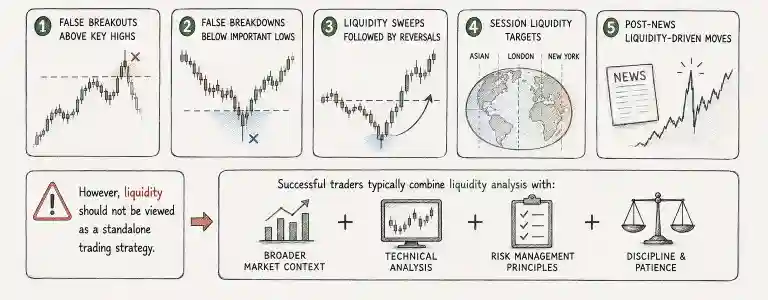
Successful traders typically combine liquidity analysis with broader market context, technical analysis, and risk management principles.
Common Misunderstandings About Liquidity Trading
As liquidity-based trading has become more popular, several misconceptions have emerged.
One common mistake is assuming every price movement is a deliberate stop hunt.
Markets are influenced by countless participants, economic developments, and institutional activities. While liquidity plays a major role, it is not the sole driver of price action.
Another mistake is entering trades immediately after every liquidity sweep.
Not all liquidity grabs result in meaningful reversals. Traders should seek confirmation from overall market structure and price behavior before making decisions.
Risk Management When Trading Liquidity Setups
Liquidity-based strategies can be effective, but they are not immune to risk.
False signals occur regularly, especially during volatile market conditions.
To manage risk effectively:
- Always use stop-loss orders
- Avoid overleveraging positions
- Wait for confirmation before entering trades
- Monitor economic events
- Maintain realistic profit expectations
Protecting trading capital should remain the primary objective regardless of the strategy being used.
Final Thoughts
Understanding how liquidity affects Forex price movement can provide traders with a deeper perspective on market behavior. Instead of viewing price action as random, traders begin to recognize how order flow, liquidity pools, and institutional participation influence market dynamics.
Liquidity exists throughout the Forex market, but it often concentrates around key highs, lows, support levels, resistance zones, and psychological price points. These areas can become important decision points where significant market activity occurs.
While liquidity concepts can create powerful trading opportunities, they should be combined with technical analysis, risk management, and overall market context. Traders who develop a balanced understanding of liquidity often gain a clearer view of how the market operates and improve their ability to navigate changing market conditions.
| You may also like this……….. Prop Firm vs Personal Trading Account – Pros, Cons, and Which One Suits You? How to Use an Economic Calendar for Forex Trading | Gain a Powerful Trading Edge |

