


Many traders spend countless hours searching for new trading strategies, indicators, and market analysis techniques. However, one of the most effective tools for improving trading performance is often overlooked: a trading journal.
A trading journal is much more than a record of wins and losses. It serves as a personal trading database that helps traders understand their strengths, identify weaknesses, and make more informed decisions. Whether you are a beginner learning the basics or an experienced trader refining your approach, maintaining a trading journal can significantly improve your consistency and discipline.
In the forex market, where emotions and decision-making play a major role, a trading journal provides valuable insights that charts alone cannot reveal. By documenting trades and reviewing them regularly, traders can develop a deeper understanding of their behavior and trading performance over time.
What Is a Trading Journal
A trading journal is a detailed record of every trade you take in the market. It includes important information such as entry price, exit price, position size, stop-loss level, take-profit target, market conditions, and the reasoning behind the trade.
Many successful traders also record screenshots of their charts before and after execution. This visual record allows them to review trade setups and evaluate whether they followed their trading plan correctly.
A trading journal can be maintained using a spreadsheet, a dedicated journaling platform, or even a simple notebook. The method is less important than the consistency of recording and reviewing trades.
Why a Trading Journal Matters in Real Trading
Forex trading is often viewed as a numbers game, but in reality, psychology plays a major role in trading success. Most traders know the basic rules of risk management and strategy execution, yet many still struggle to achieve consistent results.
The reason is simple: emotions frequently influence trading decisions.

Fear may cause a trader to close a winning trade too early. Greed may encourage excessive risk-taking. Frustration after a loss may lead to revenge trading. Without proper documentation, these behavioral patterns often go unnoticed.
A trading journal helps traders identify these recurring mistakes and take corrective action. It transforms trading from a guessing game into a measurable business process.
7 Powerful Benefits of Keeping a Trading Journal
1. Helps Identify Strengths and Weaknesses
One of the biggest advantages of maintaining a trading journal is the ability to analyze performance objectively.
Many traders assume they know which setups work best, but the data often tells a different story. By reviewing a journal, you may discover that certain currency pairs consistently perform better than others or that specific market conditions suit your strategy more effectively.

Likewise, you can identify recurring weaknesses such as entering trades too early, moving stop-loss levels unnecessarily, or trading during low-liquidity sessions.
These insights allow traders to focus on what works and eliminate habits that reduce profitability.
2. Improves Trading Discipline
Discipline is one of the most important qualities a trader can develop. Unfortunately, maintaining discipline becomes difficult when emotions take control.
Knowing that every trade will be recorded encourages traders to follow their trading plan more carefully. It creates accountability and reduces impulsive decision-making.
Over time, this habit strengthens discipline and promotes consistent execution of trading strategies.
Many professional traders consider journaling an essential part of their daily routine because it reinforces structured decision-making.
3. Helps Manage Trading Psychology
Trading psychology is often the difference between success and failure in the forex market.
A trading journal allows traders to record their emotional state before, during, and after each trade. This information can reveal patterns that affect performance.
For example, a trader may notice that most losing trades occur after a series of winning positions, indicating overconfidence. Another trader may discover that fear prevents them from taking valid setups after a losing streak.
By recognizing these psychological tendencies, traders can develop strategies to manage emotions more effectively.
4. Provides Clear Performance Statistics
Without a trading journal, it is difficult to accurately measure trading performance.
A well-maintained journal can provide valuable statistics such as:
- Win rate
- Average profit per trade
- Average loss per trade
- Risk-to-reward ratio
- Maximum drawdown
- Most profitable currency pairs
- Best trading sessions
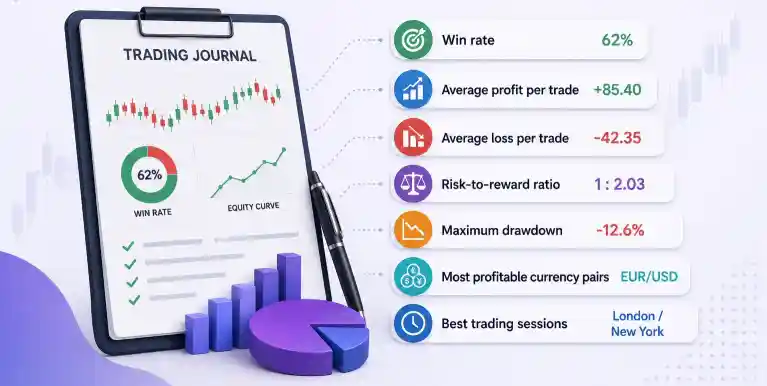
These metrics help traders evaluate whether their strategy has a genuine edge in the market.
Instead of relying on memory or assumptions, traders can make decisions based on actual data.
5. Accelerates the Learning Process
Every trade contains valuable lessons. However, those lessons are often forgotten if they are not documented.
A trading journal creates a permanent record of both successful and unsuccessful trades. Reviewing past trades helps traders understand what happened, why it happened, and how similar situations can be handled in the future.
This process accelerates learning and shortens the path toward improvement.
Many experienced traders regularly review months or even years of journal entries to identify long-term patterns and opportunities for growth.
6. Builds Confidence Through Evidence
Confidence in trading should come from proven results rather than hope or emotion.
A trading journal provides evidence that your strategy works over a series of trades. When traders experience temporary losses, they can review historical data and remind themselves of the strategy’s long-term performance.
This evidence-based confidence helps traders remain calm during periods of drawdown and avoid abandoning effective strategies prematurely.
Confidence built on data is far more reliable than confidence based on emotions.
7. Encourages Continuous Improvement
The forex market constantly evolves. Market conditions change, volatility shifts, and trading opportunities vary over time.
A trading journal supports continuous improvement by highlighting areas that require adjustment. Traders can test new ideas, compare results, and evaluate whether changes improve performance.

Rather than repeating the same mistakes, traders can make gradual improvements based on objective evidence.
This process of continuous refinement is one reason why many successful traders maintain journals throughout their entire careers.
Real-World Example
Imagine two traders using the same trading strategy.
The first trader simply executes trades and occasionally reviews account statements. The second trader records every trade in a detailed trading journal, including screenshots, reasons for entry, emotions, and market conditions.

After three months, the second trader notices that most profitable trades occur during the London session and that losses increase significantly when trading during low-volatility periods.
By focusing only on high-performing trading hours, the second trader improves overall results.
The first trader, lacking detailed records, continues making the same mistakes without understanding why performance remains inconsistent.
This example demonstrates how a trading journal transforms trading data into actionable insights.
Common Beginner Mistakes When Using a Trading Journal
While many traders understand the importance of a trading journal, they often make mistakes that reduce its effectiveness.
- Recording only winning trades
- Failing to document emotions
- Not reviewing journal entries regularly
- Providing vague trade descriptions
- Ignoring screenshots and chart analysis
- Updating the journal inconsistently
- Focusing only on profit and loss figures
A trading journal should capture both technical and psychological aspects of trading. The more complete the information, the more valuable the analysis becomes.
Practical Tips for Maintaining a Trading Journal
If you are new to journaling, start with a simple structure and gradually add more detail as you gain experience.
- Record every trade immediately after execution.
- Include entry and exit reasons.
- Track risk-to-reward ratios.
- Take screenshots before and after trades.
- Document your emotional state.
- Review journal entries weekly and monthly.
- Look for patterns rather than individual outcomes.
- Focus on process quality, not just profits.
Consistency is more important than complexity. A simple journal that is updated regularly is far more useful than a sophisticated journal that is rarely maintained.
Trader Insight
One observation shared by many long-term traders is that the market often acts as a mirror. It reflects both strengths and weaknesses in decision-making.

When traders begin keeping a trading journal, they frequently discover that their biggest challenges are not related to strategy but to execution and psychology.
Many traders realize they already possess a profitable approach but fail to follow it consistently. The trading journal exposes these gaps and provides a roadmap for improvement.
Over time, journaling becomes less about recording trades and more about understanding yourself as a trader.
Advantages and Limitations of a Trading Journal
Advantages
- Improves self-awareness and discipline.
- Provides measurable performance data.
- Helps identify profitable patterns.
- Supports emotional control.
- Accelerates skill development.
- Encourages accountability.
- Promotes long-term consistency.
Limitations
- Requires time and commitment.
- Benefits are not immediate.
- Data is only useful if recorded accurately.
- Requires regular review to generate insights.
Despite these limitations, the long-term benefits of maintaining a trading journal far outweigh the effort required.
Final Thoughts
A trading journal is one of the most valuable tools available to forex traders. While indicators, strategies, and market analysis are important, sustained trading success often comes from understanding your own decision-making process.
By maintaining a trading journal, traders gain valuable insights into performance, psychology, discipline, and risk management. The ability to review, analyze, and learn from past trades can significantly improve consistency and help traders make better decisions over time.
Whether you are a beginner trying to avoid common mistakes or an experienced trader looking to refine your edge, keeping a trading journal can become a powerful part of your trading routine.
Remember that successful trading is not about being right on every trade. It is about continuously learning, improving, and managing risk effectively. A trading journal provides the framework to achieve exactly that.
| You may also like this………………….. Select Tickmill NFP Machine Contest – Predict the Market Price and Win Up to $500 |

