

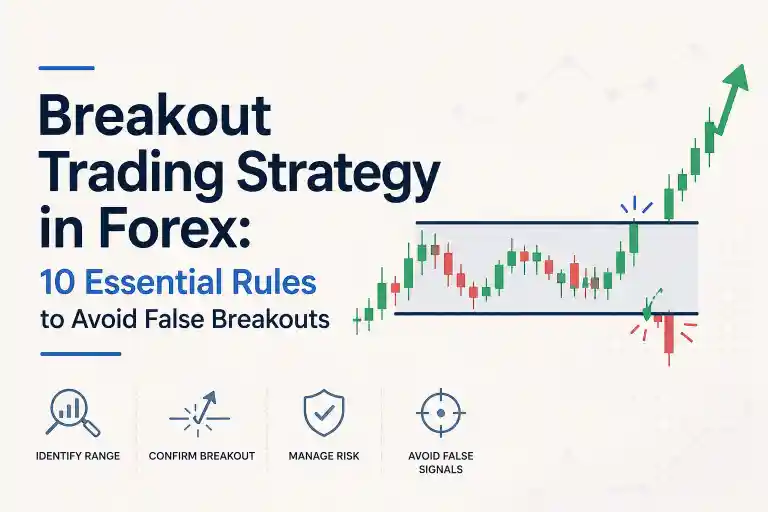
The Breakout Trading Strategy in Forex is one of the most widely used trading methods among both beginner and experienced traders. The concept behind breakout trading is straightforward — traders attempt to enter the market when price moves beyond an important support or resistance level.
In forex markets, strong breakouts can sometimes lead to large price movements and increased momentum. Because of this, many traders focus on breakout setups to capture early market trends before major moves develop.
However, breakout trading is not as simple as buying above resistance or selling below support. One of the biggest challenges traders face is dealing with false breakouts. These situations occur when price briefly breaks a key level and then quickly reverses direction.
False breakouts are extremely common in forex trading, especially during low liquidity sessions, periods of uncertainty, or highly volatile market conditions. This is why traders need proper confirmation, patience, and disciplined risk management when using the Breakout Trading Strategy in Forex.
In this guide, we will explain how breakout trading works and discuss 10 essential rules that can help traders reduce false breakout entries and improve trade quality.
What Is a Breakout in Forex Trading
A breakout occurs when price moves beyond a significant support or resistance zone with enough momentum to potentially start a larger move.
In simple terms:
- If price breaks above resistance, it is considered a bullish breakout.
- If price breaks below support, it is considered a bearish breakout.
Breakouts happen because buying or selling pressure becomes strong enough to overcome an important market level. Traders often monitor these zones because strong breakouts can lead to increased volatility and trend continuation.
Why Traders Use the Breakout Trading Strategy in Forex
The forex market spends a large amount of time moving within ranges. During these periods, buyers and sellers remain relatively balanced, causing price to move sideways.
Eventually, one side gains control, leading to a breakout from the range.
The goal of the Breakout Trading Strategy in Forex is to identify these moments early and participate in the potential momentum that follows.

Many traders prefer breakout trading because:
- It can capture strong market momentum
- It works in multiple market conditions
- It can be applied on different timeframes
- It offers structured entry and exit opportunities
However, success depends heavily on identifying high-quality breakouts instead of reacting emotionally to every market movement.
The Biggest Challenge: False Breakouts
One of the most difficult parts of the Breakout Trading Strategy in Forex is avoiding false breakouts.
A false breakout happens when:
- Price briefly moves beyond support or resistance
- Traders enter expecting continuation
- The market quickly reverses back inside the range
These fake moves often trap impatient traders and trigger unnecessary losses. False breakouts are common because institutional traders and market volatility can create temporary spikes beyond key levels.
Learning how to identify stronger confirmations is essential for long-term breakout trading success.
Rule 1: Never Trade Every Breakout
One of the biggest mistakes beginners make is taking every breakout they see.
Not all breakouts are reliable. Some occur during weak market conditions with very little momentum behind the move.
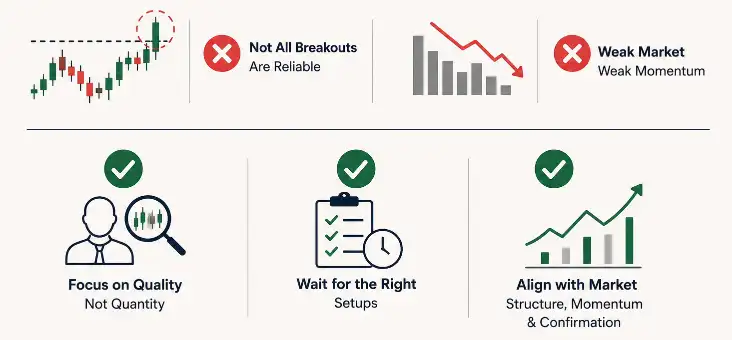
Professional traders focus on quality over quantity. Instead of forcing trades constantly, they wait for setups that align with market structure, momentum, and confirmation.
Rule 2: Wait for Candle Close Confirmation
Many false breakouts happen because traders enter too early before confirmation appears.
Experienced traders often wait for the candle to fully close beyond the breakout level before entering a trade. This helps confirm whether buyers or sellers truly gained control.
Without confirmation, price can easily reverse and move back inside the previous range.
Patience is one of the most important skills when using the Breakout Trading Strategy in Forex.
Rule 3: Analyze Market Momentum
Strong breakouts are usually supported by momentum.
If price barely moves beyond a level without strong directional pressure, the breakout may lack strength.
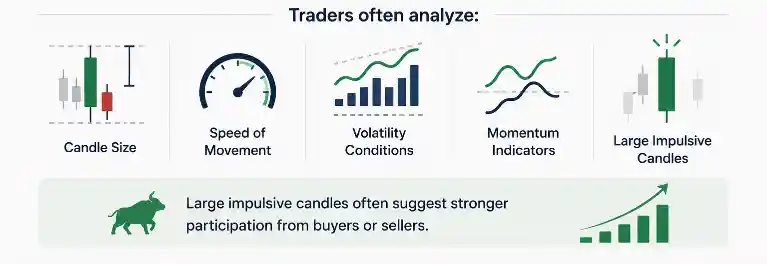
Traders often analyze:
- Candle size
- Speed of movement
- Volatility conditions
- Momentum indicators
Large impulsive candles often suggest stronger participation from buyers or sellers.
Rule 4: Avoid Low Liquidity Trading Sessions
Breakouts during quiet market sessions are often less reliable. Low liquidity conditions can create unstable price movement and increase the probability of fake breakouts.
Many traders prefer trading breakouts during active sessions such as:
- London trading session
- New York trading session
- London-New York overlap
These periods generally provide stronger participation and more stable momentum.
Rule 5: Use Higher Timeframes for Key Levels
Support and resistance levels from higher timeframes usually carry more importance. Breakouts on daily or 4-hour charts are often considered more reliable than random moves on lower timeframes.
Lower timeframes contain more market noise, which increases the risk of false breakout signals. Many traders combine higher timeframe analysis with lower timeframe entries for better accuracy.
Rule 6: Watch for Retests After Breakout
One of the most effective techniques in the Breakout Trading Strategy in Forex is waiting for a retest.
After price breaks a level, the market often revisits that same area before continuing in the breakout direction.
For example:
- Broken resistance may become new support
- Broken support may become new resistance
Retests can provide safer entries with improved risk-to-reward opportunities.
Rule 7: Avoid Trading Before Major News Events
Economic news releases can create sudden volatility and unpredictable market behavior. During high-impact news events, price may spike aggressively in both directions, increasing the chance of false breakouts.
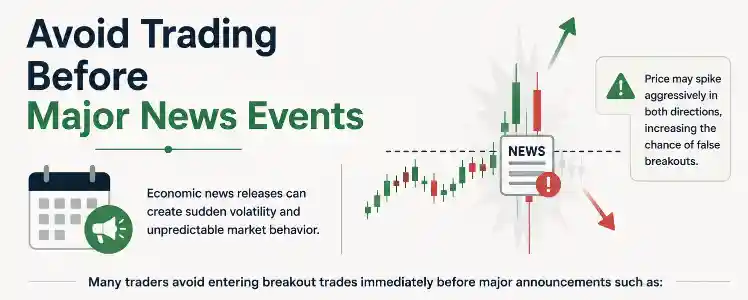
Many traders avoid entering breakout trades immediately before major announcements such as:
- Non-Farm Payroll (NFP)
- Interest rate decisions
- Inflation reports
- Central bank speeches
Waiting for post-news stability can reduce unnecessary risk.
Rule 8: Use Proper Stop Loss Placement
Risk management is a critical part of every trading strategy. When using the Breakout Trading Strategy in Forex, stop losses should not be placed too tightly because markets naturally fluctuate around breakout zones.
At the same time, excessively large stop losses can create poor risk management conditions.
Proper stop-loss placement depends on:
- Market volatility
- Timeframe being traded
- Structure of the breakout setup
Rule 9: Do Not Chase Extended Moves
Many traders enter trades emotionally after price has already moved significantly. This often creates poor entry conditions and unfavorable risk-to-reward ratios.
If a breakout already produced a large move, the market may be approaching exhaustion or temporary correction.
Experienced traders usually prefer entering near the breakout zone or after a controlled retest.
Rule 10: Always Combine Breakouts With Risk Management
No breakout setup guarantees success. Even strong setups can fail due to unexpected market conditions or sudden reversals.
This is why risk management remains more important than predicting every market move correctly.
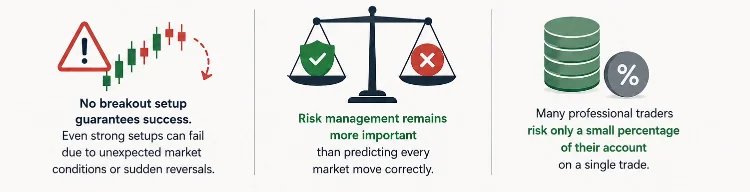
Many professional traders risk only a small percentage of their account on a single trade. This helps protect long-term account survival during losing streaks.
Common Breakout Trading Mistakes
- Entering Without Confirmation: Jumping into trades too early increases the chance of false breakout entries.
- Ignoring Market Conditions: Breakout performance can vary significantly between trending and ranging markets.
- Overtrading: Taking every breakout setup often leads to emotional decisions and inconsistent performance.
- Poor Risk Management: Without proper position sizing and stop-loss planning, even profitable strategies can become dangerous.
Who Should Use the Breakout Trading Strategy in Forex
The Breakout Trading Strategy in Forex may be suitable for traders who:
- Prefer momentum-based trading
- Understand support and resistance analysis
- Can remain patient for confirmation
- Follow structured risk management rules
However, traders who struggle with emotional decision-making may find breakout trading challenging during highly volatile conditions.
Final Thoughts
The Breakout Trading Strategy in Forex remains popular because strong breakouts can create powerful trading opportunities. However, false breakouts are a natural part of forex markets and cannot be completely avoided.
The key difference between successful and unsuccessful breakout traders is discipline. Traders who focus on confirmation, patience, and proper risk management are generally better positioned to handle market uncertainty.
Instead of chasing every price movement, traders should focus on identifying high-quality breakout setups supported by momentum and strong market structure.
With practice, patience, and controlled risk exposure, breakout trading can become a valuable part of a trader’s overall trading plan.
Forex Basics You Should Understand Before Using This Strategy
Before applying any advanced trading strategy like breakout trading, it is very important to understand basic forex concepts. Without these fundamentals, most strategies will not give consistent results.
- What is Lot Size in Forex Trading
- What is Leverage in Forex Trading
- Spread in Forex Explained – Complete Beginner Guide
- What is Pip in Forex – Complete Beginner Guide
These basic concepts will help you understand how price moves in the forex market and improve your decision-making while using any trading strategy.

