

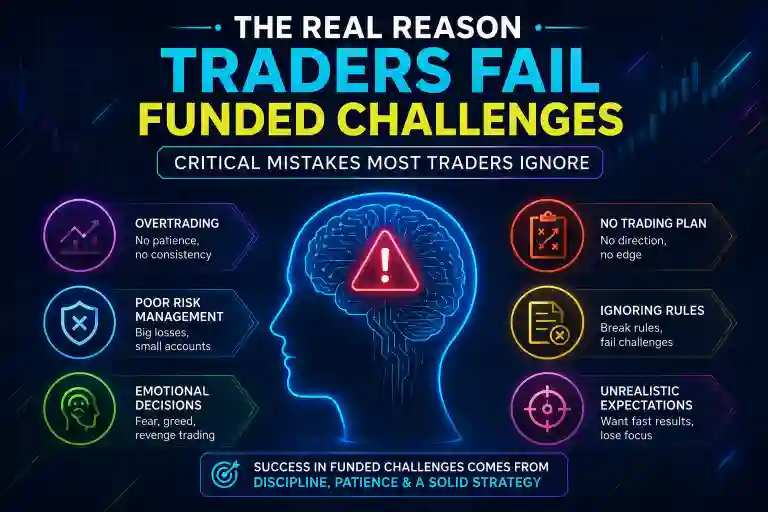
Funded trading challenges have become extremely popular in the forex and prop trading industry. Many traders are attracted to the opportunity of trading large funded accounts without risking huge amounts of personal capital. Prop firms now offer evaluation programs that allow traders to qualify for funded accounts after meeting specific performance targets.
At first glance, these challenges may appear simple. Traders only need to reach profit targets while respecting risk management rules. However, the reality is very different. A large percentage of traders fail funded challenges, often multiple times, before realizing the deeper reasons behind their failures.
Understanding the real reason traders fail funded challenges is important for anyone planning to participate in prop firm evaluations. Most traders focus entirely on strategy and market analysis while ignoring psychological pressure, risk management mistakes, and behavioral problems that quietly destroy performance.
This article explains the real reason traders fail funded challenges and highlights the critical mistakes many traders continue to ignore.
Misunderstanding the Purpose of Funded Challenges
One of the biggest reasons traders fail funded challenges is misunderstanding the actual purpose of these evaluations. Many beginners believe the challenge is designed simply to test profitability. In reality, prop firms are primarily evaluating:
- Risk management discipline
- Consistency
- Emotional stability
- Capital protection
- Professional trading behavior
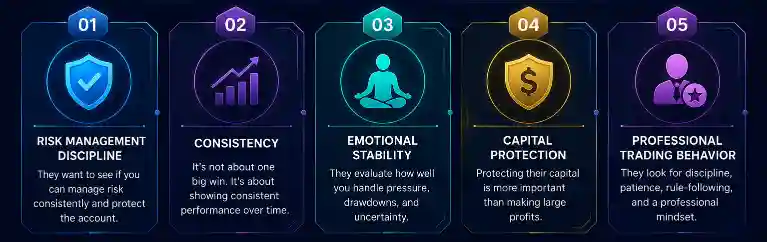
Prop firms are not searching for traders who gamble aggressively to hit profit targets quickly. They want traders capable of surviving long-term market conditions while managing risk responsibly.
Many traders approach funded challenges with a “fast profit” mindset instead of focusing on consistency. This often leads to excessive risk-taking and emotional trading.
Using Excessive Risk to Reach Profit Targets
The real reason traders fail funded challenges often comes down to improper risk management. Many traders risk too much per trade because they feel pressure to reach profit targets quickly.
Common risky behaviors include:
- Increasing lot sizes aggressively
- Ignoring stop-loss rules
- Holding losing trades emotionally
- Entering multiple correlated positions
- Overleveraging small account balances
Funded challenges usually include strict drawdown limits. A few emotional trades can immediately violate these rules and end the evaluation.
Many traders underestimate how difficult it is to recover from losses while remaining inside daily and overall drawdown restrictions.
Successful challenge traders often focus more on protecting the account than chasing rapid gains.
Emotional Pressure During Evaluations
Trading psychology becomes far more difficult during funded challenges because traders feel constant pressure to succeed.
This emotional pressure creates problems such as:
- Fear of losing challenge fees
- Fear of failing again
- Greed after winning trades
- Revenge trading after losses
- Impatience to reach targets quickly
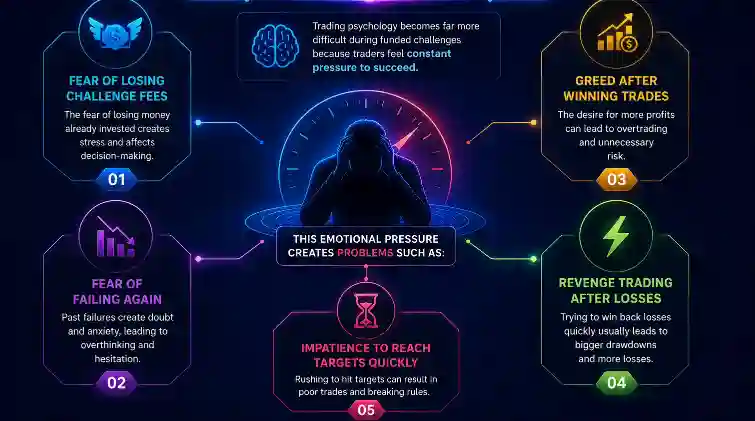
Even traders with profitable strategies may struggle emotionally during evaluations because challenge conditions create additional mental stress.
The real reason traders fail funded challenges is often psychological rather than technical.
Some traders perform well on demo or personal accounts but fail once evaluation pressure affects their decision-making.
Ignoring Daily Drawdown Limits
Daily drawdown rules are one of the most common reasons traders fail funded challenges.
Many prop firms enforce strict daily loss limits. If traders exceed the maximum allowed daily drawdown, the challenge automatically fails regardless of previous profits.
Common mistakes include:
- Continuing to trade after multiple losses
- Increasing risk to recover losses
- Trading emotionally during volatile sessions
- Ignoring account equity fluctuations
Some traders misunderstand how daily drawdown calculations work. Floating losses can sometimes count toward drawdown limits even before trades are closed.
Understanding the prop firm’s exact risk rules is essential before opening trades.
Overtrading the Market
Overtrading is another major reason traders fail funded challenges.
Many traders feel they must trade constantly to reach profit objectives quickly. This mindset often results in low-quality trades and unnecessary exposure to market volatility.
Overtrading commonly happens when traders:
- Become impatient
- Trade out of boredom
- Force setups that do not exist
- Attempt to recover losses quickly
- Lose emotional discipline
Professional traders understand that high-quality opportunities are limited. Waiting for strong setups is often more important than trading frequently.
The real reason traders fail funded challenges is not always lack of strategy knowledge. In many cases, traders simply cannot maintain patience under pressure.
Lack of a Structured Trading Plan
Many traders enter funded challenges without a detailed trading plan. Instead of following structured rules, they make decisions emotionally during live market conditions.
A professional trading plan should include:
- Entry conditions
- Exit rules
- Risk per trade
- Maximum daily loss limits
- Preferred trading sessions
- Trading schedule
- Position sizing rules
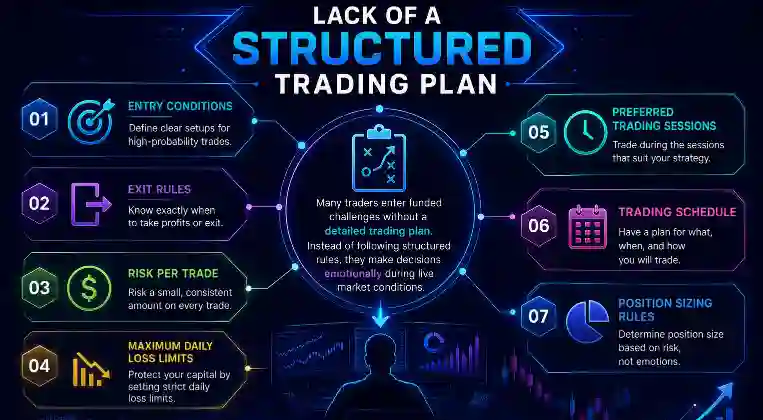
Without a plan, traders often react impulsively to short-term price movements.
Consistency is extremely important in funded evaluations. Random decision-making usually leads to inconsistent performance and increased emotional stress.
Changing Strategies During the Challenge
Another hidden reason traders fail funded challenges is constantly changing strategies during the evaluation process.
After a few losses, many traders abandon their original approach and begin searching for new indicators or systems. This behavior creates confusion and destroys consistency.
No strategy wins every trade. Losing streaks are a normal part of trading.
Successful traders understand the importance of:
- Following tested systems consistently
- Avoiding emotional strategy switching
- Tracking long-term performance
- Accepting temporary drawdowns
Frequent strategy changes often increase emotional instability during funded challenges.
Trading News Events Without Proper Planning
High-impact economic news events can create extreme volatility in the forex market. Many traders fail funded challenges because they underestimate the risks of trading during major announcements.
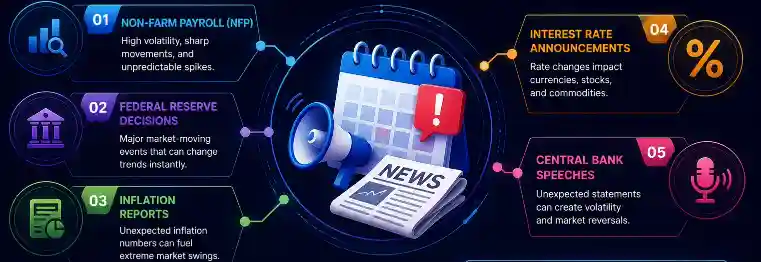
Examples include:
- Non-Farm Payroll (NFP)
- Federal Reserve decisions
- Inflation reports
- Interest rate announcements
- Central bank speeches
Volatility during these events can trigger rapid losses, slippage, and spread expansion.
Some prop firms also restrict trading during major news releases. Ignoring these rules may violate challenge conditions.
Poor Position Sizing
Position sizing is another critical area where traders fail funded challenges.
Some traders use inconsistent lot sizes based on emotions instead of structured risk management. They may increase position sizes after losses or overtrade after winning streaks.
Improper position sizing creates:
- Large emotional swings
- Unstable account performance
- Rapid drawdowns
- Difficulty maintaining discipline
Professional traders usually risk a small percentage of capital per trade to maintain long-term consistency.
Focusing Only on Profit Targets
Many traders become obsessed with reaching profit targets while ignoring risk management.
This is one of the clearest examples of the real reason traders fail funded challenges.
When traders focus only on profits, they often:
- Take unnecessary risks
- Trade emotionally
- Overtrade aggressively
- Ignore market conditions
- Break their own trading rules
Ironically, traders who focus more on discipline and consistency often perform better than traders obsessed with fast profits.
Failure to Adapt to Market Conditions
Market conditions constantly change. Strategies that perform well during trending conditions may struggle during ranging markets.
Some traders continue forcing the same setups regardless of volatility or market structure changes.
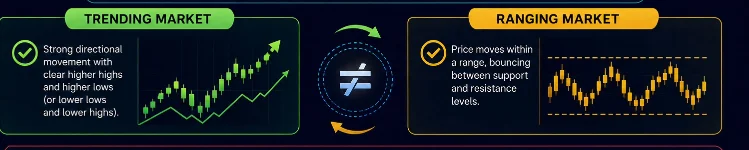
Successful traders adapt by:
- Reducing risk during uncertainty
- Avoiding low-quality setups
- Adjusting to volatility changes
- Understanding market context
Adaptability is an important skill during funded evaluations.
Ignoring Trading Psychology Completely
Many traders spend months learning technical analysis while completely ignoring trading psychology.
However, emotional discipline becomes even more important during funded challenges because traders face:
- Performance pressure
- Fear of losing fees
- Stress from drawdown limits
- Impatience to qualify quickly
The real reason traders fail funded challenges often has more to do with emotional behavior than technical skill.
Traders who cannot control emotions usually struggle to follow their plans consistently.
Trying to Recover Losses Quickly
After experiencing losses, many traders attempt to recover immediately by increasing risk aggressively.
This behavior is extremely dangerous during funded evaluations because drawdown limits are strict.
Revenge trading commonly leads to:
- Rapid account failure
- Emotional decision-making
- Ignoring strategy rules
- Overleveraging positions
Successful traders understand that losses are part of trading. Instead of reacting emotionally, they focus on maintaining discipline and protecting capital.
The Real Reason Traders Fail Funded Challenges Long Term
When analyzing failed evaluations, the real reason traders fail funded challenges usually involves a combination of:
- Poor risk management
- Emotional trading
- Lack of patience
- Overtrading
- Inconsistent discipline
- Unrealistic expectations
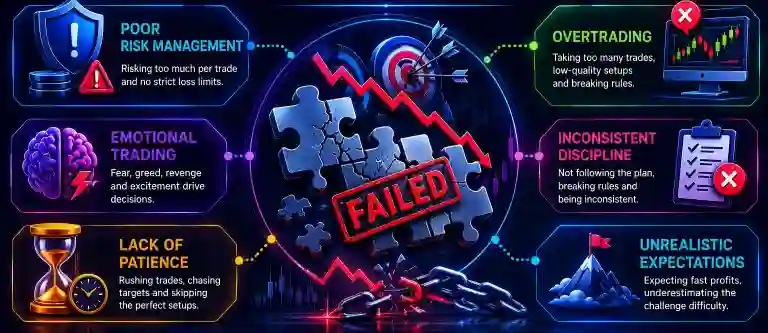
Most traders already know basic technical analysis. The real challenge is executing consistently under pressure while respecting strict prop firm rules.
Funded trading success often depends more on mindset and discipline than finding a perfect strategy.
Final Verdict
Understanding the real reason traders fail funded challenges can help traders approach evaluations more realistically and professionally.
Many traders fail not because they lack intelligence or market knowledge, but because they underestimate the psychological and risk management demands of prop firm trading.
Successful funded traders usually focus on:
- Capital preservation
- Controlled risk management
- Patience
- Emotional discipline
- Consistent execution
- Long-term thinking
Passing funded challenges is rarely about making aggressive profits quickly. In most cases, it is about surviving the evaluation process while demonstrating stable and responsible trading behavior.
Traders who understand this mindset often improve their chances of long-term success in both funded and personal trading accounts.

