

What is prop trading and how does it work This is a common question among forex traders who want access to larger trading capital without risking significant personal funds.
Over the last few years, proprietary trading firms — commonly called prop firms — have become increasingly popular in the online trading industry. Social media platforms are filled with advertisements showing traders managing large funded accounts, passing challenges, and earning payouts.
However, many beginners misunderstand What is prop trading and how does it work.
Some traders believe prop firms offer “easy money” opportunities, while others assume passing a funded challenge guarantees long-term success. In reality, prop trading is highly competitive and requires discipline, consistency, emotional control, and strong risk management.
This guide explains what is prop trading and how does it work, how prop firms make money, common evaluation models, trader responsibilities, hidden risks, and what beginners should realistically expect before purchasing a challenge.
Quick Overview of What is prop trading and how does it work
| Feature | Explanation |
|---|---|
| Meaning of Prop Trading | Trading using company-provided capital |
| Common Markets | Forex, Indices, Metals, Crypto |
| How Traders Join | Usually through evaluation challenges |
| Main Goal | Demonstrate profitable and disciplined trading |
| Risk Rules | Strict drawdown and loss limits |
| Profit Sharing | Profits are split between trader and firm |
| Main Requirement | Consistency and risk management |
What Is Prop Trading
Prop trading, short for proprietary trading, refers to a model where traders use a company’s capital instead of their own personal funds.
In simple terms, a prop trading firm allows traders to access larger trading accounts after proving their trading ability under certain conditions.
Instead of depositing large amounts of personal capital, traders usually:
- Purchase an evaluation challenge
- Follow specific trading rules
- Meet profit objectives
- Respect drawdown limitations
- Demonstrate disciplined trading behavior
If traders successfully complete the evaluation process, they may receive access to funded trading accounts.
This is the basic answer to what is prop trading and how does it work.
How Does Prop Trading Work
Understanding what is prop trading and how does it work requires understanding the evaluation process used by most prop firms.
Although every company has different structures, the general process usually follows similar steps.
Step 1: Choose a Challenge or Account Type
Most prop firms offer different account sizes and evaluation programs.

For example, traders may choose:
- $10,000 account
- $50,000 account
- $100,000 account
Larger account sizes usually require higher evaluation fees.
Step 2: Follow Trading Rules
Traders must follow strict risk management rules during the evaluation phase.
Common rules include:
- Maximum daily loss limits
- Overall drawdown restrictions
- Position sizing rules
- Consistency requirements
- Restricted trading during major news events
Breaking these rules may immediately fail the challenge.
Step 3: Reach Profit Targets
Most firms require traders to achieve a specific profit target while respecting risk limits.
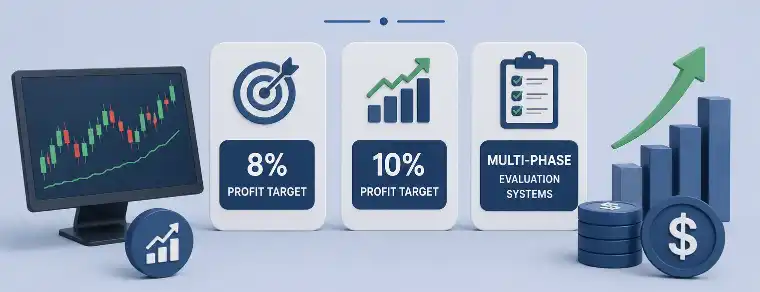
For example:
- 8% profit target
- 10% profit target
- Multi-phase evaluation systems
The challenge is not only about making profits. It is also about demonstrating controlled and disciplined trading behavior.
Step 4: Receive Funded Account Access
Traders who pass the evaluation may receive funded account access.
At this stage:
- Profits may be shared between trader and firm
- Risk management rules still apply
- Performance consistency remains important
This is how prop trading works in most modern online prop firms.
Why Prop Trading Has Become Popular
The popularity of prop trading has increased rapidly because many traders want access to larger capital without risking large personal savings.
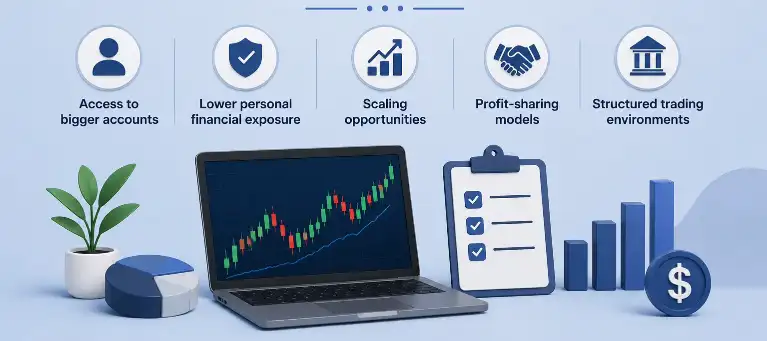
Some traders are attracted by:
- Access to bigger accounts
- Lower personal financial exposure
- Scaling opportunities
- Profit-sharing models
- Structured trading environments
Social media marketing has also contributed significantly to prop trading popularity.
However, beginners often see only successful traders online and underestimate the difficulty of passing evaluations consistently.
Trader Insight: Why Many Traders Fail Prop Firm Challenges
One important reality often ignored online is that many traders fail funded evaluations repeatedly.
The biggest reason is usually not strategy failure — it is emotional trading behavior.
Many traders fail because they:
- Overleverage positions
- Trade emotionally after losses
- Try to hit targets too quickly
- Ignore drawdown limits
- Overtrade during volatility
Professional traders usually understand that survival and consistency matter more than aggressive short-term gains.
Understanding Drawdown Rules
Drawdown rules are one of the most important parts of prop trading.
Drawdown refers to the reduction in account value from its highest point.
For example:
- If a $100,000 account falls to $95,000
- The account experiences a 5% drawdown
Most prop firms use strict drawdown restrictions to prevent excessive risk-taking.
Many beginner traders underestimate how psychologically difficult it can be to trade under drawdown limitations.
Types of Prop Trading Models
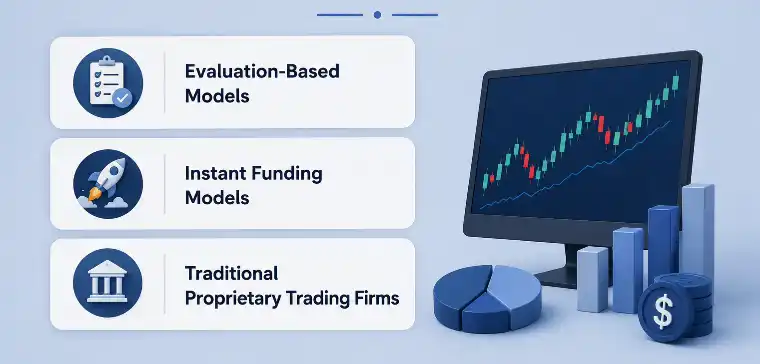
- Evaluation-Based Models: This is the most common online prop firm structure. Traders pay an evaluation fee and attempt to meet trading objectives.
- Instant Funding Models: Some firms offer accounts without traditional evaluations but may apply stricter conditions or smaller scaling opportunities.
- Traditional Proprietary Trading Firms: Institutional prop firms may hire traders directly instead of using online challenge systems.
These environments are usually more competitive and professional.
Advantages of Prop Trading
- Access to Larger Capital: Traders may control larger accounts without depositing significant personal funds.
- Limited Personal Financial Risk: Many traders risk evaluation fees instead of large trading balances.
- Structured Risk Management: Prop firms often encourage disciplined trading behavior through strict rules.
- Scaling Opportunities: Consistent traders may eventually receive larger account allocations.
Potential Risks and Limitations
- Psychological Pressure: Evaluation conditions can create emotional stress.
- Strict Rule Enforcement: Even small violations may result in failed challenges.
- Repeated Fees: Failed attempts can become expensive over time.
- Unrealistic Expectations: Many beginners assume funded trading guarantees income.
In reality, consistent profitability remains difficult.
Who Is Prop Trading Suitable For
Prop trading may suit traders who:
- Understand risk management
- Prefer structured trading rules
- Can control emotions during losses
- Focus on long-term consistency
- Avoid impulsive overtrading
Highly emotional traders may struggle under funded evaluation pressure.
Common Beginner Mistakes in Prop Trading
- Trying to Pass Challenges Too Quickly: Many traders become overly aggressive while chasing profit targets.
- Using Excessive Leverage: Large position sizes increase the risk of violating drawdown limits.
- Ignoring Risk Management: Without proper risk control, even profitable traders may fail evaluations.
- Trading Emotionally: Revenge trading after losses remains extremely common.
- Not Reading Trading Rules Carefully: Some traders fail evaluations because they misunderstand account conditions.
How Experienced Traders Approach Prop Trading
Professional traders often approach prop firms very differently from beginners.

Instead of focusing only on profit targets, they prioritize:
- Capital preservation
- Risk-adjusted returns
- Trade quality
- Consistency
- Emotional discipline
Experienced traders understand that stable long-term performance matters more than aggressive short-term gains.
Reality Check: Prop Trading Is Not Easy Money
One of the biggest misconceptions online is that prop trading provides easy income opportunities.
In reality:
- Most traders struggle with emotional discipline
- Market conditions constantly change
- Drawdown rules create pressure
- Consistency takes years to develop
Many traders repeatedly fail evaluations because they focus more on profits than risk control.
This is why traders should approach prop firms with realistic expectations.
Safety Analysis: Is Prop Trading Safe
Prop trading involves financial risk, especially when traders repeatedly purchase evaluations without improving trading behavior.
Before joining any prop firm, traders should carefully research:
- Company reputation
- Payout transparency
- Customer support quality
- Trading rules
- Risk management structure
Not all prop firms operate under the same standards, so caution remains important.
Final Verdict
Understanding what is prop trading and how does it work is important before purchasing any funded challenge.
Prop trading allows traders to access larger capital through structured evaluation systems, but success depends heavily on discipline, emotional control, and proper risk management.
While funded accounts may appear attractive, prop trading is not a shortcut to easy money. Many traders struggle because they underestimate the psychological demands of evaluation conditions.
Experienced traders often focus more on consistency, survival, and controlled risk exposure rather than aggressive short-term profits.
For beginners, developing strong trading habits and realistic expectations is usually more important than rushing into funded programs too early.

