


Forex Trading Sessions play a major role in how the currency market behaves throughout the day. Although the forex market operates 24 hours a day during weekdays, market activity does not remain the same at all times.
Some hours experience strong price movement and heavy trading volume, while other periods remain slow with limited volatility. This difference exists because forex trading activity moves between major financial centers around the world.
Many beginners focus heavily on indicators and trading strategies but ignore one of the most important factors in forex trading — timing.
A strategy that works well during high-volume sessions may perform poorly during low-liquidity periods. Similarly, some trading styles depend heavily on volatility, while others perform better in calmer market conditions.
Understanding Forex Trading Sessions helps traders identify when the market is most active, when spreads are tighter, and when trading opportunities become more favorable.
In this detailed guide, we will explain how forex trading sessions work, the characteristics of each session, how market volatility changes during the day, and how beginners can choose the most suitable trading hours.
Quick Summary of Forex Trading Sessions
| Trading Session | Main Financial Center | General Market Behavior |
|---|---|---|
| Sydney Session | Australia | Lower volatility and slower price movement |
| Tokyo Session | Japan | Moderate volatility with strong JPY activity |
| London Session | United Kingdom | Highest liquidity and strong volatility |
| New York Session | United States | Strong USD movement and major news volatility |
What Are Forex Trading Sessions
Forex Trading Sessions refer to the major market hours when financial institutions, banks, hedge funds, corporations, and retail traders actively participate in the currency market.
Because forex trading happens globally, activity shifts continuously from one financial center to another.
The market is divided into four major sessions:
- Sydney Session
- Tokyo Session
- London Session
- New York Session
Each session has different characteristics, trading volume, liquidity conditions, and volatility behavior.

These differences directly affect:
- Price movement speed
- Spread size
- Trend strength
- Breakout opportunities
- Market liquidity
Understanding session behavior helps traders avoid poor trading conditions and identify periods where their strategy may perform more effectively.
Why Forex Trading Sessions Matter More Than Beginners Realize
Many beginners believe the forex market behaves the same way throughout the day. In reality, market conditions constantly change depending on which session is active.
For example:
- A breakout strategy may perform better during London session volatility
- Scalping may become difficult during low-liquidity periods
- Spreads may widen during inactive hours
- News-related volatility may increase during New York session
This means timing can influence trading performance significantly.
Professional traders often choose trading hours carefully instead of trading randomly throughout the day.
Sydney Trading Session Explained
The Sydney session officially starts the forex trading week.
Compared to later sessions, the Sydney market is usually calmer with lower trading activity.
Characteristics of the Sydney Session
- Lower trading volume
- Slower market movement
- Reduced volatility
- Calmer price action
- Influence from Australian and New Zealand economic events
Currency pairs involving the Australian Dollar (AUD) and New Zealand Dollar (NZD) often become more active during this session.
Many traders view the Sydney session as a preparation period before stronger market participation begins in Asia and Europe.
Who May Prefer the Sydney Session
- Traders who prefer calmer market conditions
- Swing traders managing longer-term positions
- Traders focused on AUD or NZD currency pairs
However, beginners should understand that slower movement may also reduce short-term trading opportunities.
Tokyo Trading Session Explained
The Tokyo session, often called the Asian session, introduces stronger market participation compared to Sydney.
Japan is one of the largest economies in the world, making the Japanese Yen heavily traded during this period.
Characteristics of the Tokyo Session
- Moderate volatility
- Strong activity in JPY pairs
- Frequent consolidations
- Reaction to Asian economic data
- Institutional participation from Asian markets
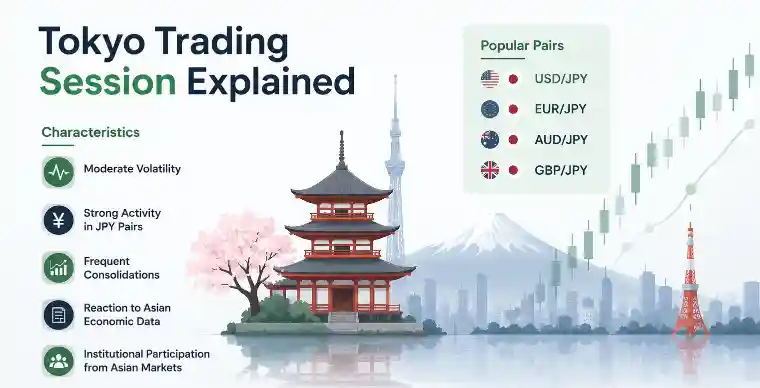
Popular currency pairs during this session include:
- USD/JPY
- EUR/JPY
- AUD/JPY
- GBP/JPY
The Tokyo session may also establish important support and resistance zones that influence later sessions.
Market Behavior During the Asian Session
Compared to London and New York, the Tokyo session often experiences narrower price ranges and slower momentum.
Some traders prefer this environment because price action may appear less aggressive.
Others avoid it because breakout opportunities can be limited during quiet periods.
London Trading Session Explained
The London session is widely considered the most important forex trading session because London remains one of the largest global financial centers.
This session introduces major institutional activity and significantly higher trading volume.
Characteristics of the London Session
- Strong market liquidity
- High volatility
- Large price movements
- Increased institutional participation
- Frequent breakout opportunities
Many professional traders prefer the London session because of stronger momentum and improved liquidity conditions.
Popular trading styles during this session include:
- Scalping
- Day trading
- Breakout trading
- Trend-following strategies
Why London Session Attracts Traders
The London session often creates strong directional movement. Many major trends begin during this period because trading volume increases substantially.
Spreads may also become tighter due to improved liquidity.
This environment can create more opportunities for short-term traders.
New York Trading Session Explained
The New York session is another major trading period in forex.
Because the US Dollar is involved in most forex transactions, this session has enormous influence on global currency movement.
Characteristics of the New York Session
- Strong USD-related volatility
- High liquidity
- Reaction to US economic news
- Active institutional participation
- Frequent trend continuation or reversals
Major US economic reports released during this session can create sudden market volatility.
Examples include:
- Non-Farm Payrolls (NFP)
- Federal Reserve announcements
- Inflation data
- GDP reports
- Interest rate decisions
Traders should understand that news-related volatility can increase both opportunity and risk.
The Most Active Period: London and New York Overlap
One of the most important periods in forex trading occurs when the London and New York sessions overlap.

During this overlap:
- Liquidity reaches very high levels
- Volatility increases significantly
- Institutional participation becomes strongest
- Major breakouts and trends often develop
Many experienced traders consider this the most favorable trading period for short-term trading strategies.
Because both European and US institutions are active simultaneously, market participation becomes extremely strong.
Advantages of the Overlap Period
- Tighter spreads
- Faster price movement
- More trading opportunities
- Stronger momentum
However, beginners should also understand that increased volatility can create emotional trading mistakes if risk management is weak.
Trader Insight: Why Timing Matters More Than Many Beginners Expect
Many beginners search endlessly for indicators while ignoring market timing completely.
In reality, the same trading setup may behave very differently depending on the trading session.
For example:
- Breakout setups during low liquidity may fail more often
- Scalping during inactive sessions may become difficult because of spreads
- News events during New York session may create unpredictable movement
Experienced traders understand that timing and market conditions often influence execution quality as much as strategy selection itself.
This is why many professional traders focus only on specific sessions instead of trading all day.
Best Forex Trading Sessions for Different Trading Styles
- Scalping: Scalpers usually prefer highly active sessions like London or the London-New York overlap because tighter spreads and stronger momentum improve short-term execution.
- Day Trading: Day traders often focus on London and New York sessions due to larger intraday price movement and better volatility conditions.
- Swing Trading: Swing traders may pay less attention to exact sessions because trades are held for multiple days or weeks.
- Breakout Trading: Breakout traders often prefer session openings when volatility and liquidity increase sharply.
How Volatility Changes During the Trading Day
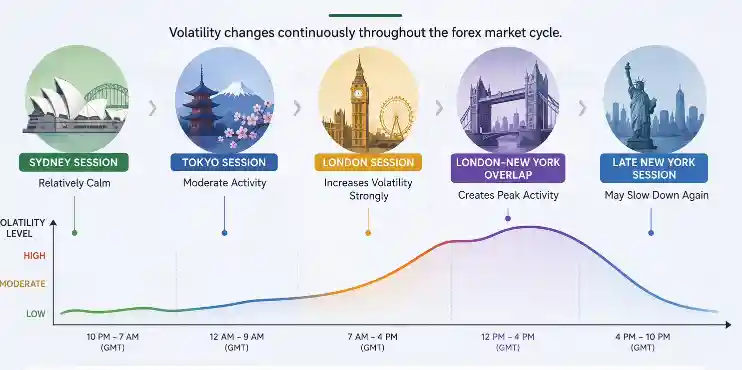
Volatility changes continuously throughout the forex market cycle.
Generally:
- Sydney session remains relatively calm
- Tokyo session introduces moderate activity
- London session increases volatility strongly
- London-New York overlap creates peak activity
- Late New York session may slow down again
Understanding volatility is important because it affects:
- Stop loss placement
- Position sizing
- Take profit targets
- Spread conditions
- Trade management
Trading without understanding volatility often leads to poor risk management decisions.
Hidden Risks Beginners Often Ignore About Trading Sessions
- Low Liquidity Can Create Difficult Trading Conditions: During inactive hours, price movement may become weak and inconsistent. This can reduce trading opportunities and increase frustration.
- High Volatility Can Trigger Emotional Trading: Fast-moving markets can encourage impulsive decisions, especially among inexperienced traders.
- News Events Increase Uncertainty: Major economic announcements can create unpredictable spikes and rapid reversals.
Different Sessions Require Different Expectations
A strategy that works during London volatility may struggle during quieter Asian sessions.
Common Mistakes Traders Make With Forex Trading Sessions
- Trading Randomly Throughout the Day: Many beginners trade without considering session quality or market activity.
- Ignoring Economic News: Unexpected volatility during news releases can disrupt trading plans.
- Overtrading During High Volatility: Strong movement may create emotional excitement and unnecessary entries.
- Using the Same Strategy in Every Session: Different market sessions behave differently, so some strategies require adjustment.
How Beginners Can Choose the Right Trading Session
The ideal forex trading session depends on several factors:
- Your trading style
- Your time zone
- Your schedule
- Your preferred currency pairs
- Your experience level
Beginners often benefit from focusing on one session consistently rather than trying to trade continuously.
This allows traders to understand session behavior more deeply and build stronger discipline.
Practical Tips for Trading Forex Sessions
- Trade during active sessions for stronger liquidity
- Monitor economic calendars daily
- Avoid forcing trades during quiet markets
- Practice understanding session behavior on demo accounts
- Adjust stop losses according to volatility
- Focus on quality setups instead of trading constantly
Patience and observation are important for improving market timing decisions.
Pros and Cons of Active Forex Trading Sessions
Advantages
- Higher liquidity
- Tighter spreads
- Stronger price movement
- More trading opportunities
- Improved execution conditions
Disadvantages
- Higher volatility increases risk
- News spikes may create unpredictability
- Emotional pressure may increase
- Overtrading temptation becomes stronger
Final Verdict: Why Understanding Forex Trading Sessions Matters
Forex Trading Sessions are one of the most important concepts beginners should understand before trading live markets.
Although the forex market operates 24 hours a day during weekdays, market behavior changes significantly depending on which financial centers are active.
Understanding these sessions helps traders identify:
- When volatility increases
- When liquidity improves
- When spreads become tighter
- When trading opportunities become stronger
Instead of trading randomly throughout the day, experienced traders usually focus on sessions that match their strategy and preferred market conditions.
By understanding how Forex Trading Sessions influence market movement, beginners can improve timing decisions, reduce unnecessary trades, and build stronger trading discipline over time.
Related Forex Trading Guides
- Breakout Trading Strategy in Forex – Learn how traders use volatility during active trading sessions for breakout setups.
- Pullback Trading Strategy in Forex – Understand how trends and pullbacks behave during different market sessions.
- Support and Resistance Strategy in Forex Trading – Learn how key market levels react during high-volume trading periods.

