

The Prop Firm Guide helps traders understand how proprietary trading firms operate and how they provide access to trading capital. A prop firm, short for proprietary trading firm, is a company that allows traders to use its funds to trade financial markets such as forex, stocks, commodities, and indices.
Instead of risking personal money, traders use the firm’s capital and share a percentage of the profits they generate. This model has become increasingly popular among retail traders who want to scale their trading without large upfront investment.
Understanding the Concept of a Prop Firm
According to this Prop Firm Guide, a proprietary trading firm acts as a capital provider. Traders focus on executing strategies, while the firm handles funding and risk control.
In return, traders receive a profit split, which typically ranges between 70% and 90%, depending on the firm and account type. This creates a performance-based environment where both the trader and the firm benefit from successful trading.
How a Prop Firm Works
This Prop Firm Guide explains that most prop firms follow a structured process before giving access to a funded account.
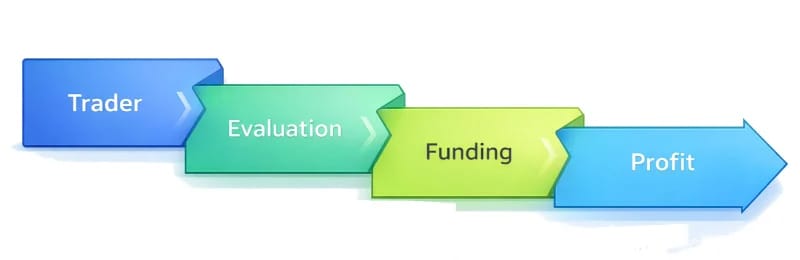
- Traders register with the firm and choose an account size
- They complete an evaluation or challenge phase
- They must meet profit targets while following risk rules
- After passing, they receive a funded account
- Profits are shared based on a predefined percentage
The evaluation phase is designed to test consistency, discipline, and risk management skills rather than just profitability.
Key Features of Prop Firms
- Funded Accounts: Traders gain access to large amounts of trading capital, allowing them to take bigger positions compared to personal accounts.
- Profit Sharing : One of the main attractions highlighted in this Prop Firm Guide is the profit split model, where traders keep a significant portion of their earnings.
- Risk Management Rules:Prop firms enforce strict rules such as daily loss limits and maximum drawdown to protect their capital.
- Evaluation Process: Before funding, traders must prove their ability through structured challenges.
- Scaling Opportunities: Successful traders can increase their account size over time, leading to higher earning potential.
Types of Prop Firms
- Evaluation-Based Prop Firms: These firms require traders to pass one-step or two-step challenges before accessing funded accounts. This is the most common model in the forex industry.
- Instant Funding Firms: In this model, traders receive funded accounts immediately after paying a fee. However, risk rules are usually stricter, and consistency is still required.
Advantages of Using a Prop Firm
This Prop Firm Guide highlights several benefits of trading with a prop firm:
- Access to large capital without personal financial risk
- Opportunity to earn higher returns
- Structured environment that promotes discipline
- Suitable for traders with limited starting capital
- Potential for long-term growth through scaling plans
Risks and Challenges of Prop Firms
While prop firms offer many opportunities, this Prop Firm Guide also emphasizes the challenges:
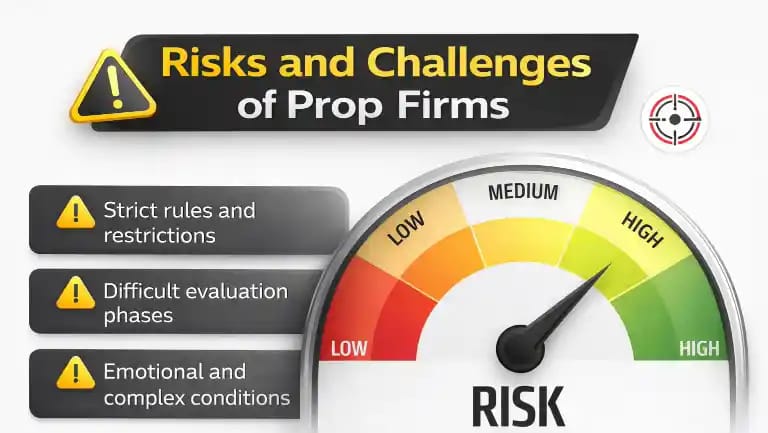
- Strict rules must be followed at all times
- Evaluation phases can be difficult to pass
- Emotional pressure when trading firm capital
- Some firms may include complex or unclear conditions
Understanding these challenges is important before choosing a prop firm.
Who Should Use a Prop Firm
This Prop Firm Guide suggests that prop firms are best suited for traders who:
- Have trading skills but lack sufficient capital
- Want to grow their trading career professionally
- Prefer structured trading environments
- Are focused on long-term consistency
Important Notes Before Joining
- Always read the firm’s rules carefully
- Check payout structure and conditions
- Understand drawdown limits and restrictions
- Practice on a demo account before attempting challenges
Final Thoughts
The Prop Firm Guide shows that proprietary trading firms provide a practical way for traders to access large capital without risking personal funds. However, success in this model depends heavily on discipline, consistency, and proper risk management.
For beginners, starting with a clear understanding of rules and focusing on steady performance can increase the chances of getting funded and maintaining long-term profitability.

