


Can you really make a living from forex trading? This is one of the most common questions asked by beginners entering the financial markets. Social media often presents forex trading as a fast path to financial freedom, showing traders traveling the world, driving luxury cars, and generating income from a laptop.
But the reality behind professional trading is far more complex.
Yes, it is technically possible to make a living from forex trading. Some traders do achieve consistent profitability and eventually rely on trading as their primary source of income. However, this outcome is far less common than many beginners expect, and it usually requires years of development, discipline, emotional control, and risk management.
The majority of traders who attempt to earn full-time income from forex either underestimate the difficulty, overestimate potential returns, or fail to manage risk properly.
This article explains what it really takes to make a living from forex trading, the challenges most traders face, common misconceptions, realistic income expectations, and the skills required for long-term survival in the market.
Can You Really Make a Living From Forex Trading?
Many people enter forex trading believing it offers unlimited income potential with complete freedom. While the forex market does provide opportunities, professional trading is not as simple as placing a few trades each day and generating easy income.
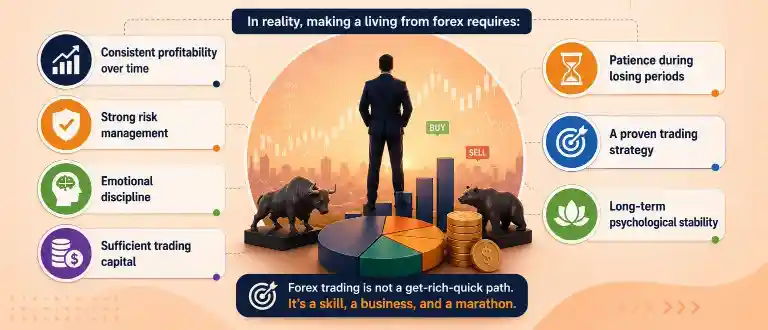
In reality, making a living from forex requires:
- Consistent profitability over time
- Strong risk management
- Emotional discipline
- Sufficient trading capital
- Patience during losing periods
- A proven trading strategy
- Long-term psychological stability
Most importantly, trading income is rarely stable in the way a traditional salary is stable.
Some months may be profitable, while others may produce minimal gains or even losses. This uncertainty creates emotional and financial pressure that many beginners are not prepared for.
Why Most Traders Fail Before Reaching Full-Time Status
One major reason most traders never make a living from forex is because they approach trading with unrealistic expectations.
Common beginner assumptions include:
- Turning small accounts into large fortunes quickly
- Winning most trades consistently
- Replacing a full-time income within months
- Finding a “perfect” strategy
- Trading without emotional stress
In practice, forex trading is a high-performance skill similar to professional sports, entrepreneurship, or investing. Success usually develops gradually through experience and repeated mistakes.
Many traders lose money early because they:
- Overleverage accounts
- Trade emotionally
- Ignore risk management
- Overtrade
- Switch strategies constantly
- Focus only on profits instead of consistency
Without discipline and structure, long-term survival becomes extremely difficult.
Capital Size Matters More Than Most Beginners Realize
One uncomfortable truth about full-time trading is that account size matters significantly.
Many beginners hope to generate a full-time income from very small accounts. While small accounts can grow over time, relying on them immediately for living expenses usually requires taking excessive risk.
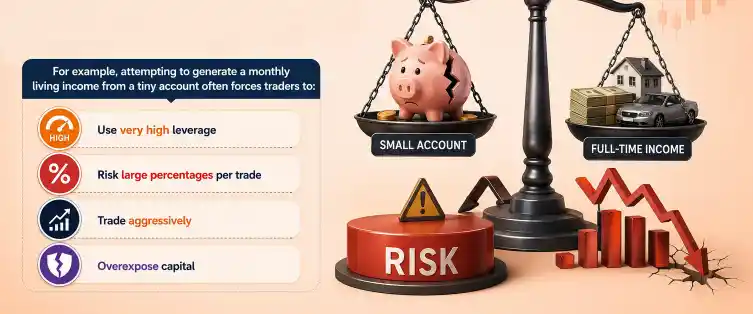
For example, attempting to generate a monthly living income from a tiny account often forces traders to:
- Use very high leverage
- Risk large percentages per trade
- Trade aggressively
- Overexpose capital
This dramatically increases the probability of blowing the account.
Professional traders usually think differently. Instead of focusing on fast growth, they focus on:
- Capital preservation
- Steady returns
- Controlled drawdowns
- Long-term sustainability
The larger the account size, the less pressure traders may feel to take dangerous risks.
Consistency Is More Important Than Big Wins
Many new traders become obsessed with large profits and fast account growth.
However, traders who survive long-term usually prioritize consistency instead of excitement.
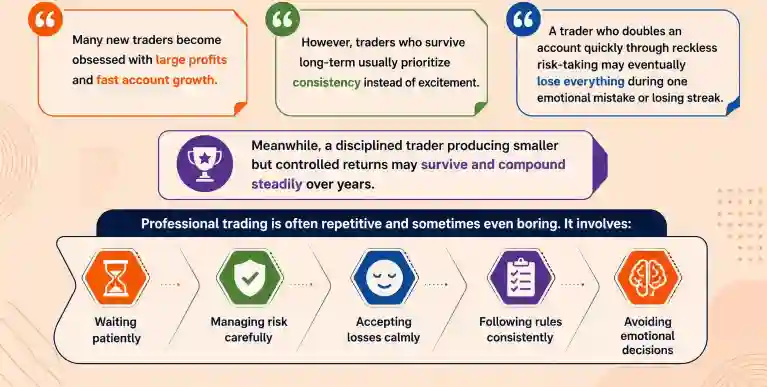
A trader who doubles an account quickly through reckless risk-taking may eventually lose everything during one emotional mistake or losing streak.
Meanwhile, a disciplined trader producing smaller but controlled returns may survive and compound steadily over years.
Professional trading is often repetitive and sometimes even boring. It involves:
- Waiting patiently
- Managing risk carefully
- Accepting losses calmly
- Following rules consistently
- Avoiding emotional decisions
This mindset is very different from the “high-adrenaline trading” image often promoted online.
Psychology Becomes More Difficult When Trading for Income
One major challenge of full-time trading is psychological pressure.
Trading casually is very different from relying on trading profits to pay bills, rent, or family expenses.
Once financial survival becomes connected to trading performance, emotions often intensify.
Common psychological challenges include:
- Fear of losing income
- Pressure to force trades
- Anxiety during drawdowns
- Impatience during slow markets
- Emotional revenge trading
This is why many experienced traders recommend avoiding dependence on trading income too early.
Building trading skills while maintaining another source of income often reduces emotional pressure and improves decision-making.
The Myth of Daily Guaranteed Income
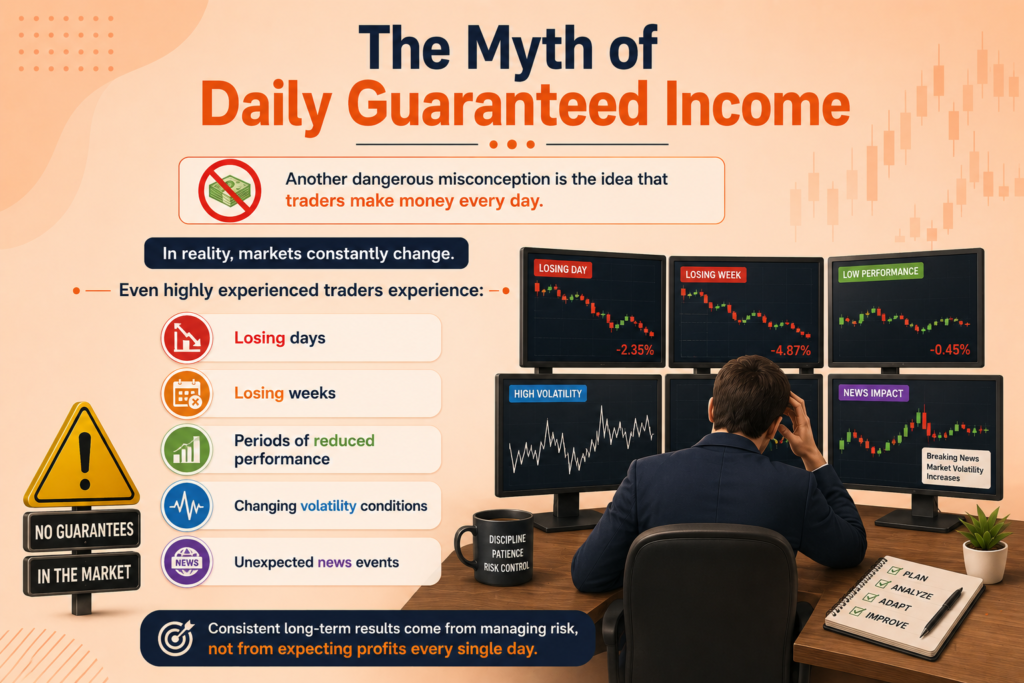
Another dangerous misconception is the idea that traders make money every day.
In reality, markets constantly change.
Even highly experienced traders experience:
- Losing days
- Losing weeks
- Periods of reduced performance
- Changing volatility conditions
- Unexpected news events
Professional trading is based on probabilities, not guarantees.
Trying to force daily income from the market often leads to:
- Overtrading
- Ignoring setups
- Increased risk-taking
- Emotional decision-making
Many profitable traders focus on long-term monthly or yearly performance rather than daily financial targets.
Can Small Retail Traders Actually Succeed?
Yes, some retail traders do become consistently profitable over time.
However, successful retail traders often share several common traits:
- Strong discipline
- Realistic expectations
- Risk management focus
- Patience
- Continuous learning
- Emotional stability
Most successful traders also understand that trading is not about constant action.
They spend significant time:
- Studying market behavior
- Reviewing trades
- Analyzing mistakes
- Improving execution
- Protecting mental discipline
Many beginners underestimate how much psychological control matters compared to technical analysis.
The Role of Risk Management in Long-Term Survival
Risk management is one of the most important skills for anyone hoping to make a living from forex.
Without proper risk control, even a good strategy can eventually fail.
Experienced traders often focus heavily on:
- Position sizing
- Maximum drawdown control
- Stop-loss discipline
- Risk-to-reward ratios
- Portfolio survival
Many losing traders focus only on entries while ignoring overall account protection.
The reality is simple: traders who survive longer gain more opportunities to improve.
Those who repeatedly blow accounts rarely stay in the game long enough to develop consistency.
Social Media Creates Unrealistic Expectations
Modern trading culture is heavily influenced by online content.
Many influencers showcase:
- Luxury lifestyles
- Massive profits
- High-leverage trades
- Fast account growth
- Expensive purchases
This creates the impression that successful trading is quick and easy.

In reality, professional trading usually involves:
- Long periods of learning
- Slow account growth
- Emotional discipline
- Careful risk control
- Continuous adaptation
Some online content may also exaggerate profitability while hiding losses, failed accounts, or unrealistic risk exposure.
Comparing your progress to social media trading content can create frustration and unrealistic expectations.
Trader Insight: What Experienced Traders Usually Realize
Experienced traders often discover that making a living from forex is less about predicting markets perfectly and more about managing themselves.
Most long-term traders eventually understand:
- Consistency matters more than large wins
- Losses are unavoidable
- Patience is a competitive advantage
- Emotional control affects performance heavily
- Trading income can fluctuate significantly
- Capital preservation is critical
Many successful traders also diversify income sources instead of relying entirely on trading profits alone.
This may include:
- Investments
- Business income
- Affiliate revenue
- Funded trading programs
- Long-term portfolio management
Reducing dependence on short-term trading income can often improve psychological stability.
How Long Does It Usually Take to Become Profitable
There is no fixed timeline for trading success.
Some traders improve relatively quickly, while others struggle for years.
The learning curve depends on:
- Discipline level
- Risk management
- Study habits
- Psychological control
- Market understanding
- Ability to learn from mistakes
Many traders underestimate how much emotional maturity is required.
Becoming consistently profitable often involves repeated setbacks, adjustments, and psychological development.
This is why treating forex trading as a professional skill instead of a shortcut to wealth is usually more realistic.
Signs a Trader May Not Be Ready for Full-Time Trading
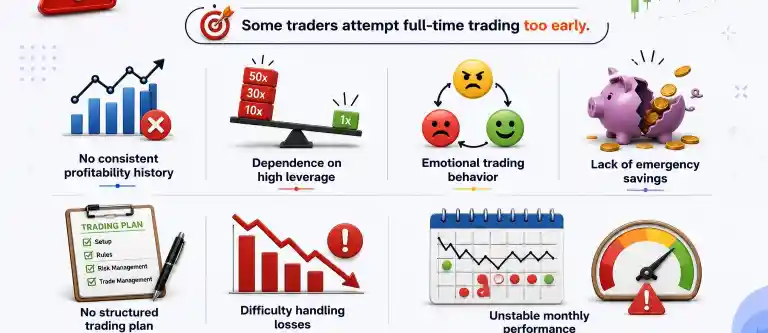
Some traders attempt full-time trading too early.
Warning signs may include:
- No consistent profitability history
- Dependence on high leverage
- Emotional trading behavior
- Lack of emergency savings
- No structured trading plan
- Difficulty handling losses
- Unstable monthly performance
Relying on trading income before achieving consistency can increase emotional pressure and worsen decision-making.
Practical Advice for Beginners
- Focus on Learning First: Do not rush to replace your primary income immediately.
- Develop Risk Discipline: Protecting capital is more important than chasing large returns.
- Use Realistic Expectations: Consistent profitability usually develops slowly.
- Track Performance Carefully: Keep a trading journal and analyze mistakes regularly.
- Avoid Social Media Pressure: Most successful traders focus more on consistency than appearance.
- Build Psychological Stability: Emotional control is often more important than technical indicators.
Final Verdict
Yes, it is possible to make a living from forex trading, but it is far more difficult than many online advertisements suggest.
Consistent trading income usually requires years of learning, disciplined risk management, emotional control, realistic expectations, and sufficient capital.
The majority of traders fail not because profitability is impossible, but because they approach trading with unrealistic goals, excessive risk-taking, and poor psychological discipline.
Successful trading is generally built slowly through consistency and survival rather than fast profits and aggressive leverage.
For beginners, the most realistic approach is to treat forex trading as a long-term skill development process rather than a quick escape from financial problems.
Those who focus on discipline, patience, and risk management usually have a much better chance of surviving long enough to improve.
Forex Risk Disclaimer
Forex and CFD trading involve substantial risk and may not be suitable for all investors. Leveraged trading can result in rapid financial losses. Always use proper risk management and never trade with money you cannot afford to lose.
| You may also like this……………. PrimeX Trading Competition – Join Now & Win From a $3000 Prize Pool |

