

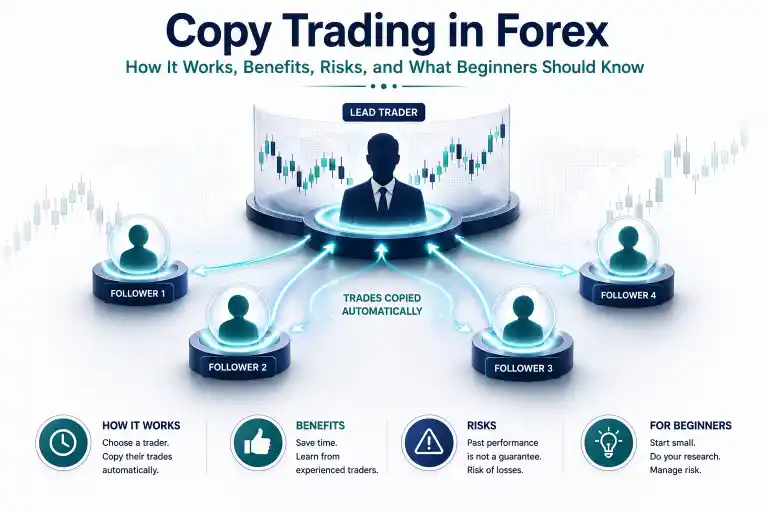
Copy trading in forex lets a retail trader automatically mirror the trades of another, usually more experienced, trader inside the same broker platform. It sounds simple on the surface — pick a trader, allocate some funds, and let the system copy their positions in real time. But copy trading in forex is not a shortcut to effortless income, and treating it that way is exactly how beginners lose money. This guide breaks down how copy trading actually works, what genuine benefits it offers, and — just as importantly — the risks, fees, leverage exposure, and trader-selection problems that rarely get mentioned in flashy marketing.
What Is Copy Trading in Forex?
Copy trading in forex is a feature offered by many broker platforms that connects a “signal provider” (an active trader who shares their trades publicly) with “followers” who allocate a portion of their account to automatically replicate those trades. When the signal provider opens a position, the same trade — scaled to the follower’s account size — opens on the follower’s account as well.
It’s different from a signal service where you manually place trades based on alerts. In copy trading, the execution is automatic. That convenience is the main appeal, but it also means followers are giving up direct control over individual trade decisions.
How Copy Trading in Forex Works
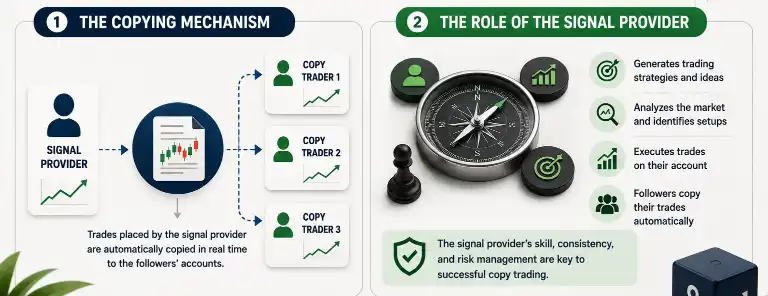
The Copying Mechanism
Most platforms allow a follower to set an allocation amount and, sometimes, a maximum risk percentage per trade. Once connected, trades are mirrored proportionally — if the signal provider risks 2% of their account on a trade, the platform calculates the equivalent position size for the follower’s smaller or larger account.
The Role of the Signal Provider
Signal providers are ranked on public leaderboards, typically by past performance, win rate, or growth percentage. This is one of the more misunderstood parts of copy trading in forex: a leaderboard ranking reflects historical results under past market conditions, not a guarantee of how that trader will perform going forward.
Benefits of Copy Trading in Forex
- Lower research burden: Beginners who don’t yet understand technical or fundamental analysis can observe how experienced traders structure entries and exits.
- Diversification across strategies: Some platforms let you split allocation across multiple traders with different styles (scalping, swing trading, trend-following).
- Transparency of track record: Reputable platforms show verified trade history, drawdown, and risk metrics for each signal provider, which is more transparent than an anonymous “trading tip.”
- Learning by observation: Watching how a disciplined trader manages stop-losses and position sizing can genuinely help a beginner build intuition over time.
These benefits are real, but none of them remove the underlying market risk. Copy trading in forex still means real capital is exposed to real price movement.
Risks of Copy Trading in Forex
This is the part most promotional content skips. Understanding these risks properly is what separates an informed decision from a blind one.
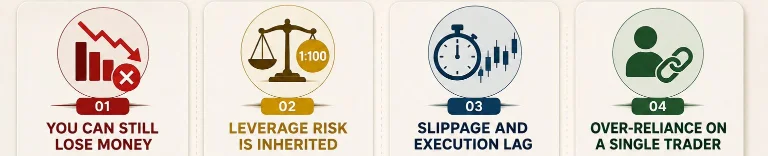
You Can Still Lose Money
Copying a profitable trader does not mean you will profit. Markets move against every strategy at some point, and a signal provider with a strong six-month track record can still hit a losing streak. Followers experience the same drawdowns the provider does, proportional to their allocation.
Leverage Risk Is Inherited
Slippage and Execution Lag
If the signal provider trades with high leverage, that leverage is often replicated on the follower’s account too, depending on the platform’s copy settings. Higher leverage magnifies both gains and losses — a losing trade that would be a minor dip without leverage can wipe out a much larger portion of a follower’s account when leverage is high. This is one of the biggest hidden dangers of copy trading in forex, especially for beginners who don’t fully grasp margin requirements.
There is usually a small delay between when the signal provider’s trade executes and when it copies to a follower’s account. In fast-moving markets, this lag can mean the follower enters at a noticeably different price than the original trader — sometimes to their disadvantage.
Over-Reliance on a Single Trader
Allocating all your funds to one signal provider concentrates your risk entirely in that person’s decision-making and current strategy. If that trader changes their approach, takes on more risk, or has an off period, a follower’s entire account is affected.
Fees and Costs Involved in Copy Trading
Copy trading in forex is rarely free. Costs typically include:
- Performance fees: A percentage of profits paid to the signal provider, often charged monthly.
- Spread markups: Some copy trading platforms widen spreads slightly compared to standard accounts.
- Subscription or platform fees: Certain third-party copy trading services charge a flat fee regardless of performance.
- Swap/rollover charges: Positions held overnight still incur standard swap costs, which apply to copied trades as well.
These costs quietly reduce net returns even when the copied trader is performing well, so it’s worth checking a platform’s full fee schedule before allocating funds.
How to Choose a Trader to Copy
Instead of chasing the highest percentage return on a leaderboard, consider these factors:
- Maximum drawdown: How much has the trader’s account dropped from its peak historically? A high return paired with a severe drawdown signals higher risk.
- Consistency over time: A trader with steady, modest performance across multiple market conditions is generally more reliable than one with a short streak of large gains.
- Risk settings used: Check whether the trader typically uses high leverage or wide stop-losses, and whether the platform lets you cap your own risk exposure independently.
- Trading style fit: A scalper who trades dozens of times a day produces a very different experience than a swing trader holding positions for days.
For a deeper look at position sizing and protecting your account from oversized losses, see our guide on risk management tips for prop firm traders, many of which apply directly to copy trading accounts as well.
Copy Trading vs Manual Trading: Which Suits Beginners?
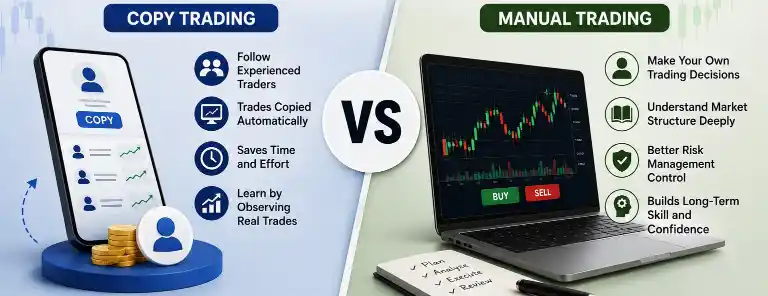
Manual trading forces beginners to learn market structure, order execution, and risk management directly — a slower but often more durable education. Copy trading in forex can complement that learning process by showing real decision-making in action, but it shouldn’t replace understanding the basics of how trades are actually executed. If you’re new to this, it helps to first understand how forex brokers execute your trades before relying on any automated copying system.
Final Thoughts
Copy trading in forex offers a genuinely useful way to observe experienced trading behavior and diversify across strategies, but it carries the same core risks as any form of forex trading — leverage, drawdowns, execution lag, and real financial loss. Approaching it with realistic expectations, understanding the fee structure, and carefully vetting a trader’s risk profile — rather than just their headline returns — is what separates an informed beginner from someone gambling on a leaderboard.
Frequently Asked Questions
Is copy trading in forex profitable?
It can be, but profitability depends entirely on the performance of the copied trader, market conditions, and the fees involved. There is no fixed outcome, and losses are a normal possibility.
Is copy trading suitable for complete beginners?
It can be a learning tool, but beginners should still understand leverage, drawdown, and order execution before allocating meaningful capital, since responsibility for losses still rests with the follower’s account.
Do regulators oversee copy trading?
In several jurisdictions, copy trading is treated as a form of portfolio or investment management and falls under existing financial regulation. The UK’s Financial Conduct Authority, for example, publishes guidance on how copy trading is classified and regulated — worth reviewing before choosing a platform.

