

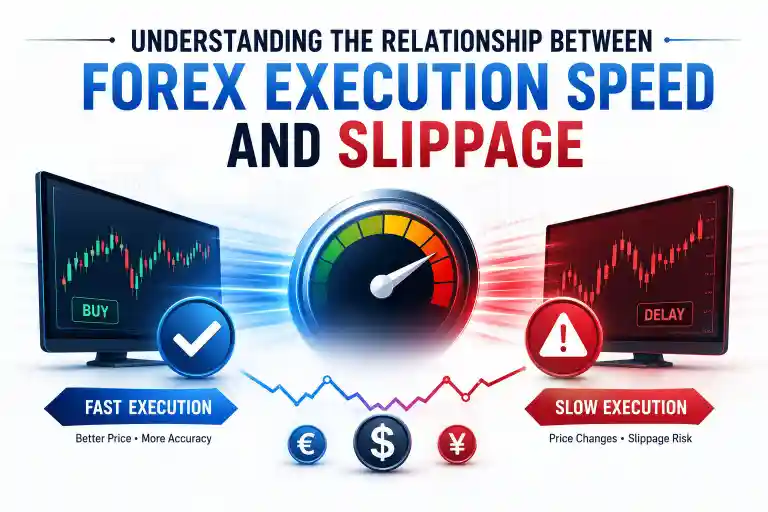
Forex Execution Speed and Slippage are closely connected and can have a significant impact on trading performance, particularly for scalpers, day traders, and other active market participants. While many traders focus on finding profitable strategies and analyzing market trends, the quality and speed of order execution are often overlooked.
Imagine identifying an ideal trading opportunity on EUR/USD, only to find that your order is executed several pips away from the expected price. Even with accurate market analysis, a delay in execution can affect your entry price and, in some cases, reduce potential profits or increase losses.
Every trading order takes a small amount of time to travel from the trading platform to the broker’s servers and then to liquidity providers for execution. Under normal market conditions, this process is usually completed within milliseconds. During periods of high volatility, however, execution delays may increase the likelihood of slippage as prices change before the order is filled.
In this guide, we explain the relationship between Forex Execution Speed and Slippage, the factors that influence execution quality, and practical ways traders can improve order execution in different market conditions.
Why Forex Execution Speed Matters More Than Most Traders Realize
Many beginners assume that every broker executes trades instantly. While modern trading technology has made execution extremely fast compared to previous decades, no broker can completely eliminate execution time.
Every market order follows a process before it reaches the market. Once you click Buy or Sell, your trading platform sends the order to the broker’s trading server. The broker then routes the order according to its execution model, which may involve internal processing or forwarding the order to external liquidity providers.
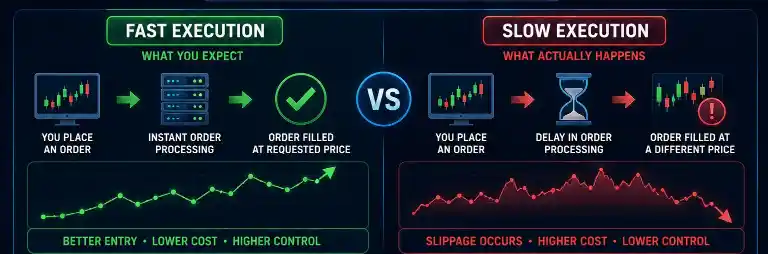
Under stable market conditions, this process is usually completed within a fraction of a second. However, during periods of increased market activity, thousands of market participants may be sending orders simultaneously. As trading volume increases, prices can change multiple times before an order reaches execution.
This explains why execution speed becomes increasingly important during volatile markets.
Key Takeaway: Fast execution does not guarantee better trades every time, but it reduces the opportunity for market prices to change before an order is filled.
Understanding the Relationship Between Forex Execution Speed and Slippage
Forex Execution Speed and Slippage are closely related because the longer an order takes to be executed, the more opportunity there is for market prices to change. In stable market conditions, a slight delay may have little impact. During periods of high volatility, however, prices can move several times within a single second, increasing the likelihood of slippage.
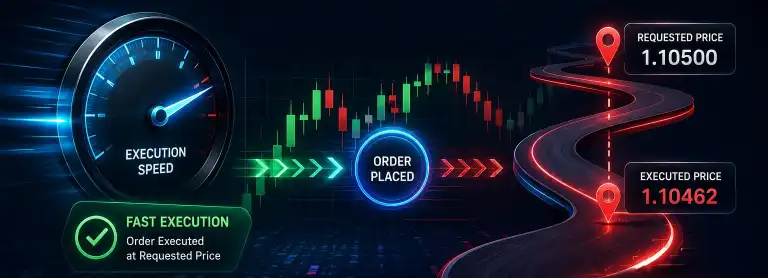
For example, imagine a trader places a market order to buy EUR/USD at 1.10500 immediately after a major economic announcement. If the order is executed within milliseconds, the trader may receive a price close to the requested level. However, if prices continue moving while the order is being processed, the execution price could be 1.10508 or higher.
This difference is known as slippage, and it often occurs because the requested market price is no longer available by the time the order reaches the market. It is important to recognize that slippage is not always caused by poor broker performance. In fast-moving markets, changing prices are a normal part of the execution process.
Experienced traders evaluate Forex execution speed and slippage over a large number of trades rather than judging execution quality based on a single order. Consistent and reliable execution across different market conditions is generally a more meaningful measure of a broker’s performance.
How Slow Order Execution Increases the Risk of Slippage
The connection between execution speed and slippage becomes much easier to understand when viewed as a race against changing market prices.
Financial markets never stop moving. Every second, thousands of buy and sell orders enter the market from banks, hedge funds, institutions, algorithmic trading systems, and retail traders.
If your order reaches the market quickly, there is a greater chance that your requested price is still available.
If execution takes longer, the market has more time to move.
Consider the following comparison.
| Fast Execution | Slow Execution |
|---|---|
| Order reaches market within milliseconds. | Order experiences noticeable delay. |
| Requested price is often still available. | Market price may already have changed. |
| Lower probability of significant slippage. | Higher probability of slippage. |
| More consistent execution quality. | Less predictable execution. |
This does not mean every slow execution results in slippage. Likewise, fast execution cannot completely eliminate slippage during major market events.
However, faster execution generally reduces the amount of time available for prices to move.
Key Takeaway: Execution speed influences the probability of slippage rather than guaranteeing a particular outcome.
Positive Slippage vs Negative Slippage
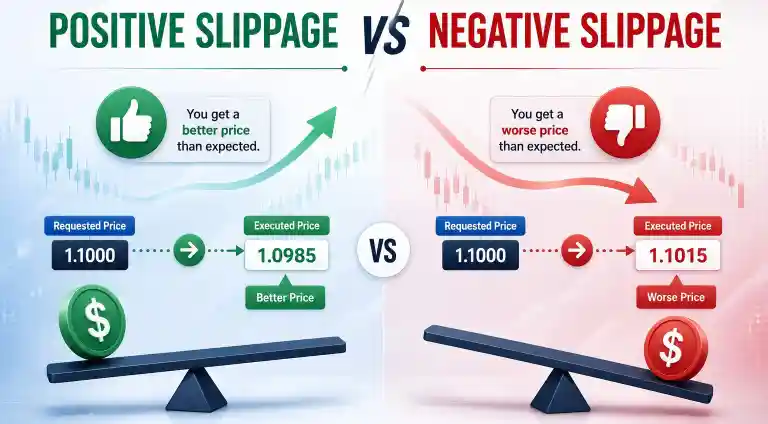
Many beginner traders assume that slippage is always unfavorable, but this is not always the case. Slippage can occur in either direction, depending on how market prices move while an order is being executed.
Positive Slippage
Positive slippage occurs when an order is executed at a more favorable price than the one requested. For example, if a trader places a Buy order at 1.20000 but it is filled at 1.19996, the trader benefits from a lower entry price. This difference is known as positive slippage.
Negative Slippage
Negative slippage occurs when an order is executed at a less favorable price than expected. For instance, if the same Buy order is filled at 1.20006 instead of 1.20000, the trader enters the market at a higher price, increasing the cost of the trade.
Both positive and negative slippage are a normal part of trading, particularly during periods of increased market volatility or reduced liquidity. Reputable and well-regulated brokers generally allow both types of slippage, reflecting actual market conditions rather than applying only unfavorable price adjustments.
Factors That Influence Forex Execution Speed
Several independent factors influence how quickly orders are executed. Understanding these variables helps traders separate normal market behavior from broker performance.
Market Liquidity
Liquidity refers to the number of buyers and sellers actively participating in the market.
During highly liquid periods, large numbers of orders are available at different price levels, allowing trades to be matched more efficiently.
Major currency pairs traded during the London and New York session overlap typically experience the highest liquidity and often the most consistent execution.
Market Volatility
Rapid price movement creates additional challenges for order execution.
During events such as Non-Farm Payrolls (NFP), inflation reports, or central bank interest rate decisions, prices can move several pips within fractions of a second.
Even brokers with advanced infrastructure cannot guarantee identical execution prices when markets change this rapidly.
Internet Connection Quality
Execution speed is influenced not only by the broker but also by the trader’s own connection.
A slow or unstable internet connection may delay order transmission before it even reaches the broker’s servers.
Professional traders often use stable high-speed internet connections to minimize avoidable delays.
Broker Infrastructure
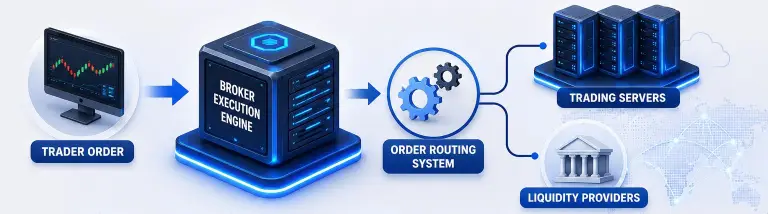
The broker’s technology plays a significant role in execution quality.
Modern trading servers, efficient order routing systems, and reliable liquidity provider connections can improve execution consistency.
Brokers that continually invest in infrastructure are generally better positioned to handle periods of increased trading activity.
Server Location and VPS Hosting
The physical distance between the trader’s platform and the broker’s trading servers can also influence execution speed.
Many active traders use Virtual Private Servers (VPS) located near broker data centers to reduce network latency.
This approach is particularly popular among algorithmic traders and scalpers, where execution speed can directly affect trading results.
Key Takeaway: Forex execution speed depends on multiple factors working together. Broker technology is important, but market liquidity, volatility, internet quality, and server location also contribute to overall execution performance.
Why Slippage Becomes More Common During High-Impact News Events
One of the most noticeable characteristics of the Forex market is how quickly prices can move after important economic announcements. Reports such as the US Non-Farm Payrolls (NFP), Consumer Price Index (CPI), Gross Domestic Product (GDP), interest rate decisions, and central bank speeches often trigger sharp movements within seconds of their release.
During these events, thousands of banks, institutions, hedge funds, algorithmic trading systems, and retail traders attempt to execute orders simultaneously. As buying and selling activity increases, available liquidity at specific price levels may disappear almost instantly.
When this happens, the price requested by a trader may no longer be available by the time the order reaches the market. The order is then executed at the next available price, increasing the likelihood of slippage.
This explains why slippage is more common during periods of extreme volatility. It is usually the result of rapidly changing market prices rather than a simple delay caused by the broker.
For example, imagine EUR/USD is trading quietly before an interest rate announcement. Immediately after the decision is released, the market moves 30 pips within a few seconds. Even a broker with excellent execution technology may not be able to fill every order at the originally requested price because that price may exist for only a fraction of a second.
Key Takeaway: High-impact news increases market activity, reduces available liquidity at specific prices, and makes slippage more likely regardless of how fast a broker executes orders.
The Role of Broker Execution Quality in Reducing Slippage

Although market conditions play a major role, broker execution quality also influences how efficiently orders are processed.
A broker’s execution quality depends on several factors, including:
- Server performance
- Order routing technology
- Connections with liquidity providers
- Network stability
- Execution infrastructure
Brokers with modern infrastructure can often process orders more efficiently during normal market conditions, reducing unnecessary execution delays.
However, it is important to have realistic expectations. No broker can completely eliminate slippage during highly volatile events because execution ultimately depends on available market liquidity.
Instead of promising “zero slippage,” reputable brokers typically focus on providing transparent execution that fairly reflects actual market conditions.
Professional Trader Insight: Experienced traders evaluate brokers over hundreds of trades rather than judging execution quality based on a single news event. Consistency is far more important than isolated results.
How Professional Traders Prepare for Fast-Moving Markets
Professional traders understand that certain market conditions naturally increase execution risk. Rather than assuming every trade will be executed perfectly, they adjust their trading approach based on expected volatility.
Some common practices include:
- Reducing position size before major economic announcements.
- Avoiding new market orders immediately before scheduled news releases.
- Reviewing the economic calendar every trading day.
- Allowing wider stop-loss distances only when supported by their trading plan.
- Accepting that occasional slippage is part of trading liquid financial markets.
Many professional traders also avoid judging execution quality during unusually volatile events because they understand that temporary execution challenges affect nearly every market participant.
Practical Ways to Reduce Slippage
Although slippage cannot be eliminated entirely, traders can often reduce its frequency and impact by following several practical guidelines.
Trade During High-Liquidity Market Hours
The Forex market generally experiences its highest liquidity during the overlap between the London and New York trading sessions.
Greater liquidity often improves order execution because more buyers and sellers are available at each price level.
Avoid Major News Releases When Appropriate
Unless your strategy is specifically designed for news trading, it is often wise to avoid entering new positions immediately before high-impact economic announcements.
Waiting until market conditions stabilize may help reduce execution uncertainty.
Use Limit Orders When Suitable
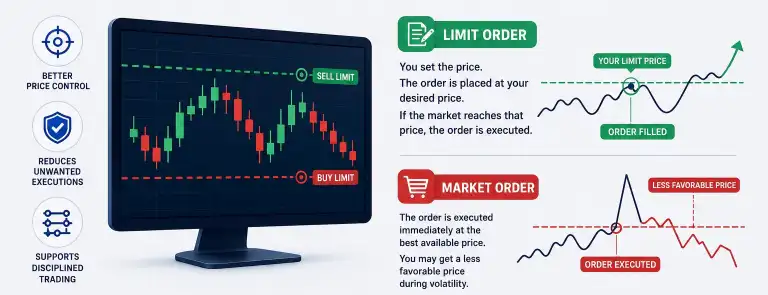
Unlike market orders, limit orders specify the maximum or minimum price at which a trader is willing to buy or sell.
If the requested price is unavailable, the order simply remains unfilled rather than being executed at a less favorable price.
However, traders should remember that limit orders prioritize price rather than guaranteed execution.
Choose Brokers with Reliable Execution
Execution quality should be considered alongside spreads, commissions, regulation, and customer support when selecting a broker.
A broker with slightly higher spreads but consistently reliable execution may provide better long-term value than one advertising extremely low spreads but inconsistent order processing.
Maintain a Stable Internet Connection
Even the fastest broker cannot compensate for a poor internet connection between the trader’s device and the broker’s servers.
Using a reliable connection can help reduce unnecessary transmission delays.
How Forex Execution Speed Affects Different Trading Styles
The importance of execution speed varies depending on how a trader approaches the market.
| Trading Style | Importance of Execution Speed |
|---|---|
| Scalping | Very High |
| Day Trading | High |
| Swing Trading | Moderate |
| Position Trading | Lower |
Scalpers
Scalpers often target only a few pips per trade. Because profit targets are relatively small, even minor execution delays or slippage can significantly influence profitability.
Day Traders
Day traders also benefit from efficient execution because they frequently enter and exit positions during the same trading session.
Consistent execution can improve trade management and reduce unexpected trading costs.
Swing Traders
Swing traders typically hold positions for several days. Since their profit targets are usually much larger, small differences in execution price often have less impact on overall performance.
Key Takeaway: The shorter your trading timeframe, the more important execution speed generally becomes.
Common Misconceptions About Forex Execution Speed and Slippage
Misconception 1: Slippage Only Happens with Bad Brokers
Slippage occurs in every financial market, including stocks, futures, and Forex.
Market volatility and liquidity conditions often play a greater role than broker quality.
Misconception 2: Fast Execution Eliminates Slippage Completely
Fast execution reduces the opportunity for prices to change but cannot prevent slippage during rapidly moving markets.
Misconception 3: Every Delayed Order Indicates Broker Manipulation
Order delays can result from several factors, including internet latency, temporary market congestion, reduced liquidity, or rapid price movement.
Not every execution difference indicates unfair broker practices.
Misconception 4: Lower Spreads Automatically Mean Better Execution
Execution quality involves far more than spreads.
Order routing, liquidity provider relationships, infrastructure, and technology all contribute to the overall trading experience.
Real-World Examples of Execution Delays and Slippage
Consider a trader placing a Buy order on GBP/USD immediately after the Bank of England announces an unexpected interest rate increase. As the news triggers a sharp market reaction, the price rises rapidly within seconds. Although the trader submits the order without delay, it is executed several pips higher because the requested price is no longer available. This is a common example of negative slippage caused by high market volatility and limited liquidity.
Now consider a different scenario where a trader places an order on EUR/USD during stable market conditions with sufficient liquidity. Since prices remain relatively steady, the order is executed almost immediately at or very close to the requested price, resulting in little or no slippage.
These examples show that Forex execution speed and slippage are influenced not only by a broker’s execution technology but also by market volatility and the amount of available liquidity at the time an order is placed.
Final Thoughts
Understanding Forex Execution Speed and Slippage is important for traders who want to improve execution quality and make more informed trading decisions. While execution delays cannot always be avoided, knowing how they affect order execution can help traders manage risk more effectively.
Rather than expecting perfect execution in every market condition, traders should focus on choosing regulated brokers with reliable execution, transparent pricing, and strong trading infrastructure. Combined with sound risk management and an understanding of market conditions, this approach can help improve overall trading consistency.
Ultimately, successful trading depends not only on identifying good opportunities but also on ensuring that orders are executed as efficiently as possible.

