

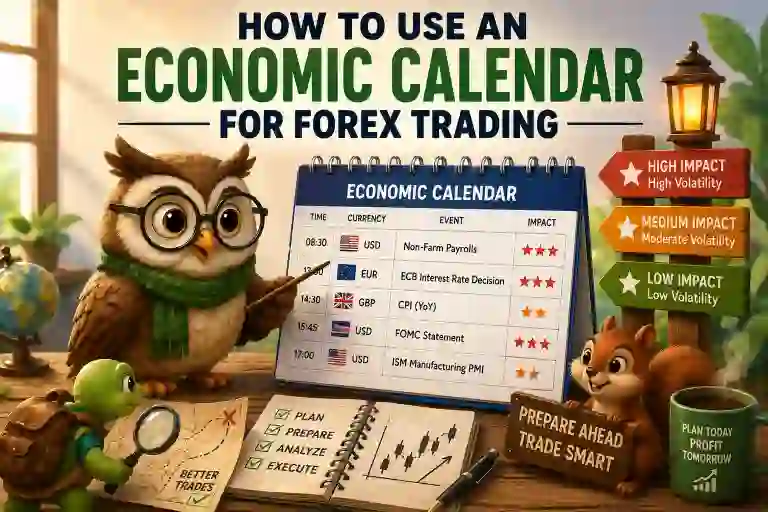
Successful Forex trading is not only about reading charts and identifying technical patterns. Currency prices are heavily influenced by economic events, government reports, central bank decisions, and market expectations. This is where an economic calendar becomes one of the most valuable tools available to traders.
Many beginners spend months learning indicators and chart patterns but completely ignore economic data releases. As a result, they are often surprised when a perfectly planned trade suddenly moves against them due to a major news announcement. Understanding how to use an economic calendar for Forex trading can help traders prepare for these market-moving events and make more informed trading decisions.
An economic calendar provides a schedule of important economic releases and events that may impact financial markets. By learning how to interpret this information, traders can anticipate periods of high volatility, avoid unnecessary risk, and identify potential trading opportunities.
In this guide, we will explore how to use an economic calendar for Forex trading, what information it contains, and how traders can incorporate it into their daily trading routine.
What Is an Economic Calendar in Forex Trading?
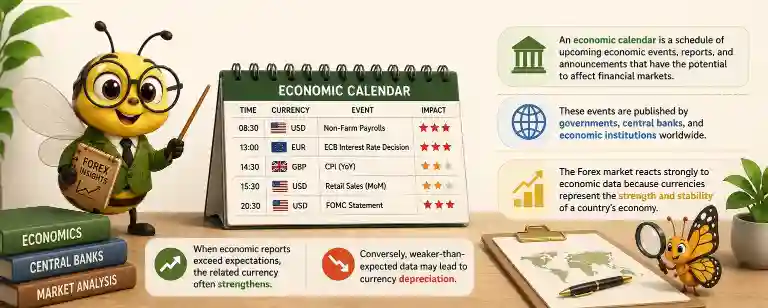
An economic calendar is a schedule of upcoming economic events, reports, and announcements that have the potential to affect financial markets. These events are published by governments, central banks, and economic institutions worldwide.
The Forex market reacts strongly to economic data because currencies represent the strength and stability of a country’s economy. When economic reports exceed expectations, the related currency often strengthens. Conversely, weaker-than-expected data may lead to currency depreciation.
The purpose of an economic calendar is to help traders stay informed about upcoming events that could influence market conditions.
Examples of common economic calendar events include:
- Interest rate decisions
- Non-Farm Payrolls (NFP)
- Consumer Price Index (CPI)
- Gross Domestic Product (GDP)
- Retail Sales reports
- Central bank speeches
- Employment data releases
- Manufacturing and services reports
Learning how to use an economic calendar for Forex trading allows traders to anticipate these events rather than being caught off guard by sudden market volatility.
Why Economic Calendars Matter to Forex Traders
Currency markets are driven by expectations. Investors constantly evaluate economic conditions to determine whether a currency is likely to strengthen or weaken in the future.
Economic reports provide valuable information about inflation, employment, consumer spending, business activity, and economic growth. These factors influence central bank policies, which are among the most important drivers of currency values.
For example, if inflation rises significantly, a central bank may increase interest rates to control price growth. Higher interest rates often attract foreign investment, which can increase demand for that country’s currency.
This relationship explains why experienced traders closely monitor economic calendars before entering positions.
Understanding how to use an economic calendar for Forex trading can help traders:
- Prepare for market volatility
- Avoid unexpected news-related losses
- Identify potential trading opportunities
- Understand market sentiment
- Improve overall risk management
Understanding the Key Components of an Economic Calendar
At first glance, an economic calendar may appear complicated. However, most calendars contain a few basic elements that are relatively easy to understand.
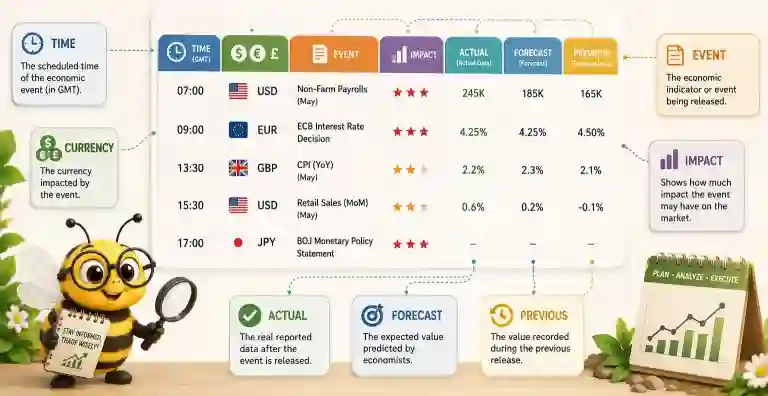
Event Time
The event time shows exactly when the economic report will be released. Since Forex markets operate globally, it is important to ensure that the calendar’s time zone matches your local trading time.
Knowing the release time allows traders to prepare before the announcement occurs.
Affected Currency
Each economic event is associated with a specific currency.
For example:
- USD events affect the US Dollar.
- EUR events affect the Euro.
- GBP events affect the British Pound.
- JPY events affect the Japanese Yen.
Traders should pay particular attention to events affecting the currencies they actively trade.
Impact Level
Most economic calendars classify events according to their expected market impact.
- Low Impact
- Medium Impact
- High Impact
High-impact events typically generate the largest price movements and attract the most attention from traders.
Previous Value
The previous value represents the result from the last reporting period. This figure helps traders compare current data with historical performance.
Forecast Value
The forecast reflects economists’ expectations for the upcoming release.
Market participants often position themselves based on these forecasts before the announcement occurs.
Actual Value
The actual value is the newly released economic data. When the actual result differs significantly from the forecast, the market may react aggressively.
This comparison between forecast and actual data is one of the most important aspects of how to use an economic calendar for Forex trading.
The Most Important Economic Events Forex Traders Should Monitor
Not all economic reports have the same impact on currency markets. Some events consistently generate larger price movements than others.
- Non-Farm Payrolls (NFP): The US Non-Farm Payrolls report measures employment growth in the United States. Because employment is closely linked to economic health, NFP releases often cause significant volatility across USD currency pairs.
- Interest Rate Decisions: Central bank interest rate decisions are among the most influential events in Forex trading. Changes in interest rates directly affect investment flows and currency demand. Traders who understand how to use an economic calendar for Forex trading pay close attention to meetings held by central banks such as the Federal Reserve, European Central Bank, and Bank of England.
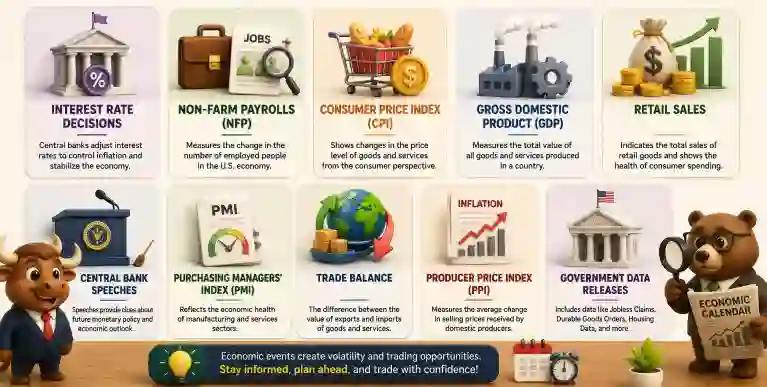
- Consumer Price Index (CPI): CPI measures inflation levels within an economy. Inflation data is closely monitored because it influences future monetary policy decisions.
- Gross Domestic Product (GDP): GDP measures overall economic growth. Strong GDP growth typically supports a country’s currency, while weak growth may create downward pressure.
- Central Bank Speeches: Comments from central bank officials can significantly influence market expectations. Even when interest rates remain unchanged, speeches often provide clues about future policy decisions.
Step-by-Step Guide: How to Use an Economic Calendar for Forex Trading
Step 1: Review the Weekly Calendar
At the beginning of each trading week, review upcoming economic events.
This habit allows traders to identify important releases before entering trades.
Professional traders often plan their entire trading week around major economic announcements.
Step 2: Focus on High-Impact Events
While every economic report has some significance, high-impact events deserve the most attention.
These events are more likely to generate large price swings and increased volatility.
Step 3: Identify Relevant Currency Pairs
If a major US economic report is scheduled, traders should focus on currency pairs involving the US Dollar.
Examples include:
- EUR/USD
- GBP/USD
- USD/JPY
- AUD/USD
This targeted approach helps traders concentrate on markets most likely to react.
Step 4: Compare Forecast and Previous Values
Before the announcement, compare the forecast with the previous result.
This provides insight into market expectations and potential sentiment.
Understanding these expectations is a critical part of how to use an economic calendar for Forex trading effectively.
Step 5: Develop a Trading Plan
Never wait until the news is released to decide what to do.
Create a plan beforehand.
Consider:
- Potential market scenarios
- Entry opportunities
- Stop-loss placement
- Profit targets
- Risk exposure
Having a plan helps traders remain disciplined during volatile conditions.
Step 6: Manage Risk Carefully
News releases often produce rapid price movements.
Spreads may widen, slippage can occur, and market conditions may become unpredictable.
Effective risk management remains essential regardless of how attractive a trading opportunity appears.
Practical Example of Economic Calendar Analysis
Imagine economists expect US inflation to rise from 3.0% to 3.4%.
If the actual CPI release comes in at 4.0%, inflation is significantly higher than expected.
Traders may interpret this as increasing the likelihood of future interest rate hikes by the Federal Reserve.
As a result, demand for the US Dollar could increase, causing USD-related currency pairs to move sharply.
This example demonstrates how to use an economic calendar for Forex trading by comparing actual data against market expectations.
Common Mistakes Traders Make
- Ignoring major news events before opening positions.
- Trading immediately before high-impact announcements.
- Failing to adjust stop-loss levels during volatile periods.
- Focusing only on technical analysis.
- Misinterpreting economic data releases.
Many losses can be avoided simply by checking the economic calendar before entering a trade.
Should Beginners Trade During Major News Releases?
For most beginners, caution is recommended.
While major news events can create trading opportunities, they also introduce significant uncertainty.
Rapid market movements can trigger stop losses, create slippage, and increase emotional decision-making.

Many new traders benefit from observing market reactions during important announcements before attempting to trade them directly.
As experience grows, traders can gradually incorporate news-based strategies into their overall trading approach.
Final Thoughts
Learning how to use an economic calendar for Forex trading is an essential skill for every trader. Economic data influences market sentiment, central bank decisions, and currency valuations, making it impossible to ignore fundamental events completely.
Rather than viewing the economic calendar as a tool exclusively for news traders, it should be considered a risk management resource for all Forex participants.
By monitoring important economic releases, understanding market expectations, and preparing for volatility, traders can make more informed decisions and avoid unnecessary surprises.
Over time, combining economic calendar analysis with technical analysis can help create a more balanced and professional trading approach.

