


Price action trading remains one of the most popular approaches in the Forex market, and among all price action patterns, the pin bar is arguably one of the most recognized. Traders across different experience levels use pin bars to identify potential reversals, trend continuation opportunities, and high-probability entry points.
However, despite its popularity, many traders misunderstand how the pattern should be used. A pin bar alone does not guarantee that the market will reverse or continue in a particular direction. In reality, the success of a pin bar setup often depends more on where it forms than the pattern itself.
This is why experienced traders focus on context rather than simply reacting to every pin bar that appears on a chart.
Understanding how to use a Pin Bar Trading Strategy correctly can help traders improve entry timing, enhance risk management, and avoid some of the most common mistakes that lead to unnecessary losses.
In this guide, we will explore how pin bars work, where they are most effective, how professional traders use them, and the mistakes every Forex trader should avoid.
What Is a Pin Bar in Forex Trading?
A pin bar is a candlestick pattern that signals strong rejection of a particular price level.
The pattern typically consists of:
- A long wick or shadow
- A relatively small candle body
- A short wick on the opposite side
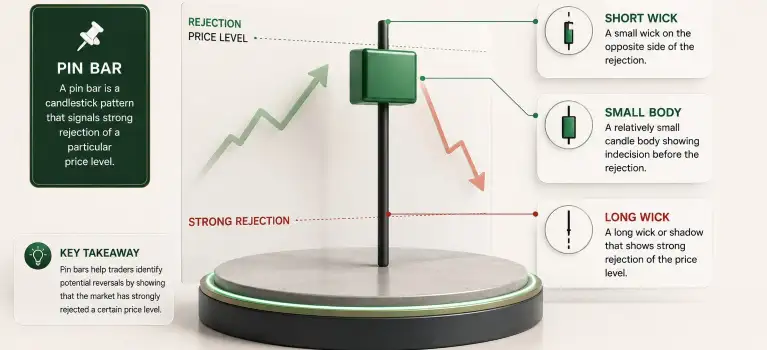
The long wick represents an area where the market attempted to move but failed to maintain momentum. Buyers or sellers stepped in aggressively, forcing price back in the opposite direction before the candle closed.
This rejection is what attracts the attention of price action traders.
The larger the rejection and the more significant the surrounding market context, the more meaningful the pin bar becomes.
Why the Pin Bar Trading Strategy Remains Popular Among Professional Traders
One reason the Pin Bar Trading Strategy has remained relevant for many years is its simplicity.
Unlike some indicator-based systems that require multiple confirmations and complicated calculations, a pin bar provides direct insight into buyer and seller behavior.
Professional traders appreciate that pin bars reveal:
- Market rejection
- Potential shifts in momentum
- Institutional activity near key levels
- Changes in market sentiment
- Potential entry opportunities
However, experienced traders rarely trade pin bars in isolation. Instead, they combine the pattern with market structure, support and resistance analysis, trend direction, and risk management principles.
Understanding Bullish and Bearish Pin Bars
Pin bars can signal either bullish or bearish intentions depending on where they form and the direction of rejection.
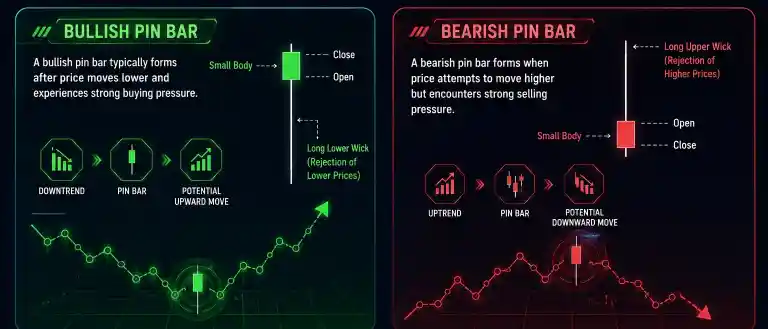
Bullish Pin Bar
A bullish pin bar typically forms after price moves lower and experiences strong buying pressure.
Characteristics include:
- Long lower wick
- Small candle body near the top
- Strong rejection of lower prices
This pattern suggests that sellers initially pushed the market lower, but buyers regained control before the candle closed.
When found near support levels, bullish pin bars can indicate potential upward movement.
Bearish Pin Bar
A bearish pin bar forms when price attempts to move higher but encounters strong selling pressure.
Characteristics include:
- Long upper wick
- Small candle body near the bottom
- Strong rejection of higher prices
This suggests that buyers lost control and sellers dominated the session.
When found near resistance levels, bearish pin bars may signal potential downside movement.
How the Pin Bar Trading Strategy Works
The core principle behind the Pin Bar Trading Strategy is market rejection.
Instead of focusing solely on the candle itself, traders attempt to understand why rejection occurred.
For example, if a bullish pin bar forms at a major support level that has held multiple times in the past, it may indicate that buyers are actively defending that area.
Similarly, a bearish pin bar at a major resistance zone may suggest that sellers are rejecting higher prices.
Many traders enter after the pin bar closes, while others wait for additional confirmation such as:
- Break of short-term market structure
- Trendline confirmation
- Support and resistance reactions
- Higher timeframe alignment
The objective is not simply to trade a candle but to trade the market story behind that candle.
Best Locations to Trade Pin Bars
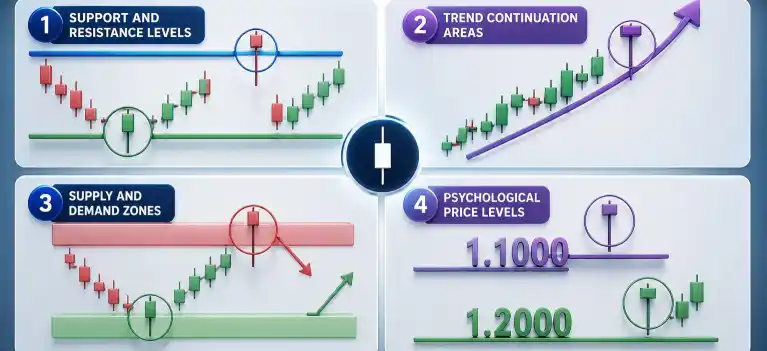
The effectiveness of a pin bar often depends more on its location than on the pattern itself. A well-formed pin bar that appears in the middle of a trading range may offer limited value. However, when a pin bar develops near a significant support or resistance level, trendline, or other key technical area, it can provide a stronger indication of potential market direction and trader sentiment.
Support and Resistance Levels
Support and resistance zones are widely regarded as some of the most reliable areas for identifying pin bar setups. These levels often attract increased buying or selling activity, making them important decision points in the market.
When a pin bar forms near a well-established support or resistance zone, it may suggest that market participants are reacting to that level and potentially rejecting further price movement in one direction. This can provide traders with additional confirmation when evaluating potential trade opportunities.
Trend Continuation Areas
Pin bars are not limited to identifying potential reversals. They can also be useful for spotting trend continuation opportunities within an established market trend.
For example, during an uptrend, a bullish pin bar that forms after a temporary pullback into a support area may indicate renewed buying interest and suggest that the broader trend could continue. In this context, the pin bar acts as a confirmation signal rather than a reversal pattern.
Supply and Demand Zones
Supply and demand traders frequently use pin bars as additional confirmation before entering a trade. When a pin bar forms within a well-defined supply or demand zone and shows strong price rejection, it can reinforce the validity of the setup and provide greater confidence in the potential trading opportunity.
Psychological Price Levels
Psychological price levels such as 1.1000, 1.2000, or 150.00 often attract increased market attention because many traders place orders around these round numbers. As a result, pin bars that form near these key levels can carry greater significance, as they may reflect strong buying or selling interest and a clear rejection of price at an important market area.
A Practical Example of a Pin Bar Trade
Imagine EUR/USD is trading in a clear uptrend.
Price pulls back toward a major support level that has previously acted as resistance.
At the support zone, a bullish pin bar forms with a long lower wick showing strong rejection.
A trader analyzing this setup may observe:
- Overall bullish trend
- Support level holding
- Bullish pin bar confirmation
- Potential continuation opportunity
The trader may then enter a long position with a stop loss below the pin bar low and target the next major resistance level.
This example demonstrates how the Pin Bar Trading Strategy works best when combined with market context.
How Professional Traders Use Confluence with Pin Bars
Professional traders rarely rely on a single signal.
Instead, they seek confluence.
Confluence occurs when multiple factors support the same trading idea.
Examples include:
- Pin bar at support
- Higher timeframe trend alignment
- Liquidity sweep
- Market structure confirmation
- Fibonacci retracement level
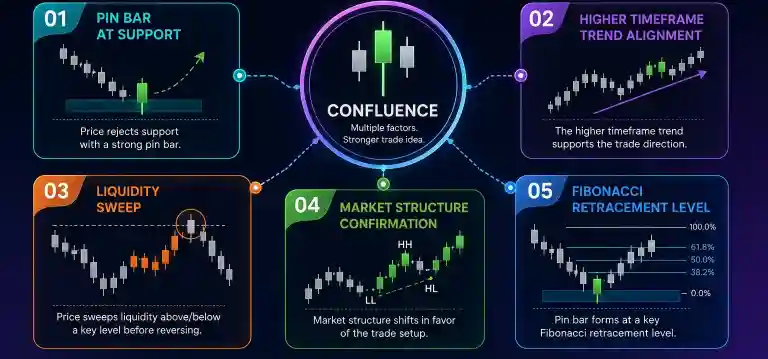
The more evidence supporting a setup, the stronger the overall trade idea becomes.
This is one reason why professional traders often achieve better consistency than traders who focus on isolated candlestick patterns.
Common Pin Bar Trading Mistakes Every Trader Should Avoid
Trading Every Pin Bar You See
One of the most common mistakes made by beginner traders is treating every pin bar as a trading signal. In reality, the pattern alone is not enough to justify a trade. Without support from key technical levels, market structure, or trend context, many pin bars simply reflect normal market noise rather than meaningful buying or selling pressure.
Ignoring Market Structure
A bullish pin bar that forms during a strong downtrend should not automatically be viewed as a reversal signal. Price action patterns are generally more reliable when they align with the broader market structure and prevailing trend.
Before acting on any pin bar setup, traders should evaluate the overall market direction and consider how the pattern fits within the larger price context. This helps improve trade selection and reduces the likelihood of taking low-probability setups
Trading Against the Higher Timeframe Trend
Many unsuccessful trades occur when traders rely solely on lower timeframes and overlook the broader market picture. Incorporating higher timeframe analysis can help filter out weaker setups and improve trade selection.
When a pin bar forms in the direction of the higher timeframe trend, it often carries greater significance and may offer a higher-probability trading opportunity compared to signals that go against the prevailing market direction.
Entering Too Early
One common mistake is entering a trade before the pin bar candle has fully closed. Since the candle’s shape can change significantly before completion, acting too early may lead to unreliable signals.
Waiting for the candle to close provides confirmation of the pattern and can help traders make more informed trading decisions.
Poor Risk Management
Even high-quality pin bar setups are not guaranteed to succeed. Market conditions can change quickly, and no trading signal is accurate all the time.
For this reason, effective risk management should always be part of the trading plan. Using appropriate stop-loss orders and limiting risk on each trade can help protect trading capital and support long-term consistency.
Risk Management When Trading Pin Bars
Proper risk management is what separates professional traders from gamblers.
When using the Pin Bar Trading Strategy, traders should:
- Risk a small percentage of account equity per trade.
- Use logical stop-loss placement.
- Maintain favorable risk-to-reward ratios.
- Avoid emotional decision-making.
- Follow a consistent trading plan.
Many traders focus entirely on finding better entries while neglecting risk control. In reality, long-term success depends far more on risk management than on any individual pattern.
Can the Pin Bar Trading Strategy Work in 2026?

Yes, because the pattern reflects human behavior and market psychology rather than a temporary market condition.
Markets continue to operate through the interaction of buyers and sellers, and rejection patterns remain visible across all major financial instruments.
However, success depends on understanding the context behind the pattern.
The traders who consistently profit from the Pin Bar Trading Strategy are not simply looking for candles. They are identifying areas where price action suggests a meaningful shift in supply and demand dynamics.
Final Thoughts
The Pin Bar Trading Strategy remains a widely used price action approach among Forex traders because of its simplicity and ability to highlight potential market rejection points. However, identifying a pin bar alone is rarely enough to make a trading decision.
Experienced traders typically evaluate additional factors such as market structure, trend direction, support and resistance zones, and overall price context before entering a trade. Combining these elements with sound risk management can help improve the quality of trading setups.
While no strategy guarantees success, pin bars can be a valuable tool when used as part of a well-defined trading plan focused on discipline, confirmation, and long-term consistency.

