

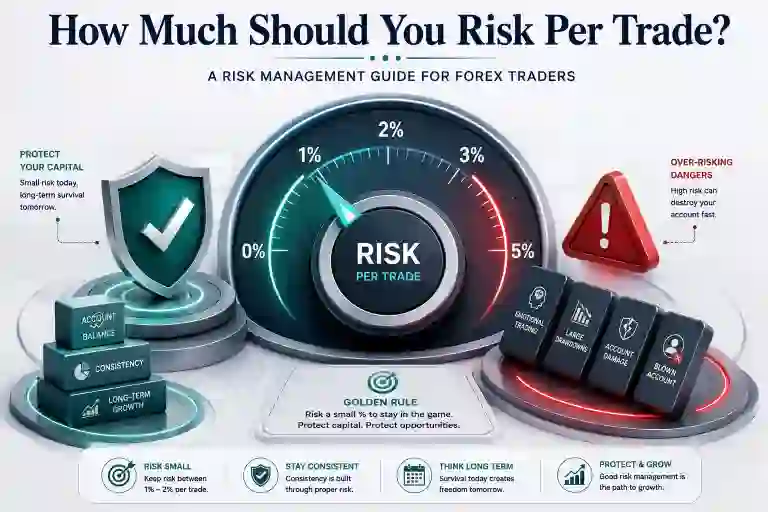
How Much Should You Risk Per Trade is one of the most important questions every Forex trader should answer before placing a single trade. While many beginners focus heavily on finding the perfect strategy, experienced traders understand that long-term success depends far more on risk management than on entries and exits.
Every year, thousands of traders enter the market with high expectations. Many spend months learning technical indicators, chart patterns, and market analysis techniques. Yet despite acquiring this knowledge, a large percentage eventually lose their trading capital. In many cases, the problem is not the strategy itself but poor risk control.
This is why understanding how much capital to risk on each trade is a fundamental part of successful trading. Effective risk management helps protect trading accounts during losing streaks, reduces emotional decision-making, and allows traders to stay in the market long enough to benefit from their edge.
Whether you are opening your first live account or looking to improve trading consistency, understanding position risk can have a significant impact on your long-term results.
Why Risk Management Matters More Than Most Traders Realize
Many traders focus almost entirely on potential profits. They spend hours searching for high-probability setups while paying little attention to the amount of money they could lose if the trade fails.
Professional traders often take the opposite approach.
Before considering potential profit, they first determine how much they are willing to lose if the market moves against them.

This mindset is important because losses are an unavoidable part of trading. Even the most successful traders experience losing trades regularly. The difference is that professional traders manage losses carefully, while inexperienced traders often allow a few bad trades to cause significant damage to their accounts.
Understanding how much should you risk per trade creates a framework that protects capital and promotes long-term consistency.
The Golden Rule of Risk Management
Among professional traders, one principle is widely accepted:
Never risk more than a small percentage of your trading account on a single trade.

One of the most important principles in trading is protecting your capital. Experienced traders understand that long-term success is not determined by a single winning trade but by the ability to manage risk consistently over time.
For this reason, many professional traders choose to risk only a small percentage of their account on any individual trade, often between 1% and 2% of their total balance. By keeping risk limited, they reduce the impact of losing trades and avoid significant damage to their trading capital.
For example, if a trader has a $1,000 account and risks 1% per trade, the maximum potential loss on a single position would be $10. Even after a series of losing trades, the account would retain most of its value, allowing the trader to continue following their strategy without excessive pressure.
This disciplined approach helps traders survive inevitable losing streaks and forms the foundation of effective risk management. Understanding and applying this principle is essential when deciding how much should you risk per trade.
Understanding Percentage-Based Risk
When deciding how much should you risk per trade, many traders prefer using a percentage-based approach rather than risking the same dollar amount on every position. This method naturally adapts as the account balance changes over time.
As profits accumulate and the account grows, position sizes can gradually increase. On the other hand, if the account experiences a losing period, trade sizes automatically become smaller, helping to protect capital. This flexibility is one reason why percentage-based risk management is widely used by experienced traders seeking steady, long-term growth.
Consider the following example:
| Account Balance | 1% Risk Per Trade |
|---|---|
| $500 | $5 |
| $1,000 | $10 |
| $5,000 | $50 |
| $10,000 | $100 |
This method keeps risk proportional regardless of account size.
Traders who understand how much should you risk per trade often rely on percentage-based risk management because it provides consistency and scalability.
Why Over-Risking Is So Dangerous
Many beginners become attracted to the idea of growing an account quickly. To achieve this, they may risk 10%, 20%, or even more on a single trade.
While such an approach can generate rapid gains, it can also produce devastating losses. This is why understanding how much should you risk per trade is so important for long-term survival in the market.
Consider a trader risking 20% per trade.
After three consecutive losses, the account would already be significantly damaged. Recovering from large drawdowns becomes increasingly difficult because percentage losses require larger percentage gains to recover.
| Loss | Gain Needed to Recover |
|---|---|
| 10% | 11.1% |
| 20% | 25% |
| 30% | 42.9% |
| 50% | 100% |
This table highlights why understanding how much you should risk per trade is critical. Protecting capital is often easier than recovering from substantial losses.
The 1% Risk Rule Explained
The 1% risk rule is one of the most widely used risk management principles in trading.
Under this approach, traders risk no more than 1% of their account balance on any individual trade.
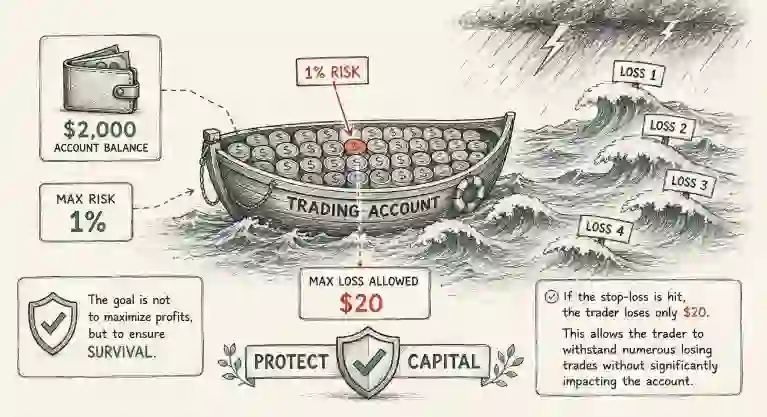
The primary objective is not to maximize profits but to ensure survival during periods of unfavorable market conditions.
For example:
- Account Balance: $2,000
- Maximum Risk Per Trade: 1%
- Maximum Loss Allowed: $20
If the stop-loss is hit, the trader loses only $20.
This allows the trader to withstand numerous losing trades without significantly impacting the account.
Many professional traders consider the 1% rule an excellent starting point for anyone learning how much you should risk per trade.
When Is a 2% Risk Appropriate?
Some experienced traders choose to risk up to 2% per trade.
This slightly higher risk level can increase profit potential while still maintaining reasonable account protection.
However, increasing risk should only be considered when:
- A trading strategy has been thoroughly tested.
- The trader has demonstrated consistent discipline.
- Risk management rules are followed consistently.
- Emotional control is well developed.
For newer traders, remaining closer to 1% is generally the safer option.
How Stop-Loss Placement Affects Risk
Many traders mistakenly believe that risk is determined solely by lot size.
In reality, risk is determined by the relationship between position size and stop-loss distance.
For example, risking $50 with a 20-pip stop loss requires a different position size than risking $50 with a 100-pip stop loss.
This is why stop-loss placement should always be based on market structure rather than an arbitrary number of pips.
Understanding how much you should risk per trade requires considering both stop-loss placement and position sizing together.
The Psychological Benefits of Proper Risk Management
Risk management is not only about protecting money. It also helps manage emotions.
When traders risk too much, every market fluctuation feels significant.
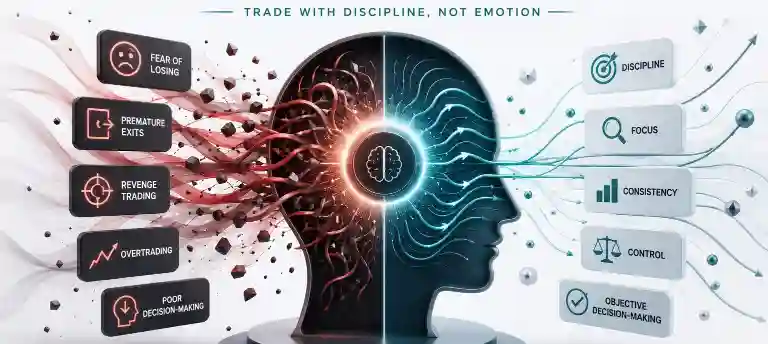
This often leads to:
- Fear of losing
- Premature exits
- Revenge trading
- Overtrading
- Poor decision-making
By keeping risk small and manageable, traders can focus on executing their strategy objectively rather than reacting emotionally to market movements.
This psychological advantage is one reason why experienced traders place such importance on understanding how much should you risk per trade.
Common Risk Management Mistakes Traders Make
Risking Too Much to Recover Losses
- Increasing position sizes after a losing trade often leads to larger losses.
- Attempting to recover losses quickly can result in emotional decision-making.
- Larger drawdowns make it more difficult to recover account equity.
- Maintaining consistent risk is generally more effective than chasing losses.
Ignoring Stop Losses
- Removing a stop-loss order can expose a trading account to significant risk.
- Widening stop losses without a valid reason may increase potential losses.
- Stop-loss levels should be planned before entering a trade.
- Following predetermined stop-loss rules helps support disciplined trading.
Using Excessive Leverage
- High leverage can magnify both profits and losses.
- Even a small market movement can have a large impact on account balance when leverage is excessive.
- Many traders underestimate the risks associated with leveraged trading.
- Responsible leverage usage is an important part of risk management.
Inconsistent Risk Levels
- Risking different percentages on similar trades creates inconsistency.
- Large variations in risk can make trading results difficult to evaluate.
- Consistent risk management helps produce more predictable outcomes.
- Maintaining the same risk level across trades supports long-term trading discipline.
How Professional Traders Think About Risk
Professional traders rarely judge their performance based on a single trade. Instead, they view trading as a process that unfolds over a large number of trades, where consistency matters more than individual outcomes.
Because no strategy wins every time, experienced traders focus on protecting capital and allowing their statistical edge to develop over time. By risking only a small portion of their account on each trade, they reduce the impact of losses and avoid making emotionally driven decisions.
This long-term perspective helps traders remain disciplined during both winning and losing periods. Ultimately, understanding how much should you risk per trade is not just about managing money—it is about developing the mindset required for long-term trading success.
Finding the Right Risk Level for Your Trading Style
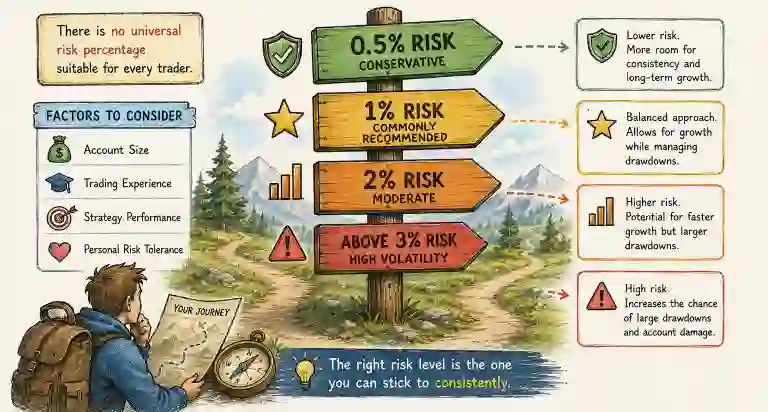
There is no universal risk percentage suitable for every trader.
Factors such as account size, trading experience, strategy performance, and personal risk tolerance all play a role.
However, for most traders:
- 0.5% risk is considered conservative.
- 1% risk is commonly recommended.
- 2% risk is considered moderate.
- Above 3% generally increases account volatility significantly.
The goal should be to find a risk level that allows consistent execution without creating excessive emotional stress.
Final Thoughts
If there is one lesson every trader should learn early in their journey, it is that protecting capital is more important than chasing profits. Opportunities in the Forex market will always exist, but capital lost through poor risk management can be difficult to recover.
Understanding how much should you risk per trade provides the foundation for long-term trading success. By limiting risk to a small percentage of account equity, traders can survive losing streaks, maintain emotional control, and allow their trading edge to work over time.
While many traders search endlessly for the perfect strategy, experienced market participants understand that consistent risk management is often the true difference between long-term success and failure.
Mastering this principle may not seem exciting, but it remains one of the most powerful habits a trader can develop.

