

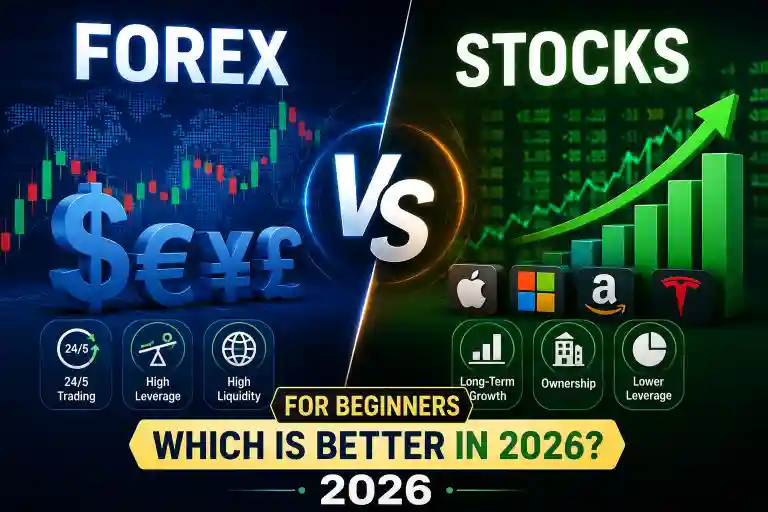
One of the first decisions new traders face is choosing between the forex market and the stock market. Both markets offer opportunities to profit from price movements, but they operate differently and require different approaches to risk management, analysis, and capital allocation.
The debate around Forex vs Stocks for Beginners continues because each market has unique advantages and challenges. Some traders are attracted to forex because of its low entry requirements and 24-hour trading sessions, while others prefer stocks because of their transparency and long-term growth potential.
For beginners, the right choice often depends on personal goals, risk tolerance, available capital, and trading style. Understanding how these two markets differ can help traders make a more informed decision before risking real money.
In this guide, we will compare forex and stocks across several important factors, including market structure, volatility, capital requirements, risk, and learning curve.
What Is Forex Trading
Forex trading involves buying one currency while simultaneously selling another. Traders attempt to profit from changes in exchange rates between currency pairs such as EUR/USD, GBP/USD, USD/JPY, and AUD/USD.
The forex market is the largest financial market in the world, with trillions of dollars changing hands daily.
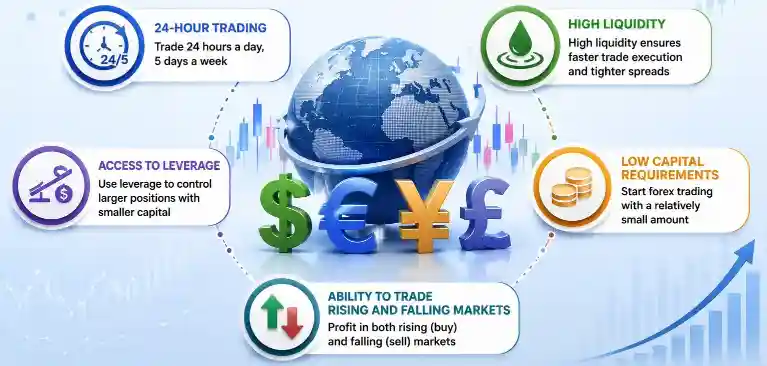
Popular features of forex trading include:
- 24-hour trading during weekdays
- High liquidity
- Access to leverage
- Low capital requirements
- Ability to trade rising and falling markets
Forex traders often rely on technical analysis, economic data, and central bank policies when making trading decisions.
What Is Stock Trading
Stock trading involves buying and selling shares of publicly listed companies. When traders purchase stock, they acquire partial ownership in a company.
Stock prices are influenced by various factors, including company earnings, industry performance, economic conditions, and investor sentiment.
Examples of well-known stocks include:
- Apple
- Microsoft
- Amazon
- Tesla
- NVIDIA
Unlike forex, stock traders often focus on company-specific developments alongside broader market trends.
Forex vs Stocks for Beginners: Key Differences
Market Size and Liquidity
When comparing Forex vs Stocks for Beginners, market size and liquidity are important factors to consider. The forex market is the largest financial market in the world, with trillions of dollars traded daily. Major currency pairs generally offer high liquidity, allowing traders to enter and exit positions quickly with minimal price disruption.
Stocks can also be highly liquid, particularly those of large, well-established companies. However, liquidity varies significantly between different stocks and market sectors.
Advantage: Forex
Trading Hours
One of the biggest differences between forex and stocks is market accessibility.
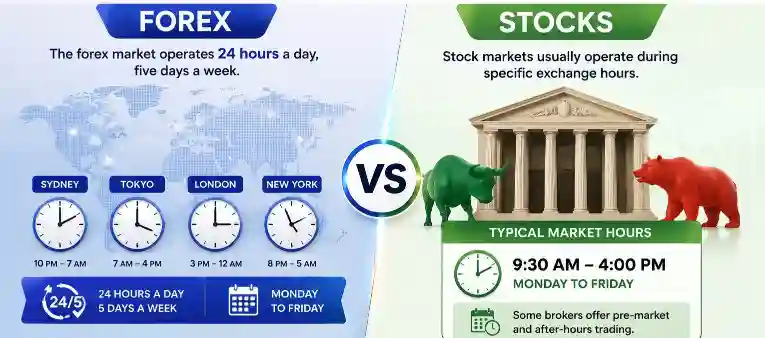
The forex market operates 24 hours a day, five days a week, as trading sessions overlap across major financial centers worldwide. This flexibility allows traders to participate at different times based on their schedules.
Stock markets, on the other hand, usually operate during specific exchange hours, although some brokers offer pre-market and after-hours trading.
Advantage: Forex
Number of Instruments
When comparing Forex vs Stocks for Beginners, the number of available instruments is an important consideration. Forex traders typically focus on a limited selection of major, minor, and exotic currency pairs, making the market easier to understand and follow.
In contrast, stock traders have access to thousands of publicly listed companies across different sectors. While this wider selection offers greater variety, it can sometimes feel overwhelming for beginners who are just starting their trading journey.
Advantage: Forex for simplicity, Stocks for variety
Leverage Availability
Forex brokers often provide higher leverage than stock brokers, enabling traders to control larger positions with relatively small amounts of capital.
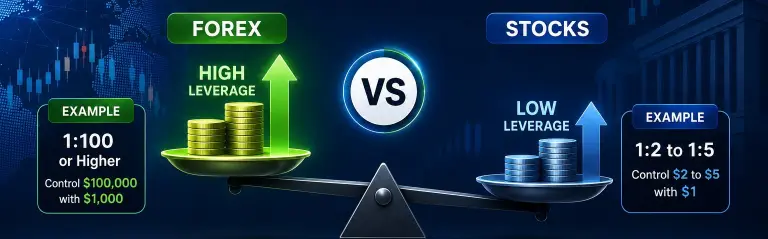
While leverage can increase potential returns, it also magnifies losses. Many beginner traders underestimate the risks associated with excessive leverage, making proper risk management essential.
Advantage: Forex (with higher risk exposure)
Market Drivers
Forex and stock markets are influenced by different factors.
Forex markets are primarily driven by:
- Interest rates
- Inflation data
- Employment reports
- Central bank policies
- Economic growth
Stock markets are primarily influenced by:
- Company earnings
- Revenue growth
- Industry trends
- Management decisions
- Economic conditions
Many beginners find stock analysis more intuitive because they can evaluate businesses, products, and brands they are already familiar with. Forex trading, however, often requires a stronger understanding of global economic events and monetary policy.
Capital Requirements
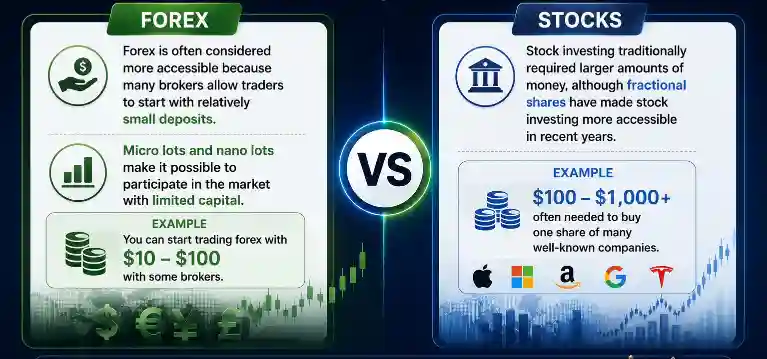
When comparing Forex vs Stocks for Beginners, the amount of capital required to get started is an important consideration. Forex trading is often viewed as more accessible because many brokers allow traders to open accounts with relatively small deposits.
The availability of micro lots and nano lots enables traders to participate in the market with limited capital. In contrast, stock investing has traditionally required a larger initial investment, although the introduction of fractional shares has made stocks more accessible to new investors in recent years.
For beginners with a limited budget, forex may seem like an attractive option. However, lower capital requirements should not be mistaken for lower risk. Regardless of account size, proper risk management remains essential for long-term trading success.
Volatility Comparison
When comparing Forex vs Stocks for Beginners, understanding market volatility is essential. Both markets experience price fluctuations, but the nature of that volatility can differ significantly.
Major forex pairs often move within relatively stable and liquid trading ranges, although volatility can increase during major economic announcements and central bank decisions. In contrast, individual stocks may experience sharp price gaps due to earnings reports, company news, or unexpected business developments.
While both markets involve risk, stock traders are generally more exposed to sudden overnight price movements, whereas forex volatility is often driven by economic events and global market sentiment.
Advantage: Depends on trading style and risk tolerance.
Learning Curve for Beginners
When considering Forex vs Stocks for Beginners, the learning curve is an important factor.
Forex requires understanding:
- Currency correlations
- Economic indicators
- Central bank policies
- Interest rate expectations
- Global macroeconomic events

Stocks require understanding:
- Company financial statements
- Earnings reports
- Business models
- Industry trends
- Market valuation concepts
Neither market is inherently easy, but many beginners find stock investing more intuitive because companies are easier to understand than global monetary systems.
Risk Management in Forex and Stocks
Regardless of market choice, risk management remains essential.
Common risk management principles include:
- Using stop-loss orders
- Limiting position size
- Avoiding excessive leverage
- Diversifying exposure
- Maintaining realistic expectations
The biggest mistake beginners make is focusing entirely on potential profits while ignoring downside risk.
Pros and Cons of Forex for Beginners
Advantages
- 24-hour market access
- High liquidity
- Low capital requirements
- Large selection of brokers
- Ability to trade both directions easily
Disadvantages
- High leverage risk
- Rapid price movements during news events
- Complex macroeconomic influences
- Emotional trading temptations
Pros and Cons of Stocks for Beginners
Advantages
- Easier connection to real businesses
- Long-term investment opportunities
- Less reliance on leverage
- Potential dividend income
- Strong historical growth potential
Disadvantages
- Limited trading hours
- Thousands of stocks to analyze
- Company-specific risks
- Potential overnight price gaps
Reality Check: Most Beginners Lose Because of Poor Risk Management, Not Market Choice
In the Forex vs Stocks for Beginners debate, many new traders focus too much on choosing the “better” market. In reality, success usually depends more on risk management, discipline, and realistic expectations than on the market itself.
Both forex and stocks offer opportunities as well as risks. While forex attracts traders with higher leverage and flexible trading hours, stocks appeal to those interested in company analysis and long-term investing.
The key to long-term success is not finding the perfect market, but developing a consistent trading approach, managing risk effectively, and continuously improving your skills.
Which Market Is Better for Beginners

The answer depends on individual goals.
- Forex may suit traders who prefer active trading, shorter-term opportunities, and flexible trading hours.
- Stocks may suit individuals interested in company analysis, long-term investing, and building wealth gradually.
Some traders eventually participate in both markets, using different strategies for each.
Rather than asking which market is universally better, beginners may benefit more from identifying which market aligns with their personality, schedule, and financial objectives.
Final Verdict
When comparing Forex vs Stocks for Beginners, neither market is automatically superior. Forex offers liquidity, flexibility, and accessibility, while stocks provide exposure to businesses and long-term growth opportunities.
The best choice depends on your trading goals, risk tolerance, available time, and commitment to learning. Before risking real capital, beginners should spend time studying market fundamentals, practicing on demo platforms when available, and developing a solid risk management plan.
Ultimately, long-term success is determined less by the market you choose and more by the habits, discipline, and education you bring to your trading journey.
| You may also like this…………………. 10 Powerful Economic Events That Move the Forex Market Most in 2026 |

