

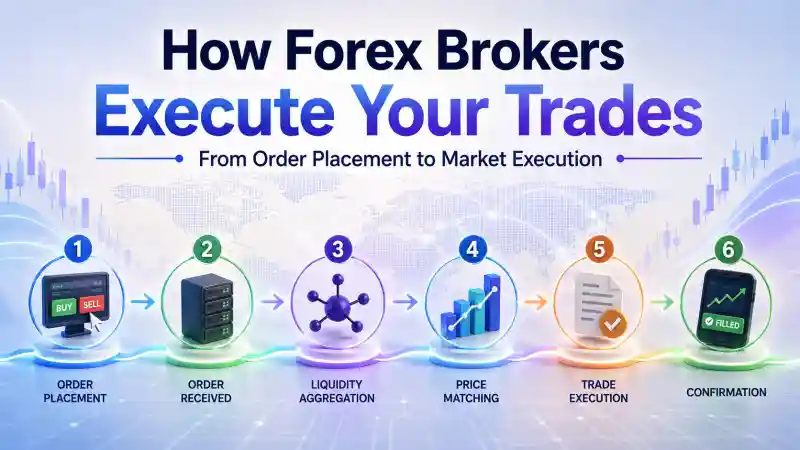
Understanding how forex brokers execute your trades changes the way you think about every position you open. Most traders click “buy” or “sell” without ever considering what happens in the milliseconds afterward — where the order goes, who fills it, and why the price you get sometimes differs from the price you saw. This guide walks through that entire process step by step, from the moment you place an order to the moment it’s filled in the market.
What Happens the Moment You Click “Buy” or “Sell”?
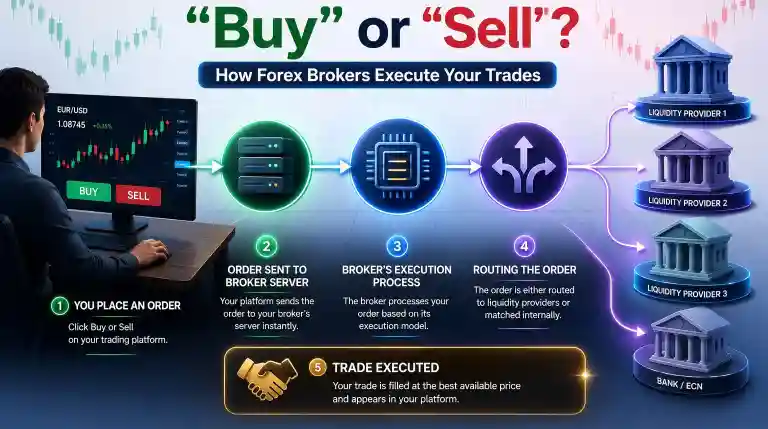
How Forex Brokers Execute Your Trades is an important concept for every Forex trader to understand. When you submit an order, your trading platform sends it to your broker’s server, where the execution process begins. What happens next depends on the broker’s execution model. Some brokers route orders directly to external liquidity providers, while others may match them internally. Understanding how forex brokers execute your trades helps explain why execution speed, pricing, and overall trading experience can vary between brokers, even when trading the same currency pair.
Market Execution vs. Instant Execution
How Forex Brokers Execute Your Trades also depends on the broker’s execution method. Most brokers use either Market Execution or Instant Execution. With Market Execution, your order is filled at the best available market price, which may differ slightly from the price displayed on your screen. With Instant Execution, the broker attempts to fill the order at the quoted price, but if that price is no longer available, the order may be requoted or rejected. Many modern ECN and STP brokers use Market Execution because it allows orders to be processed more efficiently during fast-moving market conditions.
The Role of Liquidity Providers in Trade Execution
Behind every broker sits a network of liquidity providers — typically banks, financial institutions, or other market makers — who supply the buy and sell prices your broker quotes. When a broker routes your order externally, it is essentially passing your trade to one of these providers for a genuine market fill. This is a core part of how forex brokers execute your trades on an ECN or STP model, and it’s the reason spreads can widen or narrow depending on how much liquidity is available at any given moment.
Order Types and How They Affect Execution
Market Orders
A market order tells your broker to fill the trade immediately at the best currently available price. Speed is prioritized over price precision, which makes market orders the most common — and the most exposed to slippage during volatile conditions.
Limit Orders
A limit order only fills at your specified price or better. This gives you price control, but there’s no guarantee the order fills at all if the market never reaches your level.

Stop Orders
A stop order becomes a market order once a specified price is reached, commonly used for stop-losses or breakout entries. Because it converts into a market order on trigger, it carries the same slippage risk as any other market order.
For a fuller breakdown of these and other trading terms, see our complete guide to forex trading terms.
Slippage: Why Your Fill Price May Differ From Your Requested Price
Slippage is the gap between the price you expected and the price you actually received, and it’s a natural byproduct of how forex brokers execute your trades in a live, constantly moving market. It tends to increase around high-impact news releases or during periods of thin liquidity, when prices can shift meaningfully in the time it takes an order to reach the market. Our complete guide to slippage in forex covers this in more depth, including practical ways to reduce its impact.
A-Book vs. B-Book Execution Models
A-Book (STP/ECN) Execution
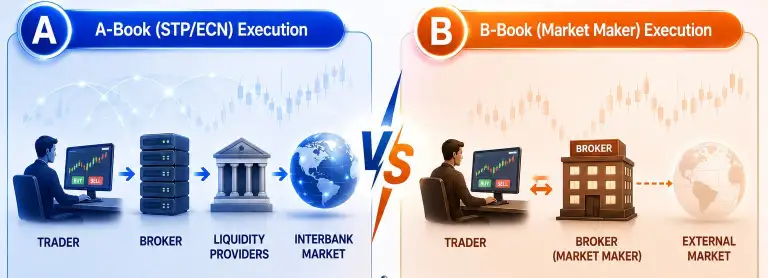
In an A-Book model, your orders are passed straight through to liquidity providers. The broker earns revenue from spreads or commissions rather than from your trading losses, which generally aligns broker and client interests more closely.
B-Book (Market Maker) Execution
In a B-Book model, the broker takes the other side of your trade internally rather than routing it to the external market. This isn’t inherently dishonest — many regulated brokers operate hybrid models — but it does mean the broker’s revenue can be tied to client losses on some trades, which is worth understanding when evaluating a provider.
How Long Does Trade Execution Actually Take?
Execution speed varies by broker infrastructure, but well-regulated ECN and STP brokers typically execute orders within milliseconds under normal conditions. Execution can slow slightly during high-volatility events as liquidity providers update prices rapidly, which is one reason experienced traders pay close attention to execution speed alongside spreads when comparing brokers.
What to Check Before Trusting a Broker’s Execution
- Regulation: A properly regulated broker is required to meet standards around fair execution and order handling.
- Execution model transparency: Reputable brokers disclose whether they operate an A-Book, B-Book, or hybrid model.
- Published execution speed and slippage data: Some brokers share average execution statistics publicly, which is a useful transparency signal.
- Real user reviews focused on execution quality, not just spreads or bonuses.
If you’re still comparing providers, our forex brokers comparison guide looks at execution speed and slippage across several well-known brokers side by side. You can also start with our complete beginner’s guide to forex brokers if you’re still new to how brokers operate overall.
Why Execution Quality Matters More for Some Trading Styles
Not every trader is affected by execution quality equally. Scalpers and high-frequency traders, who rely on capturing small price movements repeatedly throughout the day, are highly sensitive to even a fraction of a second of delay or a small amount of slippage — these costs compound quickly across dozens of trades. Swing traders and position traders, by contrast, hold positions for days or weeks, so a few pips of slippage on entry matters far less relative to their overall target.
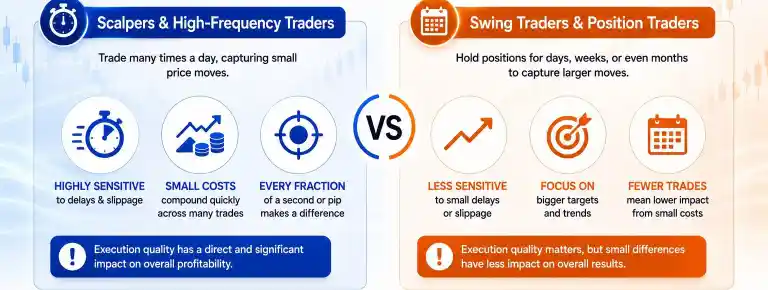
This is worth keeping in mind when comparing brokers: a provider with excellent execution speed but wider average spreads might suit a scalper poorly despite the fast fills, while a swing trader might not notice the difference at all. Matching execution characteristics to your actual trading style is often more useful than chasing the broker with the single fastest execution time on paper.
How Technology Has Improved Trade Execution
The infrastructure behind how forex brokers execute your trades has changed significantly over the past decade. Many brokers now use multiple liquidity providers simultaneously, automatically routing each order to whichever provider offers the best price at that instant — a process often called liquidity aggregation. This reduces the chances of a single provider’s thin liquidity causing unnecessary slippage on your order.
Servers located physically closer to major liquidity hubs, along with faster order-routing technology, have also cut typical execution times considerably compared to a decade ago. While no broker can promise zero slippage — since live markets are inherently dynamic — these infrastructure improvements have made reliable, fast execution far more accessible to everyday retail traders than it once was.
Common Execution Complaints and What They Usually Mean
Traders sometimes report an order being “requoted” or rejected outright. With instant execution, this typically happens when the exact price you requested is no longer available by the time the order reaches the broker’s server — the broker offers you the new price instead of filling automatically. Under market execution, this problem is largely eliminated since the order fills at the next available price rather than being rejected, which is one reason many traders prefer it despite the small trade-off in price certainty.
Another common complaint involves orders filling instantly on demo accounts but showing occasional delays on live accounts. This is usually a reflection of real market conditions and liquidity, since demo environments often simulate execution without routing to genuine liquidity providers the way a live account does.
Final Thoughts
Once you understand how forex brokers execute your trades, price differences and occasional slippage stop feeling like broker unfairness and start making practical sense as part of how live markets actually function. Paying attention to a broker’s execution model, regulation, and transparency around fills is just as important as comparing spreads — because the best spread on paper means little if your orders aren’t filled reliably when it matters.
FAQs
Why did my trade fill at a different price than I saw on screen?
This is typically slippage — the market price moved slightly between the moment you clicked and the moment your order reached the market, which is a normal part of live execution.
Is market execution better than instant execution?
Market execution generally fills more reliably during fast-moving conditions, since it doesn’t reject or requote orders the way instant execution can when the exact quoted price is no longer available.
How can I tell if my broker uses A-Book or B-Book execution?
Check the broker’s regulatory disclosures and account types — many brokers state their execution model directly, and some offer separate ECN/STP account types specifically for A-Book routing.

