


Forex brokers make money through a variety of trading-related fees and services rather than from a single source. For many new traders, understanding how brokers generate revenue is an important step before opening a live trading account.
Since brokers provide access to financial markets, trading platforms, leverage, and customer support, it is natural to wonder how these services are funded. A common misconception is that brokers only profit when traders lose. In reality, most reputable brokers earn revenue through transparent charges such as spreads, commissions, swap fees, and other account-related services.
Understanding these costs is important because they can directly affect overall trading performance. Even relatively small trading fees may have a noticeable impact over time, particularly for active traders.
In this guide, we explain how Forex brokers make money, examine the most common revenue sources, and address several misconceptions to help traders better understand the costs associated with Forex trading.
How the Forex Market Works
To understand how Forex brokers make money, it is first important to understand the role they play in the Forex market.
The Forex market is a decentralized global marketplace where currencies are traded electronically. Unlike a stock exchange, there is no single central location where all Forex transactions take place. Instead, banks, financial institutions, liquidity providers, hedge funds, governments, companies, brokers, and retail traders interact through a network of electronic trading systems.
Individual traders generally cannot access institutional liquidity providers directly. Forex brokers bridge this gap by acting as intermediaries between retail traders and the broader market. Through their trading platforms, brokers facilitate trade execution, provide market pricing, manage trading accounts, and process transactions.
Because brokers offer these services, Forex brokers make money through various trading-related fees and charges rather than providing market access at no cost.
Do Forex Brokers Trade Against Their Clients?
This is one of the most common misconceptions among new traders. Whether a broker benefits from client losses largely depends on its execution model and business structure.
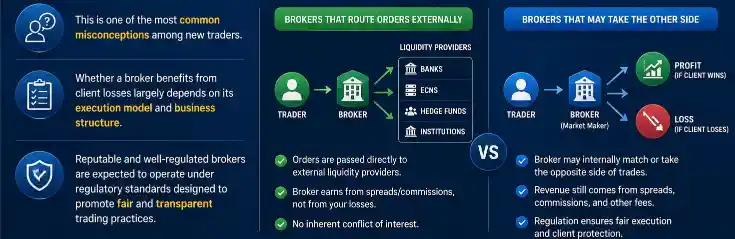
Some brokers route client orders directly to external liquidity providers, while others may internally manage certain trades in accordance with their execution model. Regardless of the approach, reputable and well-regulated brokers are expected to operate under regulatory standards designed to promote fair and transparent trading practices.
Rather than relying on common myths, traders should take the time to understand how Forex brokers make money by reviewing a broker’s execution model, fee structure, regulatory status, and overall reputation before opening an account.
How Forex Brokers Make Money: The Main Revenue Sources
Forex brokers typically generate income through several different sources rather than relying on a single fee.
The exact combination depends on the broker’s account types, pricing structure, and execution model.
The most common revenue sources include:
- Spreads
- Trading commissions
- Swap (overnight financing) charges
- Currency conversion fees
- Deposit and withdrawal fees (with some brokers)
- Inactivity fees
Let’s examine each of these in detail.
Spreads: The Most Common Source of Broker Revenue
The spread is the difference between the buying price (Ask) and the selling price (Bid) of a currency pair.
Every time a trader opens a position, they effectively pay the spread as part of the transaction cost.
For example:
| Bid Price | Ask Price | Spread |
|---|---|---|
| 1.1050 | 1.1052 | 2 pips |
In this example, the spread is two pips.
Although the cost appears relatively small, spreads represent one of the primary ways Forex brokers make money, particularly from traders who open and close positions frequently.
Spread sizes vary depending on several factors, including:
- Currency pair liquidity
- Market volatility
- Trading session
- Economic news releases
- Broker pricing model
Major currency pairs such as EUR/USD usually have tighter spreads than more volatile or less frequently traded pairs.
Trading Commissions
Some brokers charge a fixed commission instead of adding their entire revenue into the spread.
This pricing model is commonly used with ECN (Electronic Communication Network) and Raw Spread accounts.
Under this structure:
- Spreads remain extremely low.
- A commission is charged separately for each trade.
For example, a broker may offer spreads starting from 0.1 pips while charging a commission per standard lot traded.
This model provides greater pricing transparency because traders can clearly see both the market spread and the broker’s commission.
Professional traders often prefer commission-based accounts because tighter spreads can benefit strategies such as scalping or high-frequency trading.
Understanding commissions is another important part of learning how Forex brokers make money.
Swap (Overnight Financing) Charges
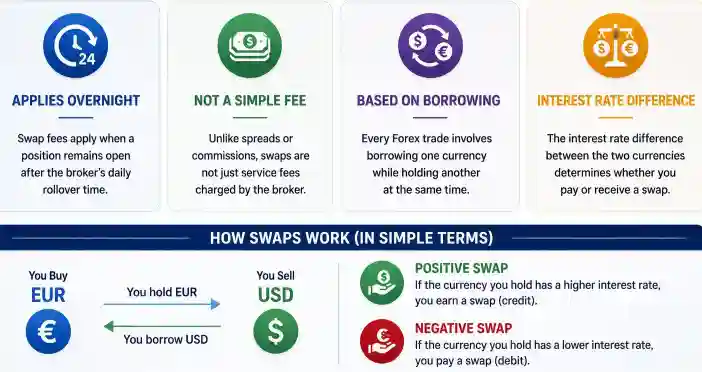
Swap fees, sometimes called rollover fees or overnight financing charges, apply when a position remains open after the broker’s daily rollover time.
Unlike spreads or commissions, swaps are not simply service fees charged by the broker.
They arise because every Forex transaction involves borrowing one currency while simultaneously holding another.
The interest rate difference between the two currencies determines whether a trader pays or receives a swap.
Depending on market conditions:
- A positive swap may credit money to the trader.
- A negative swap may result in a financing charge.
Although swap rates are influenced by interest rate differentials, brokers may apply administrative adjustments depending on their pricing policies.
For traders who hold positions for several days or weeks, swap costs can become a meaningful part of overall trading expenses.
Currency Conversion Fees
Many traders overlook currency conversion costs because they are less visible than spreads or commissions.
If your trading account is denominated in one currency while profits, losses, or deposits are processed in another, a currency conversion may occur.
For example:
- Your trading account is in USD.
- You deposit funds in EUR.
- The broker converts the deposit into USD.
Some brokers include a small markup within the exchange rate used for these conversions.
Although these fees are generally modest, they can accumulate over time for traders making frequent international deposits or withdrawals.
Deposit and Withdrawal Fees
Many modern Forex brokers advertise free deposits and withdrawals.
However, this policy is not universal.
Depending on the payment provider and withdrawal method, some brokers may charge administrative fees or pass third-party processing costs to clients.
Common payment methods include:
- Bank transfers
- Credit and debit cards
- Electronic wallets
- Local payment gateways
- Cryptocurrency transfers (where supported)
Before opening an account, traders should always review the broker’s payment policy to understand whether additional charges apply.
Inactivity Fees
Some brokers charge an inactivity fee when an account remains unused for an extended period.
This fee is designed to cover the administrative costs of maintaining inactive accounts.
For example, if a trader does not place any trades for several consecutive months, the broker may begin deducting a small monthly fee from the account balance.
Not every broker applies inactivity charges, making this another factor worth comparing before selecting a trading platform.
Market Maker vs ECN vs STP Brokers
Understanding different broker models also helps explain how Forex brokers make money.
Market Maker Brokers
Market makers create internal prices and may execute client orders within their own dealing environment. Revenue generally comes from spreads and overall trading activity.
STP (Straight Through Processing) Brokers
STP brokers route client orders directly to one or more liquidity providers. They typically earn through spread markups or commissions while acting as intermediaries.
ECN (Electronic Communication Network) Brokers
ECN brokers connect traders directly with multiple liquidity providers. These accounts usually feature very low spreads with separate commission charges.
Each model has advantages and disadvantages, and no single model is automatically better for every trader. The most important factors remain regulation, transparency, execution quality, and trading costs.
Can Forex Brokers Profit When Traders Win
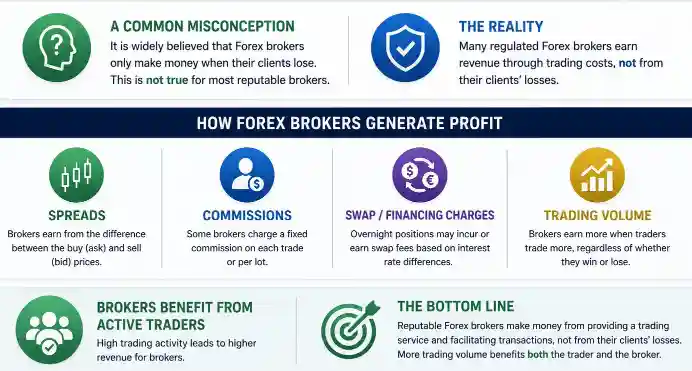
A common misconception among beginner traders is that every Forex broker profits only when its clients lose money. While this belief is widespread, it does not accurately describe how most reputable brokers operate.
Many regulated Forex brokers earn revenue through trading costs such as spreads, commissions, and financing charges. Their income depends largely on trading volume rather than whether individual traders make or lose money.
For example, if a trader opens and closes multiple positions each week, the broker earns revenue from the spread or commission regardless of the trade’s final outcome.
This business model benefits both parties. The trader gains access to the Forex market, while the broker earns service-related revenue for providing trading infrastructure, technology, and market access.
This is another reason why understanding how Forex Brokers Make Money helps eliminate common myths surrounding the trading industry.
Other Services That Help Forex Brokers Generate Revenue
Besides direct trading fees, some brokers offer additional services that contribute to their overall business model.
These services vary from one broker to another and may include:
- Premium educational programs
- Advanced charting and analytical tools
- Virtual Private Server (VPS) hosting
- Copy trading platforms
- API trading services
- Institutional account solutions
In many cases, these services are optional. Some brokers provide them free of charge to active traders, while others charge subscription or usage fees depending on the service offered.
These additional revenue streams allow brokers to invest in platform development, customer support, and technological improvements.
How to Choose a Forex Broker with Transparent Pricing
Not every broker offers the same pricing structure. Before opening a trading account, it is important to compare the complete cost of trading rather than focusing on just one fee.
Professional traders usually evaluate several factors before selecting a broker.
- Spread competitiveness
- Commission structure
- Swap rates
- Execution speed
- Regulatory status
- Deposit and withdrawal policies
- Customer support quality
- Trading platform reliability
A broker advertising extremely low spreads may charge higher commissions or wider spreads during volatile market conditions. Looking at the complete pricing structure provides a more accurate comparison.
Transparency is often one of the strongest indicators of a trustworthy Forex broker.
Common Misconceptions About How Forex Brokers Make Money
Several myths continue to circulate within the Forex community. Understanding the facts can help traders make better decisions.
Myth 1: Brokers Always Want Traders to Lose
Many regulated brokers earn revenue from trading activity through spreads, commissions, and other service fees rather than from client losses. Their business model generally depends on facilitating trades rather than the outcome of individual positions.
Myth 2: Trading Is Completely Free
While opening a trading account is often free, trading itself usually involves costs such as spreads, commissions, swap fees, or other account-related charges.
Myth 3: Lower Spreads Always Mean Lower Trading Costs
A broker offering very low spreads may also charge trading commissions. Comparing the total trading cost, rather than spreads alone, provides a more accurate picture of overall expenses.
Myth 4: Every Broker Uses the Same Business Model
Not all brokers follow the same execution model. Market Maker, STP, and ECN brokers operate differently, and understanding these differences can help traders better understand how Forex brokers make money and how their orders are executed.
Red Flags to Watch Before Opening a Trading Account
Choosing the wrong broker can create unnecessary risks regardless of your trading strategy.
Before depositing funds, consider the following warning signs:
- Unclear or hidden trading fees.
- Lack of regulatory information.
- Promises of guaranteed profits.
- Difficulty withdrawing funds.
- Poor customer support.
- Unrealistic bonus offers with restrictive conditions.
Legitimate brokers generally explain their pricing, execution policies, and trading conditions openly on their official websites.
If important information is difficult to locate or appears intentionally vague, traders should proceed with caution.
How Trading Costs Affect Long-Term Profitability
Many beginner traders underestimate the cumulative effect of trading costs.
For example, paying only a few extra pips per trade may seem insignificant initially. However, after hundreds of trades over several months, those small costs can have a noticeable impact on overall profitability.
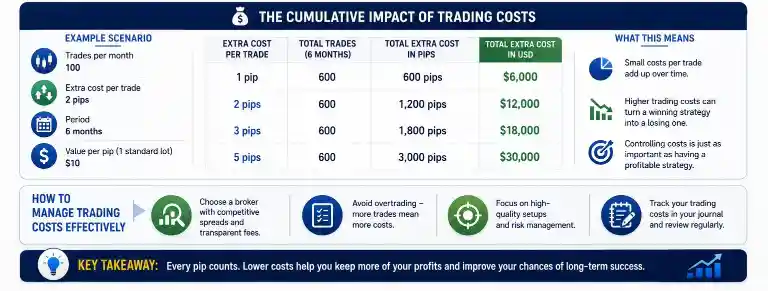
Consider two traders using identical strategies:
- Trader A pays consistently lower overall trading costs.
- Trader B pays higher spreads and commissions.
Even if both traders achieve the same win rate and risk management, Trader A may retain a larger portion of their profits simply because trading expenses are lower.
This illustrates why experienced traders pay close attention to pricing structures when selecting a broker.
Why Understanding Broker Revenue Helps Traders
Learning how Forex Brokers Make Money provides more than just general knowledge.
It helps traders:
- Estimate trading costs more accurately.
- Compare brokers objectively.
- Select the most suitable account type.
- Avoid hidden fees.
- Understand different execution models.
- Develop realistic profit expectations.
The more informed a trader becomes about broker pricing, the easier it is to build a trading plan that accounts for all potential expenses.
Final Thoughts
Understanding how Forex brokers make money helps traders make more informed decisions when choosing a broker and managing trading costs. While trading strategies are important, fees such as spreads, commissions, and swap charges can also influence long-term performance.
Reputable brokers generally disclose their pricing structure, allowing traders to compare costs, execution quality, and regulatory standards before opening an account. By understanding these revenue sources, traders can select a broker that best matches their trading style and financial goals.

