

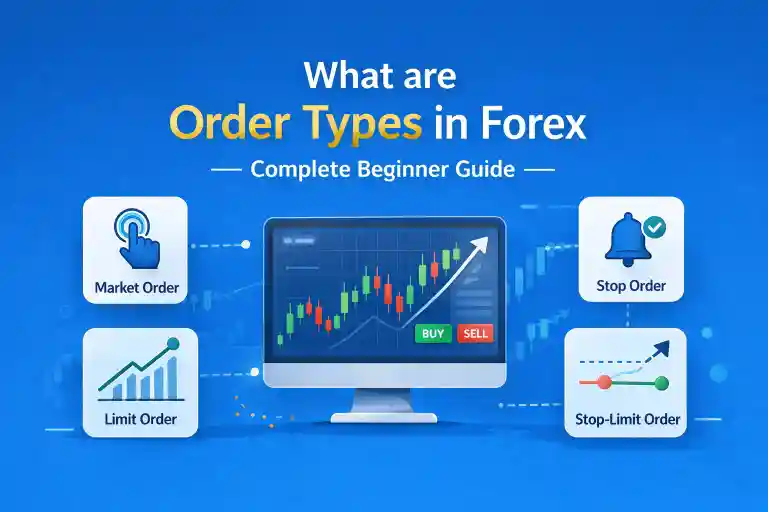
Order types in forex are the different ways traders enter and exit trades in the market. Each order type is designed to control how and when a trade is executed, making it easier to manage risk and improve trading accuracy.
For beginner traders, understanding order types in forex is essential because it helps eliminate guesswork and allows trades to be executed based on predefined conditions rather than emotions.
In this guide, you will learn the main types of orders, how they work, and when to use them effectively.
What Do Order Types Mean in Forex
An order in forex is simply an instruction given to a broker to buy or sell a currency pair under certain conditions. These conditions can include price levels, timing, and execution methods.
Order types in forex allow traders to automate their trading decisions. Instead of constantly watching the market, traders can set orders that trigger automatically when specific price levels are reached.
This not only saves time but also ensures that trades are executed exactly as planned.
Main Types of Orders in Forex
There are several types of orders available in forex trading, but they can be broadly divided into market orders and pending orders.

1. Market Order
A market order is the simplest and most commonly used order type. It executes instantly at the current market price.
- Immediate execution
- No waiting required
- Best for quick entry and exit
Traders use market orders when they want to enter a trade without delay. However, the exact price may vary slightly due to market conditions.
2. Pending Orders
Pending orders are used when traders want to enter the market at a specific price in the future. These orders are activated only when the market reaches a predefined level.
Order types in forex that fall under pending orders include limit orders and stop orders.
3. Limit Order
A limit order is placed to buy or sell at a better price than the current market price.
- Buy Limit: Placed below the current market price
- Sell Limit: Placed above the current market price
Limit orders are commonly used when traders expect the price to reverse after reaching a certain level.
4. Stop Order
A stop order is used to enter the market when the price moves beyond a certain level, usually in the direction of the trend.
- Buy Stop: Placed above the current market price
- Sell Stop: Placed below the current market price
These orders are widely used in breakout trading strategies where traders aim to catch strong price movements.
5. Stop-Limit Order
A stop-limit order combines features of both stop and limit orders.
- The trade is triggered at a stop price
- The order is executed only at a specified limit price
This type of order provides more control over execution price, but there is a risk that the trade may not be executed if the market moves too quickly.
Types of Pending Orders Explained
To understand order types in forex better, let’s break down the four main pending orders:

- Buy Limit: A buy limit order is placed below the current price when a trader expects the market to drop and then rise.
- Sell Limit: A sell limit order is placed above the current price when a trader expects the market to rise and then fall.
- Buy Stop: A buy stop order is placed above the current price when a trader expects the market to continue rising.
- Sell Stop: A sell stop order is placed below the current price when a trader expects the market to continue falling.
These pending order types in forex allow traders to plan trades in advance and avoid emotional decision-making.
Stop Loss and Take Profit Orders
In addition to entry orders, traders also use protective orders to manage risk and secure profits.
- Stop Loss: Automatically closes a trade to limit losses
- Take Profit: Automatically closes a trade to lock in profits
Using these tools is essential for maintaining proper risk management and protecting your trading account.
Why Order Types in Forex are Important
Understanding order types in forex gives traders more control over their trades and improves overall performance.
- Helps automate trading decisions
- Reduces emotional trading
- Improves trade accuracy
- Enhances risk management
Without proper knowledge of order types, traders may struggle with execution and risk control.
Order Types and Market Conditions
Different order types in forex are suitable for different market conditions. Choosing the right one can significantly impact your results.
- Market Orders: Best for instant execution
- Limit Orders: Ideal for reversal strategies
- Stop Orders: Useful for breakout strategies
By aligning order types with market conditions, traders can improve both timing and accuracy.
Common Mistakes Traders Make
Many beginners misuse order types in forex due to lack of understanding. Here are some common mistakes:
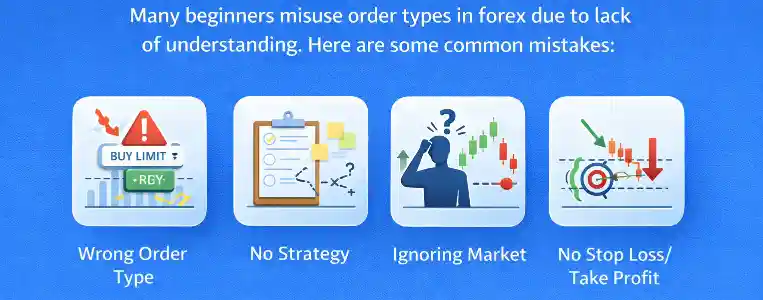
- Using the wrong order type for the situation
- Placing trades without a clear strategy
- Ignoring market conditions
- Not using stop loss or take profit
Avoiding these mistakes can help you become a more disciplined trader.
Pro Tips for Beginners
If you are just starting, follow these practical tips to master order types in forex:
- Begin with market orders to understand execution
- Gradually learn pending orders
- Always use stop loss for risk control
- Practice on a demo account before trading live
These steps will help you build confidence and improve your trading skills over time.
Final Thoughts
Order types in forex are a fundamental part of trading that allow you to execute trades efficiently and manage risk effectively. Each order type serves a specific purpose and should be used based on market conditions and trading strategy.
For beginners, mastering order types is a crucial step toward becoming a disciplined and consistent trader. Once you understand how to use them properly, you can take full control of your trading decisions and improve your overall performance.
To improve your trading execution, you should also understand Stop Loss in Forex and Take Profit in Forex, as they are essential components of every order.

