

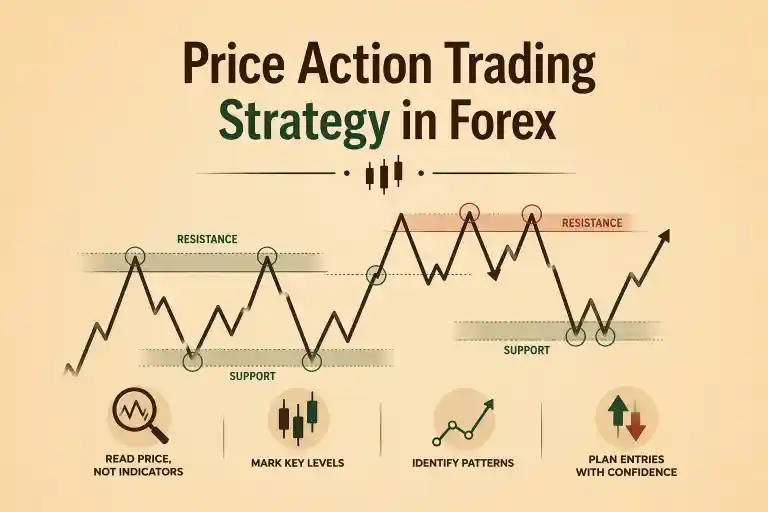
The Price Action Trading Strategy in Forex is one of the most reliable and widely used approaches among traders. Instead of relying on multiple indicators, this method focuses on understanding how price moves in real-time. It allows traders to interpret market behavior directly from charts and make informed decisions.
The Price Action Trading Strategy in Forex is especially popular among experienced traders because it removes unnecessary complexity. By focusing only on price movement, traders gain clarity and develop a deeper understanding of how markets operate.
What is Price Action Trading Strategy in Forex
The Price Action Trading Strategy in Forex is a trading approach where decisions are based purely on price movement. Traders analyze candlestick patterns, market structure, and key levels such as support and resistance.
Unlike indicator-based systems that often lag behind the market, price action reflects real-time activity. This helps traders react faster and identify potential opportunities more accurately.
Instead of relying on signals generated by tools, traders observe how price behaves at important levels and use that information to plan entries and exits.
Core Principles of Price Action Trading
The Price Action Trading Strategy in Forex is built on a few key principles that guide trading decisions:
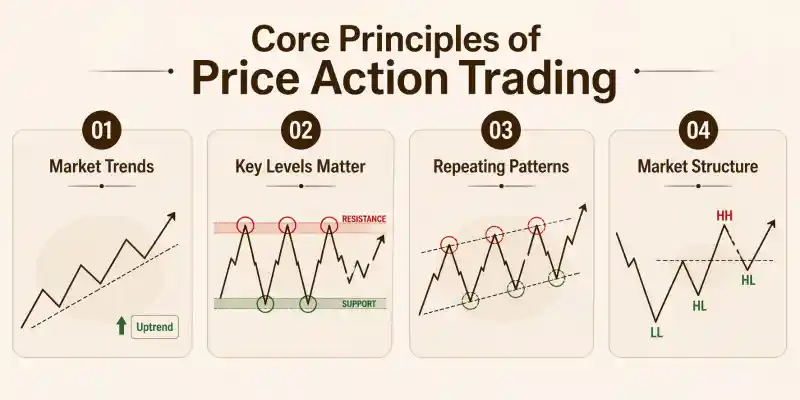
- Market Trends: Price moves in trends such as uptrend, downtrend, or sideways movement
- Key Levels Matter: Support and resistance zones influence price reactions
- Repeating Patterns: Historical price behavior often repeats in similar ways
- Market Structure: The arrangement of highs and lows defines opportunities
Understanding these principles helps traders read charts more effectively and avoid unnecessary confusion.
Key Components of Price Action Strategy
1. Market Structure
Market structure is the foundation of the Price Action Trading Strategy in Forex. It helps traders identify the direction of the market.
- Uptrend: Higher highs and higher lows
- Downtrend: Lower highs and lower lows
- Sideways Market: Price moves within a range
Trading in the direction of the trend increases the probability of successful trades.
2. Support and Resistance
Support and resistance are key areas where price tends to react. These zones act as decision points in the Price Action Trading Strategy in Forex.
- Support: A level where price may stop falling and reverse upward
- Resistance: A level where price may stop rising and reverse downward
Traders use these levels to identify potential entry and exit points.
3. Candlestick Patterns
Candlestick patterns are essential tools in the Price Action Trading Strategy in Forex. They reveal market sentiment and potential reversals.
- Pin Bar: Indicates strong rejection of price
- Engulfing Pattern: Signals possible reversal or continuation
- Doji: Shows indecision in the market
These patterns are most effective when they appear near support or resistance levels.
Trading Setup (Practical Approach)
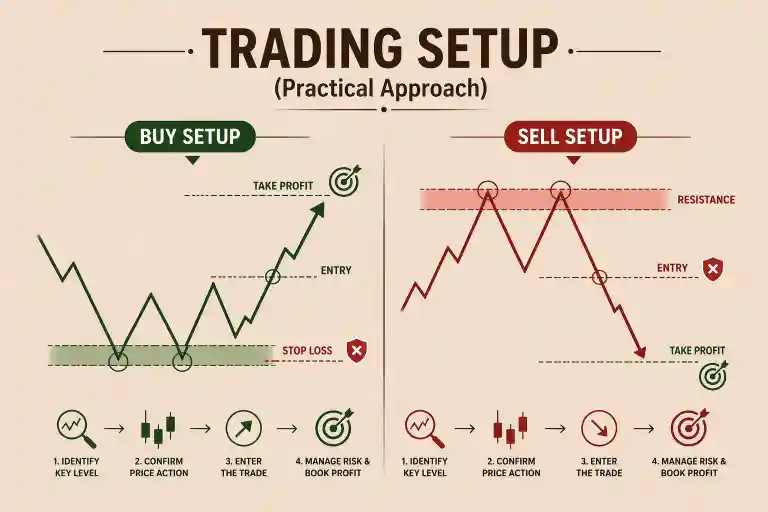
Buy Setup
- Market is in an uptrend
- Price pulls back to a support level
- A bullish candlestick pattern forms
- Entry: After confirmation candle closes
- Stop Loss: Below the support level
- Take Profit: Near the next resistance level
Sell Setup
- Market is in a downtrend
- Price retraces to a resistance level
- A bearish candlestick pattern forms
- Entry: After confirmation candle closes
- Stop Loss: Above the resistance level
- Take Profit: Near the next support level
Advantages of Price Action Trading Strategy in Forex
- No dependency on indicators
- Clear understanding of market behavior
- Applicable across all timeframes
- Improves decision-making skills
This approach simplifies trading and helps traders focus on what truly matters — price movement.
Limitations to Consider
- Requires practice and chart experience
- Different traders may interpret patterns differently
- Can be challenging for beginners at first
With consistent practice, these challenges can be gradually reduced.
Best Timeframes for Price Action Trading
The Price Action Trading Strategy in Forex can be applied to different timeframes depending on trading style:
- Intraday Trading: 15-minute to 1-hour charts
- Swing Trading: 4-hour to daily charts
Higher timeframes generally provide more reliable signals as they reduce market noise.
Risk Management Insight
No matter how effective the Price Action Trading Strategy in Forex is, risk management remains essential. Traders should always maintain a proper risk-to-reward ratio and avoid overtrading.
- Risk only a small percentage of capital per trade
- Use stop-loss consistently
- Avoid emotional trading decisions
- Focus on long-term consistency
Even strong setups can fail, so protecting capital should always be the priority.
Final Thoughts
The Price Action Trading Strategy in Forex provides a clean and effective way to understand the market. By focusing on price behavior, traders can build strong analytical skills and improve their overall performance.
Success with this strategy comes from patience, practice, and discipline. Over time, traders who consistently apply these principles can develop a more confident and structured trading approach.

